Carlos Cruz-Diez: The Master of Kinetic Art and Autonomous Color
Carlos Cruz-Diez (1923–2019) was a visionary Franco-Venezuelan artist who redefined the relationship between color, space, and the viewer. A leading figure in the Kinetic art movement—art that depends on movement for its effect—and Op art (optical art), Cruz-Diez challenged the traditional notion of color as a static property of an object. Instead, he proposed that color is an autonomous reality that evolves in time and space, existing independently of form or support.
Born in Caracas, Venezuela, and later establishing his life and work in Paris from 1960 until his death, Cruz-Diez spent decades investigating the chromatic phenomenon. His work transitioned from early social painting to a sophisticated visual discourse that transformed galleries and urban spaces into immersive experiences.
Key Facts
- Core Philosophy: Color is an autonomous fact that exists without the need for form.
- Primary Movements: Kinetic Art, Op Art, and Light Art.
- Major Series: Known for the Physichromie and Chromosaturation series.
- Global Impact: Represented Venezuela at the 35th Venice Biennale (1970) and posthumously represented France at the 2021 Dubai World Expo.
- Legacy Institutions: The Carlos Cruz-Diez Museum of Print and Design, the Atelier Cruz-Diez, and the Cruz-Diez Foundation.
The Evolution of a Visual Discourse
Early Training and Conceptual Shift
Cruz-Diez began his journey at the Escuela de Bellas Artes de Caracas. By the 1950s, his work entered a critical phase of experimentation. Between 1954 and 1959, he explored Signos Vegetales (Plant Signs) and Objetos Rítmicos Móviles (Mobile Rhythmic Objects), alongside studies on optical perception and plane instability. A pivotal moment occurred in 1955 during a visit to Paris, where he saw the "Le Mouvement" exhibition at Galerie Denise René. This experience, coupled with the influence of his friend Jesús Rafael Soto, steered him toward the study of the chromatic phenomenon.
Establishing the Framework
In 1959, Cruz-Diez created his first Additive Color and Physichromie works. Moving to Paris in 1960, he spent the next several decades structuring the supports necessary to materialize his theories. His international ascent accelerated in the 1960s, winning the III American Art Biennial in Córdoba (1966) and the International Painting Prize at the São Paulo Biennial (1967).
Monumental Works and Digital Integration
From the 1970s onward, Cruz-Diez shifted toward monumental installations that integrated art into urban architecture. In the 1990s, he began incorporating digital technology into his investigations. His later years were marked by global retrospectives, including a major exhibition at the Museum of Fine Arts, Houston (MFAH) in 2011, and his participation in the 2013 Dynamo exhibition at the Grand Palais in Paris.
The Eight Chromatic Investigations
Cruz-Diez did not simply paint; he conducted scientific investigations into how we perceive color. Between 1959 and 1993, he developed eight distinct series to demonstrate different chromatic behaviors:
- Additive Color (1959): Exploring how colors blend in the eye.
- Physichromie (1959): Using vertical lines to create shifting colors based on the viewer's position.
- Chromatic Induction (1963): Investigating how adjacent colors influence one another.
- Chromo-interference (1964): Creating colors that change as the viewer moves.
- Transchromie (1965): Exploring the transparency and layering of color.
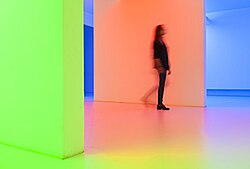
- Chromosaturation (1965): Immersive environments where the viewer is enveloped in color.
- Chromoscope (1967): Tools for observing the behavior of color.
- Color in Space (1993): The final evolution of color as a three-dimensional entity.
Summary of Career and Recognition
| Category | Details |
|---|---|
| Born/Died | August 17, 1923 (Caracas) – July 27, 2019 (Paris) |
| Key Styles | Kinetic Art, Op Art, Light Art, Contemporary Art |
| Major Awards | Legion of Honour (Officer), Order of Arts and Letters (Commander), National Prize for Plastic Arts |
| Notable Institutions | Cruz-Diez Foundation (Houston), Carlos Cruz-Diez Museum (Caracas) |
| Key Work | Physichromie Series |
Frequently Asked Questions
What is the main philosophy behind Carlos Cruz-Diez's work?
Cruz-Diez believed that color is an autonomous reality. He argued that color does not need a form or a physical support to exist; rather, it is an event that happens in time and space through the interaction of light and the viewer's perception.
What is the difference between Kinetic Art and Op Art in his work?
While closely related, Kinetic Art involves actual or perceived movement, whereas Op Art (Optical Art) uses illusions to create the impression of movement or hidden images. Cruz-Diez utilized both to make the viewer an active participant in the artwork.
What are 'Physichromies'?
Physichromies are one of his most famous investigations. They consist of surfaces with thin, colored vertical lines that create a shimmering, changing color effect as the viewer moves across the work, making the color appear to shift and evolve.
Where can his work be seen today?
His works are displayed globally in museums such as the Centre Pompidou in Paris, the Museum of Modern Art (MoMA) in New York, and the Carlos Cruz-Diez Museum of Print and Design in Caracas, as well as in various public urban installations.
Which honors did he receive during his lifetime?
He received numerous prestigious awards, including being named an Officer of the National Order of the Legion of Honour in France (2012) and a Commander of the Order of Arts and Letters (2002).