Carbon Bubble Deflation: Strategies for an Orderly Energy Transition
The global economy faces a significant financial risk known as the carbon bubble—the potential for fossil fuel assets to lose their value abruptly as the world shifts toward climate-friendly energy. However, a disruptive "bursting" of this bubble is not inevitable. Through a planned and orderly transition, the global community can move away from hydrocarbon dependence while mitigating economic shocks.
Key Facts
- To limit global temperature rise to 2°C, roughly one-third of oil, half of gas, and over 80% of coal reserves must remain underground.
- Global fossil fuel divestment commitments grew from $2.6 trillion in 2015 to approximately $11.48 trillion by September 2019.
- In 2011, direct government subsidies for fossil fuels totaled $523 billion, rising to $1.9 trillion if a $25 per ton CO2 carbon tax is factored in.
- U.S. consumption of coal and petroleum liquids fell by 21% and 13% respectively between their 2005 peaks and the end of 2014.
- New wind power became cheaper than new coal and gas in the U.S., China, and Australia by 2014.
Government Action and Climate Targets
Meeting the target of no more than a 2°C rise in average global temperature requires drastic reductions in the extraction of hydrocarbon fuels. Research indicates that the majority of current coal and significant portions of oil and gas reserves must remain unextracted between 2010 and 2050. To achieve this, governments may need to implement strong demand-suppression measures, such as a substantial carbon tax (a fee imposed on the carbon content of fuels).
The economic impact of these measures varies by region based on production costs. For instance, Canada's open-pit bituminous sand mining is significantly less economic than other methods and would likely drop to negligible levels after 2020. Furthermore, the University of Cambridge's Centre for Science and Policy has warned that standard economic estimates often underestimate climate risks by omitting difficult-to-quantify impacts.
Financial Industry Awareness and Divestment
The financial sector is increasingly recognizing the risks of exposure to fossil fuel extraction. In 2014, the FTSE Group, BlackRock, and the Natural Resources Defense Council created stock market indices that exclude companies involved in carbon-based fossil fuel reserves, allowing investors to steer capital away from these risks.
There are growing calls for companies to legally report greenhouse gas emissions and assess the resulting financial risks. Christiana Figueres of the UNFCCC has emphasized that companies have a fiduciary duty to shareholders to transition to a low-carbon economy to avoid the effects of the carbon bubble.
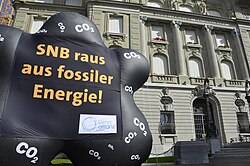
This shift is further accelerated by divestment campaigns across universities, churches, and pension funds. A notable example occurred in September 2019, when the University of California divested $83 billion from the fossil fuel industry, citing financial risk.
Economic Drivers of the Transition
Several economic factors are making the transition to clean energy more viable and inevitable:
- Falling Costs: Renewable energy prices continue to drop. In many regions, photovoltaic roof systems are now cheaper than grid electricity.
- Pollution Control: Addressing negative externalities—the hidden costs of pollution not reflected in market prices—makes alternative energies more competitive.
- Subsidy Reform: Removing the trillions of dollars in direct and indirect government subsidies for fossil fuels would further level the playing field for renewables.
- Political Influence: As renewable energy corporations grow in wealth and employment, their political lobbying power is expected to increase, challenging the dominance of fossil fuel interests.
Technological and Societal Shifts
Urbanization and innovation are fundamentally changing energy consumption patterns. The adoption of green buildings, efficient public transport, and electricity-based transportation (EVs) reduces the demand for petroleum. Combining roof photovoltaics with second-hand EV batteries can provide essential grid storage for intermittent renewable sources.
Technological advancements in 3D printing, biotechnology, LEDs, and virtual reality are enabling economic growth while reducing the need for physical travel and resource-heavy manufacturing. As the economy shifts toward the service sector, energy consumption may decouple from economic growth.
Demographic changes also play a role. In the U.S., younger generations are driving less and opting for walkable urban communities. While global petroleum consumption rose 32% between 1995 and 2014, domestic U.S. trends show a decline in coal and petroleum use since 2005.
| Driver | Mechanism | Expected Impact |
|---|---|---|
| Policy | Carbon taxes & subsidy removal | Reduced fossil fuel demand |
| Finance | Divestment & ESG indices | Lower capital for hydrocarbon extraction |
| Technology | Renewables & Energy Efficiency | Lower cost of clean energy alternatives |
| Societal | Urbanization & Behavioral shifts | Decreased per-capita energy usage |
Frequently Asked Questions
What is the carbon bubble?
The carbon bubble refers to the financial risk associated with fossil fuel assets that may become "stranded" or lose their value if climate regulations prevent them from being extracted and burned.
How much of the world's fossil fuel reserves must stay underground?
To meet the 2°C global temperature rise target, research suggests that about one-third of oil reserves, half of gas reserves, and over 80% of coal reserves should remain underground.
Why are universities and pension funds divesting from fossil fuels?
Many institutions are divesting for financial reasons, believing that holding fossil fuel assets poses a long-term financial risk as the world transitions to a low-carbon economy.
How do government subsidies affect the energy market?
Subsidies artificially lower the cost of fossil fuels. Removing these—which totaled $523 billion in direct payments in 2011—would make renewable energy more competitive.
Is energy consumption decreasing in the United States?
U.S. consumption of coal and petroleum liquids peaked in 2005 and fell by 21% and 13% respectively by the end of 2014, though natural gas consumption continued to climb during that period.