The Genus Canis: Evolution, Biology, and Behavior
The genus Canis represents one of the most recognizable groups of mammals on Earth. This diverse lineage includes a wide array of extant (currently living) species, ranging from the domestic dog and the gray wolf to the coyote and the golden jackal. While they vary significantly in size and habitat, members of this genus share fundamental biological traits, such as moderate to large bodies, long legs, and specialized dental structures designed for predation.
Species within the genus are phylogenetically—meaning related through evolutionary history—closely linked, often sharing 78 chromosomes and possessing the potential to interbreed. However, modern science continues to refine our understanding of these relationships. For instance, recent taxonomic recommendations suggest that certain jackals, such as the black-backed jackal, may belong to a distinct genus, Lupulella, because they form a monophyletic lineage (a group consisting of an ancestor and all its descendants) that sits outside the primary Canis clade.
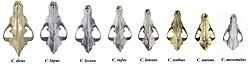
Taxonomy and Classification
The genus Canis was first established by Carl Linnaeus in 1758. It is classified within the family Canidae and the tribe Canini. The type species for the genus is Canis familiaris, the domestic dog. The scientific classification is as follows:
- Kingdom: Animalia
- Phylum: Chordata
- Class: Mammalia
- Order: Carnivora
- Family: Canidae
- Subfamily: Caninae
- Tribe: Canini
- Genus: Canis
Evolutionary History
The evolutionary journey of canids began approximately 43 million years ago within the clade Carnivoramorpha. The ancestors of modern canines, such as the fox-like Leptocyon, existed as early as 24 million years ago. By 11.9 million years ago, this lineage branched into foxes (Vulpes) and canines (Canini). The jackal-sized Eucyon inhabited North America starting 10 million years ago, eventually migrating to Eurasia around 6 to 5 million years ago.
In the New World, Eucyon gave rise to early North American Canis species. By 5 million years ago, the larger Canis lepophagus—a direct ancestor to both wolves and coyotes—appeared in what is now the southwestern United States and Mexico. Meanwhile, in the Old World, the evolution of Canis led to a dominant predator across the Palearctic. A significant period known as the "wolf event" occurred in the Early Pleistocene (around 1.8 million years ago), characterized by an explosion of Canis evolution across Eurasia, likely linked to the formation of the mammoth steppe.
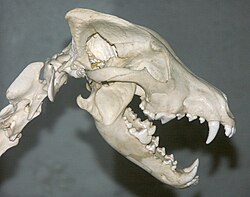
One of the most significant recent discoveries in canine evolution concerns the dire wolf (Aenocyon dirus). While previously classified under Canis, genetic studies in 2021 revealed that the dire wolf was actually part of an ancient, distinct lineage that diverged in the Miocene. Unlike true Canis species like the gray wolf and coyote, which survived the Quaternary extinction event through dietary flexibility and hybridization, the dire wolf lineage eventually went extinct.
Physical Characteristics and Dentition
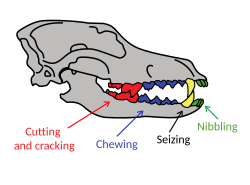
Members of the genus Canis are characterized by massive, well-developed skulls and specialized teeth. Their dental arrangement is critical to their role as predators. In carnivores, the upper fourth premolar (P4) and the lower first molar (m1) function together as carnassials, acting like scissors to shear through muscle and tendon.
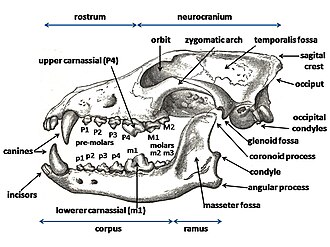
The structure of the lower molar (m1) provides insight into a species' diet. The tooth consists of a trigonid, used for slicing, and a talonid, used for grinding. A larger trigonid typically indicates a hypercarnivore (an animal with a diet consisting almost entirely of meat), while a larger talonid suggests a more omnivorous diet. Additionally, the strength of the mandibular symphysis—the joint where the two halves of the lower jaw meet—can indicate hunting styles; pack hunters often have weaker symphyses than solitary hunters.
Bite force is another key indicator of predatory capability. When adjusted for body mass, the extinct dire wolf possessed the highest canine bite force among placental mammals, followed by modern hypercarnivores like the African wild dog and the gray wolf.
| Canid | Carnassial (N/kg) | Canine (N/kg) |
|---|---|---|
| Gray wolf | 131.6 | 127.3 |
| Dhole | 130.7 | 132.0 |
| African wild dog | 127.7 | 131.1 |
| Greenland dog and dingo | 117.4 | 114.3 |
| Coyote | 107.2 | 98.9 |
| Side-striped jackal | 93.0 | 87.5 |
| Golden jackal | 89.6 | 87.7 |
| Black-backed jackal | 80.6 | 78.3 |
Social Behavior and Mating
Canids exhibit diverse social structures. Many species, including wolves, coyotes, and jackals, live in groups consisting of breeding pairs and their offspring. Gray wolves, in particular, are known to live in extended family packs. These social structures allow them to hunt prey much larger than an individual wolf; for example, a pack of timber wolves can successfully take down a 500 kg moose.
Mating systems within the genus vary. Wolves are typically monogamous, forming long-term pair bonds. In contrast, domestic dogs can be promiscuous when free-ranging. Research suggests that social status plays a major role in mating; for instance, free-ranging female dogs often seek out dominant males. Parental care also varies; in coyotes, paternal investment often increases to match the level of care provided by the mother, whereas mother dogs may shift from high-energy to lower-energy care as their pups age to ensure long-term survival.
Key Facts
- Taxonomy: The genus Canis includes wolves, dogs, coyotes, and golden jackals.
- Evolution: The "wolf event" in the Early Pleistocene led to a massive expansion of Canis across Eurasia.
- The Dire Wolf: Genetic evidence shows the dire wolf belongs to a separate lineage from true Canis species.
- Dentition: Carnassial teeth (P4 and m1) are specialized for shearing meat and tendon.
- Social Structure: Many species live in monogamous pairs or organized social packs.
- Bite Force: Hypercarnivores like the gray wolf and African wild dog have significantly higher bite forces relative to their body mass than jackals.
Frequently Asked Questions
Are all wolves members of the genus Canis?
No. While many species referred to as "wolves" belong to Canis (such as the gray wolf and Ethiopian wolf), the extinct dire wolf belongs to a different, ancient lineage known as Aenocyon.
What is the difference between a wolf and a jackal?
In common terminology, "wolf" is typically applied to larger species, while "jackal" is used for smaller species. However, many jackals are actually closely related to wolves within the Canis genus.
How do canids use their teeth for different diets?
Canids use their premolars for cutting and crushing, while molars are generally used for grinding. Hypercarnivores have teeth specialized for slicing meat, whereas omnivorous species have teeth more suited for grinding plant matter.
Do wolves hunt alone or in packs?
While some canids may hunt alone, many species like the gray wolf are highly social and hunt in packs. This cooperative behavior allows them to take down much larger prey than they could individually.
Why do some canids have broken teeth?
Tooth breakage is common in carnivores due to the stresses of feeding. Eating bone increases the risk of fracture, and the shape of canine teeth makes them particularly susceptible to unpredictable bending stresses during prey subdual.