Cable Transport Systems: A Comprehensive Overview of Aerial Lifts
Aerial transport systems provide essential connectivity in challenging terrains, from steep mountain peaks to dense urban centers. These systems rely on a sophisticated interplay of stationary support ropes and moving haul cables to transport passengers safely and efficiently. While often grouped together as "cable cars," these systems vary significantly in their engineering, capacity, and stability.
Aerial Tramways and Gondola Lifts
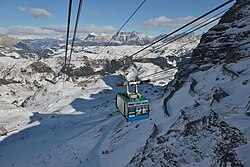
An aerial tramway (known as an aerial tram in American English or a cable car in British English) utilizes one or two stationary ropes for support, while a separate moving rope provides the propulsion. In these systems, the grip is permanently fixed to the propulsion rope. Notable urban examples include the Portland Aerial Tram and the Roosevelt Island Tramway in New York City.
In contrast, a gondola lift features a continuously circulating cable strung between stations via intermediate supporting towers. This cable is driven by a bullwheel—a large pulley wheel—connected to an electric motor or engine. Most modern gondolas use detachable grips, which allow cabins to slow down at stations for safe boarding, though fixed-grip versions exist. Single-cable designs are often called "mono-cable" lifts.
Gondolas are widely used for urban transit, with prominent examples including London Cable Car, Mi Teleférico in La Paz, Metrocable in Medellín and Caracas, and the Singapore Cable Car.
Bicable and Tricable Variations
To increase stability and span, some gondolas use additional ropes. Bi-cable gondola lifts utilize one stationary support rope and one haul rope. Tri-cable gondola lifts employ two support ropes and one haul rope. High-profile examples of these advanced systems include the Peak 2 Peak Gondola in Canada and the Ngong Ping Skyrail in Hong Kong.
Specialized High-Stability Systems: Funitels and Funifors
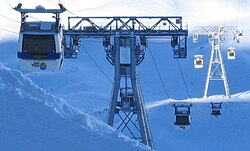
A funitel (a portmanteau of the French funiculaire and telepherique) is designed for superior stability in high winds. Unlike standard gondolas, it uses two overhead arms attached to two parallel haul cables. These systems are sometimes categorized as "double monocable" (DMC) or "double loop monocable" (DLM), the latter of which loops a single haul cable twice. Funitels are characterized by high capacity, typically carrying 20 to 30 people per cabin, with short intervals between successive cabins.
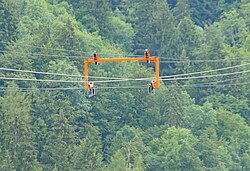
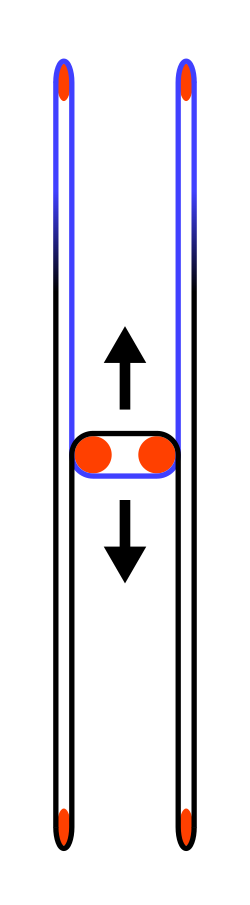
The funifor is a specialized cable car developed by Hölzl (now part of the Doppelmayr Garaventa Group). It features two support ropes and a looped haul rope, typically operating a single cabin that shuttles back and forth. A key engineering distinction is that the haul rope loops back to the bottom at the top of each track rather than crossing to the other track. This allows for single-cabin operation and facilitates evacuations via bridge connections between adjacent cabins. The wide horizontal distance between the two support ropes makes the funifor exceptionally stable in high winds.
Ski Area and Utility Lifts
Chairlifts are circulating systems common in mountainous regions and amusement parks. They allow passengers, particularly skiers, to board without removing their equipment. According to American National Standards Institute guidelines for fixed-grip lifts, maximum speeds vary by chair capacity: single chairs up to 3 m/s (9.8 ft/s), double chairs up to 2.8 m/s (9.2 ft/s), and triple chairs up to 2.5 m/s (8.2 ft/s).
Detachable chairlifts operate at roughly double the speed of fixed-grip versions. They use powerful spring-loaded grips to detach the chair from the fast-moving cable at terminals, slowing the chair down for convenient loading. Some chairs include "bubble" canopies for weather protection.
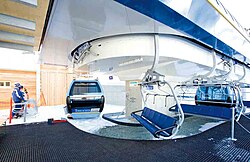
A hybrid lift (referred to as a telemix by Leitner or a combination lift by Doppelmayr) merges the features of a gondola and a chairlift. An example is the Weibermahd lift in Vorarlberg, Austria, which alternates between 10-person gondolas and 8-person chairlifts.
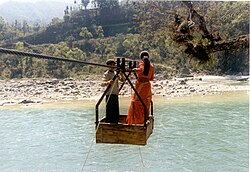
In undeveloped regions with rough terrain, hand-powered cable cars are used for basic utility, such as the tuin used to cross rivers in Nepal.
Key Facts
- Funitels provide high wind stability using two parallel haul cables and can carry 20-30 people per cabin.
- Funifors use a unique looped haul rope and two support ropes for maximum stability in extreme wind.
- Detachable grips allow gondolas and chairlifts to slow down for boarding while the main cable continues at high speed.
- Hybrid lifts combine the capacity of gondolas with the open-air experience of chairlifts.
- Fixed-grip chairlifts have regulated speed limits based on the number of passengers per chair.
System Comparison Summary
| System Type | Support Mechanism | Propulsion | Primary Use Case |
|---|---|---|---|
| Aerial Tramway | 1-2 Stationary Ropes | Separate Moving Rope | Urban/Point-to-Point |
| Gondola Lift | Circulating Cable (Mono/Bi/Tri) | Integrated Haul Cable | Urban/Tourism/Ski |
| Funitel | Two Parallel Haul Cables | Dual Propulsion | High-Wind Mountain Areas |
| Funifor | Two Support Ropes | Looped Haul Rope | Extreme Wind/High Altitude |
| Chairlift | Circulating Cable | Integrated Haul Cable | Ski Resorts/Amusement Parks |
Frequently Asked Questions
What is the difference between a gondola and an aerial tramway?
A gondola lift uses a continuously circulating cable with multiple cabins, whereas an aerial tramway typically uses stationary support ropes and a separate propulsion rope to move one or two cabins back and forth.
How do detachable grips work on chairlifts?
Detachable grips use a powerful spring-loaded mechanism to disconnect the chair from the high-speed main cable as it enters the terminal. This allows the chair to slow down significantly for safe loading and unloading before re-attaching to the cable for the ascent or descent.
Why is a funifor more stable in high winds than other lifts?
The funifor's stability comes from the significant horizontal distance between its two support ropes, which prevents the cabin from swaying excessively in strong wind conditions.
What is a hybrid lift?
A hybrid lift, also known as a combination lift or telemix, is a system that alternates between different types of carriers—typically gondolas and open-air chairlifts—on the same cable.
What is a tuin?
A tuin is a simple, hand-powered cable car used in undeveloped areas, such as Nepal, primarily for crossing rivers in rough terrain.