Byzantine EmpireConstantinopleEastern Roman EmpireJustinian IByzantine history

Byzantine Empire: The Eternal Legacy of the Eastern Roman State

Byzantine Empire: The Eternal Legacy of the Eastern Roman State The Byzantine Empire, often referred to as the Eastern Roman Empire, served as the bridge between antiquity and the Middle ...

Byzantine Empire: The Eternal Legacy of the Eastern Roman State

The Byzantine Empire, often referred to as the Eastern Roman Empire, served as the bridge between antiquity and the Middle Ages. Spanning from 330 to 1453, this absolute monarchy preserved the legal, political, and cultural heritage of Rome while evolving into a distinct Greek-speaking civilization centered in the magnificent city of Constantinople.

From its inception under Constantine I to its final days under Constantine XI, the empire weathered centuries of conflict, religious schisms, and territorial shifts, remaining the dominant power in the Eastern Mediterranean for over a millennium.
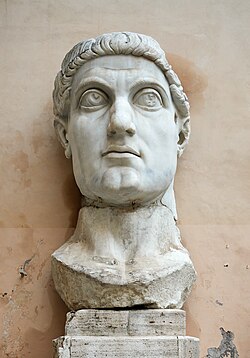
Constantine I, also known as Constantine the Great, was Roman emperor from AD 306 to 337 and the first Roman emperor to convert to Christianity. He founded the city of Constantinople (now Istanbul) and made it the capital of the Empire, which it remained for over a millennium.

Key Facts

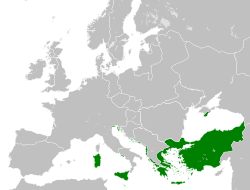
Map centred on Western Europe. The territories of the Byzantine Empire are shaded dark green; namely the Italian islands, southern Greece, south-central Bulgaria, southern Crimea and most of Turkey.
The Byzantine Empire c. 814
  • Capital: Constantinople (modern-day Istanbul).
  • Duration: 330 AD to 1453 AD.
  • Official Religion: Christianity.
  • Primary Languages: Latin (until the 6th century), then predominantly Greek.
  • Peak Territory: Reached its greatest extent in 565 AD under Justinian I, covering approximately 3,400,000 km².
  • Government: Absolute monarchy.

The Rise and Evolution of the Empire
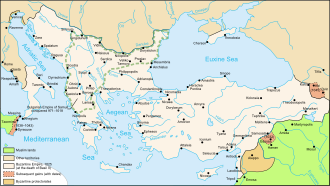
Territorial extent of the Byzantine Empire at the time of Basil II's death in 1025

Foundations and Early Dynasties

The empire's origins are tied to the Roman Tetrarchy, a system of four-way division established by Diocletian to manage the vast Roman territories.
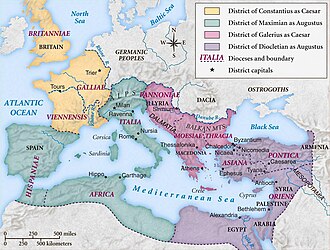
A map showing the division of the Roman empire c. 300
Four-way division of the Roman Empire under the Tetrarchy system established by Diocletian

Constantine I became the first Roman emperor to convert to Christianity and founded Constantinople, making it the new capital of the Empire. Following the death of Theodosius I in 395 AD, the empire was formally divided into the Western Roman Empire and the Byzantine (Eastern) Roman Empire.
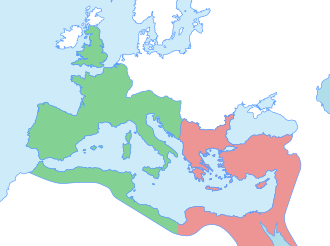
A map showing the Western and Eastern Roman empires c. 395, divided in the Balkans and North Africa
Division of the empire after the death of Theodosius I in 395 The Western Roman Empire The Byzantine/Eastern Roman Empire

The Golden Age of Justinian I

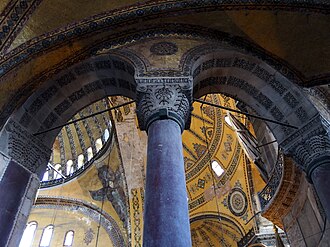
Under the rule of Justinian I (527–565), the empire reached its territorial zenith. Justinian is most remembered for his ambitious efforts to reclaim lost western territories and for the construction of the Hagia Sophia, a masterpiece of architecture that utilized the principles of solid geometry attributed to Archimedes.

The Hagia Sophia in Constantinople (now Istanbul) was built by the Eastern Roman emperor Justinian the Great in 532–537.[193]

A photograph of the interior of a building built with blue arches and pillars and ornate yellow walls
Interior of the Hagia Sophia; the influence of Archimedes' principles of solid geometry is evident.

State Structure and Governance

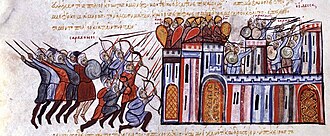
Depiction of an army attacking a walled town
The seizure of Edessa (1031) by the Byzantines under George Maniakes and the counterattack by the Seljuk Turks

Administration and Law

The Byzantine state was characterized by a highly centralized absolute monarchy. To manage defense and administration, the empire utilized a system of themes (military-administrative districts), particularly in Asia Minor, which allowed for more efficient local responses to invasions.

Military Prowess and Diplomacy

The Byzantine military evolved over centuries to meet diverse threats. One of their most feared secrets was Greek fire, a combustible weapon launched from ceramic grenades or siphons that could burn on water, proving critical during the siege of 717–718.
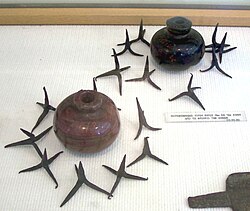
Two pots surrounded by caltrops
Ceramic grenades which were filled with Greek fire, surrounded by caltrops, 10th–12th century, National Historical Museum, Athens

The defense of the capital relied heavily on the Theodosian Walls, a massive fortification system that protected Constantinople from numerous assaults.
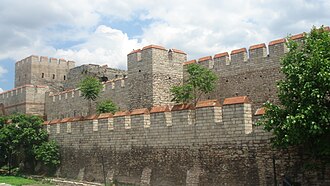
A photograph of a large double-layered fortification.
The Theodosian Walls of Constantinople, very important during the 717–718 siege

Society, Culture, and Religion

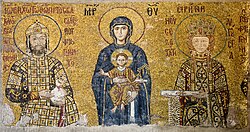
A mosaic depicting a haloed woman holding a baby, flanked by a man and woman, both crowned and haloed
A mosaic from the Hagia Sophia of Constantinople (modern Istanbul), depicting Mary and Jesus, flanked by John II Komnenos (left) and his wife Irene of Hungary (right), 12th century

Faith and the Church

Christianity was the official state religion and deeply intertwined with governance. The empire played a pivotal role in spreading Christianity to the Slavs, notably through the missionary work of St. Cyril and St. Methodius.
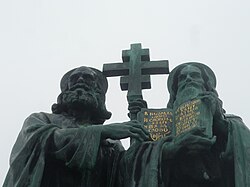
A photograph of statue, which depicts two bearded and hooded men; the one on the left is holding up a cross and the one on the right is holding up a book
Monument to St. Cyril and St. Methodius, Byzantine missionaries to the Slavs, on Mt. Radhošť in Czechia

Arts and Sciences

Byzantine art is renowned for its mosaics and icons, such as the Christ Pantocrator. The empire also maintained a rich literary tradition, exemplified by the Alexiad, a history written by Anna Komnene.
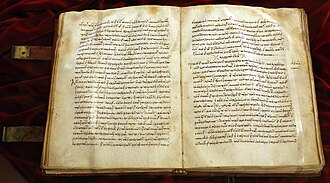
The Alexiad, a history by Anna Komnene, in a 12th-century manuscript. Kept in the Biblioteca Medicea Laurenziana, Florence

The empire's economy was supported by a stable currency system, utilizing the solidus, follis, and hyperpyron.
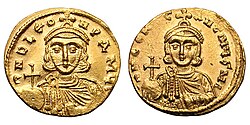
Two gold coins, each depicting a man
Gold solidus of Leo III (left) and his son and heir, Constantine V (right)

The Decline and Fall

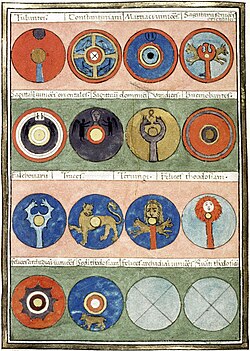
Shield insignia of regiments under the command of the Magister Militum Praesentalis II of the East Roman army c. 395 AD. Page from the Notitia Dignitatum

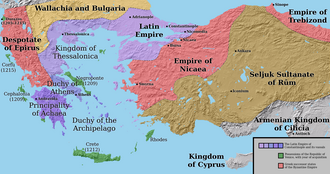
The empire faced a gradual decline marked by internal strife and external pressures. A devastating blow occurred during the Fourth Crusade in 1204, when Constantinople was sacked and the empire was partitioned.
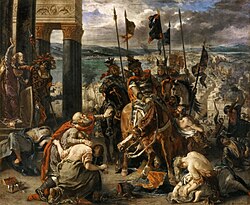
A painting of an army marching into a city gate with much smoke in the background
The Entry of the Crusaders into Constantinople, by Eugène Delacroix (1840)

A map showing the competing states after the Fourth Crusade.
The partition of the empire following the Fourth Crusade, c. 1204[155]

Despite a brief restoration under the Palaiologos dynasty, the empire's territory shrank significantly. The end came in 1453 when the city of Constantinople finally fell to the Ottoman Turks.
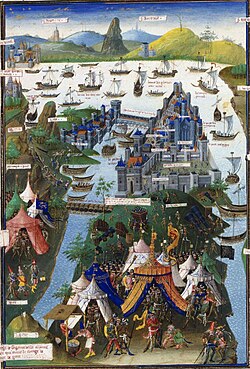
A painting of a siege of a city
The siege of Constantinople in 1453, depicted in a 15th-century French miniature

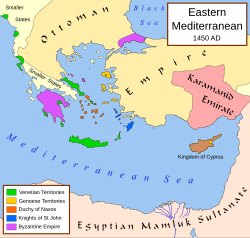
A map centred on Greece and Turkey in 1450 AD. The Byzantine Empire holds only Southern Greece and northwestern Turkey
The Eastern Mediterranean just before the Fall of Constantinople

Empire Summary Table

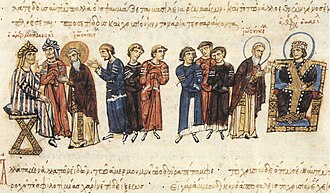
Manuscript illustration of an embassy travelling between two rulers
The embassy of John the Grammarian in 829, sent by emperor Theophilos to the Abbasid caliph Al-Ma'mun
Byzantine Empire Overview
Metric Early Period (c. 457) Peak Period (565) Middle Period (1025) Late Period (1320)
Area (km²) 2,350,000 3,400,000 1,675,000 Not Specified
Population 16,000,000 20,000,000 12,000,000 2,000,000

Frequently Asked Questions

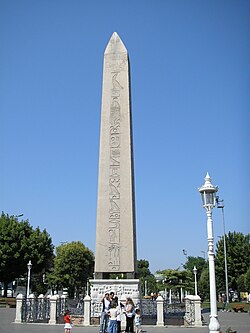
The Obelisk of Theodosius, an ancient Egyptian obelisk dedicated to the Egyptian King Thutmose III, was re-erected in the Hippodrome of Constantinople by the Roman emperor Theodosius I in the 4th century AD.
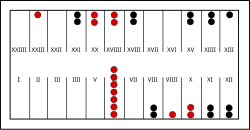
A depiction of a board game
A game of τάβλι (tabula) played by the Byzantine emperor Zeno in 480 and recorded by Agathias in c. 530 because of a very unlucky dice throw for Zeno (red)[247]
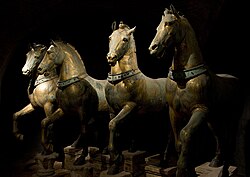
The four bronze horses that were once in the Hippodrome of Constantinople are today put on display in Venice.

What was the difference between the Roman Empire and the Byzantine Empire?

The Byzantine Empire was the continuation of the Roman Empire in its eastern provinces after the Western Roman Empire fell. While it maintained Roman law and political structures, it eventually adopted Greek as its primary language and became more centered on Eastern Orthodox Christianity.

Who was the most influential Byzantine emperor?

Justinian I is often considered the most influential due to his legal reforms, his massive building projects like the Hagia Sophia, and his efforts to reconquer former Roman territories in the West.

What was Greek fire?

Greek fire was a secret incendiary weapon used by the Byzantine navy. It was a liquid combustible that could continue burning while floating on water, making it an effective tool for destroying enemy ships.

Why was Constantinople so strategically important?

Constantinople's location allowed it to control the trade routes between Europe and Asia and the maritime passage between the Mediterranean and Black Seas, making it a global hub of wealth and power.

When did the Byzantine Empire officially end?

The empire officially ended in 1453 AD when the Ottoman Turks captured Constantinople, marking the death of the last emperor, Constantine XI.

References

  1. Medieval Greek: Ῥωμαῖοι, romanized: Rhōmaîoi. Due to the imperial seat's move to Byzantium, the adoption of state Christianity, and the predominance of Greek instead of Latin, most historians make a distinction between the earlier Roman Empire and the later Byzantine Empire.[5]
  2. Leo VI was officially the son of Basil I, but a persistent rumour alleged that he had been fathered by Michael III, who had previously taken Leo's mother Eudokia Ingerina as his mistress. One of Leo's first acts was to rebury Michael III in Basil's mausoleum in the Church of the Holy Apostles complex, which exacerbated the rumours.[113]
  3. Arianism, one of the first major controversies, shook the empire until it was addressed by the Nicene Creed.[198] Other controversies persisted, leading to schisms, such as debates on the fundamental definitions of Christ's nature at the Council of Chalcedon in 451.[199]
  4. Treadgold 1997, p. 137.
  5. Treadgold 1997, p. 278.