Byzantine Architecture: The Legacy of the Eastern Roman Empire
Byzantine architecture represents the artistic and engineering brilliance of the Byzantine Empire, also known as the Eastern Roman Empire. Spanning from AD 330—when Constantine the Great established Constantinople as the new Roman capital—until the empire's fall in 1453, this style bridged the gap between classical antiquity and the Middle Ages. While early Byzantine works were structurally similar to late Roman architecture, the style evolved into a distinct identity characterized by massive domes, intricate vaults, and opulent gold-ground mosaics.
At its core, the architecture focused on creating vast, light-filled sacred spaces. While mosaics served as the gold standard for grand interiors, frescos were often used as a more affordable alternative for smaller structures.
Key Facts
- Timeline: Active from the 4th century until 1453.
- Core Elements: Heavy reliance on arches, vaults, and large-scale domes.
- Defining Feature: The use of gold-background wall mosaics in major religious buildings.
- Global Influence: Profoundly impacted early Islamic (Umayyad) architecture and later Eastern Orthodox traditions.
- Iconic Monument: The Hagia Sophia, once the largest church in the world.
Architectural Characteristics and Evolution
Sacred Building Types
Sacred Byzantine architecture is generally categorized into several types, most notably the basilican style, which dominated from the 4th to the 7th centuries, and the conversion of ancient Egyptian temples into Christian spaces.
The Evolution of Columns
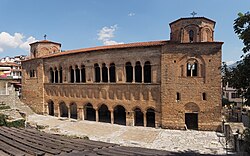
Byzantine columns evolved from the classical Corinthian style. Architects moved away from fluted shafts, instead leaving stone blocks rough from the quarry and carving unique, imaginative designs. Some of the most striking examples feature leaves that appear to be blown by the wind, as seen in the 7th-century Hagia Sophia in Thessaloniki.
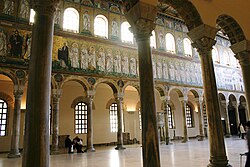
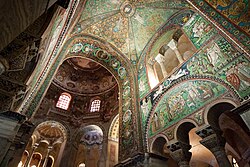
In some structures, such as San Vitale in Ravenna, a dosseret (an impost block) was placed atop the column to support the arch, as the arch's springing was wider than the column's abacus.
Structural Innovations
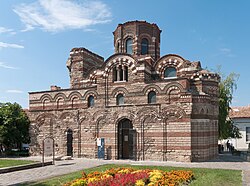
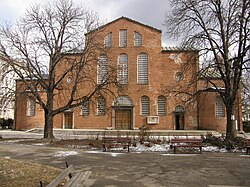
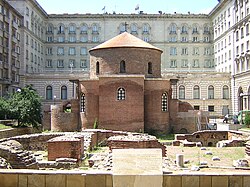
The transition from the basilican plan to central-plan structures marked a significant shift. Early central buildings were often cylindrical or square with a dome, such as the Church of St. George in Sofia. Over time, architects added vaulted aisles or annexes to form a cross shape, which helped counterbalance the weight of the central vault.
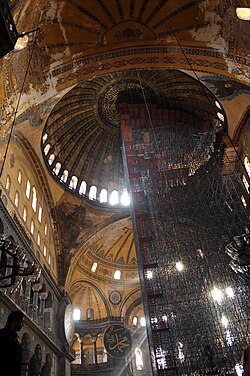
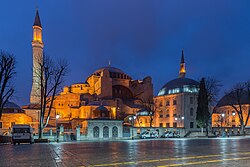
The pinnacle of this evolution was the Hagia Sophia, which combined a central square space with hemicycles (semi-circular recesses) and a massive central dome supported by two semi-domes and two-story vaulted aisles.
Chronological Overview of Monuments
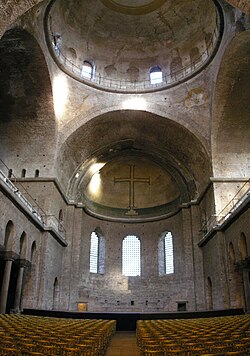
![Hagia Irene is a former Greek Eastern Orthodox Church located in the outer courtyard of Topkapı Palace in Istanbul. It is one of only two Byzantine churches still standing in the city today which were never converted into mosques, as it was used as an arsenal until the 19th century.[8] Today it operates as a museum and concert hall.](/images/6b/cf/6bcf340ae4da32626743a2f94e68465f69a2d196642f6114130735c4c1c6ef28.jpg)
Early Byzantine Period
The reign of Emperor Justinian I produced some of the most enduring examples of the era, particularly in Istanbul and Ravenna. Notable engineering feats include the 430-meter Sangarius Bridge and the innovative walls of Constantinople, which featured 192 towers.
Middle Byzantine Period
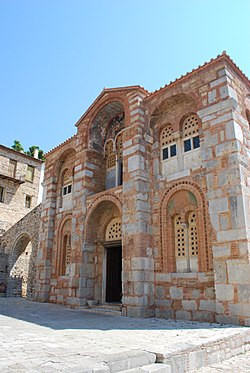
During the Macedonian dynasty, the cross-in-square sanctuary became the standard model. Following the end of Iconoclasm, architectural decoration became more standardized. This era is characterized by cloisonné masonry—a technique where walls are built using a regular mix of stone and brick.
Late Byzantine Period
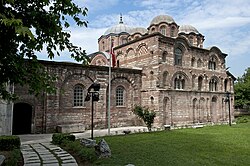
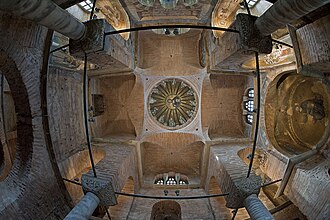
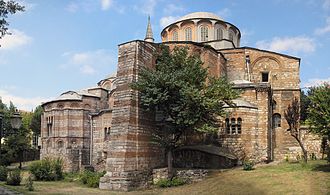
The late period (c. 1310) favored attenuated proportions and shifts in the treatment of figures in mosaics. An example is the ornate parekklesion (side chapel) added to the Pammakaristos Church in Constantinople for the tomb of Michael Glabas Tarchaniotes.
Major Monuments in Detail
Hagia Sophia
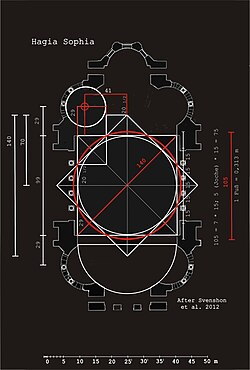
The Hagia Sophia ("Holy Wisdom") is the most iconic symbol of Byzantine civilization. Originally built in 360 and later rebuilt by Emperor Justinian, it served as the center of Orthodox Christianity for 900 years. Its geometric design is based on the mathematical formulas of Heron of Alexandria, avoiding irrational numbers to create a highly sophisticated mathematical space.
Hagia Irene
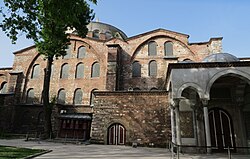
Hagia Irene is one of only two Byzantine churches in Istanbul that was never converted into a mosque, having served as an arsenal until the 19th century. It is constructed from stone, brick, and lightweight volcanic concrete for durability. The church is noted for the contrast between its plain exterior and its elaborate interior mosaics.
| Monument | Location | Key Feature | Period/Century |
|---|---|---|---|
| Hagia Sophia | Istanbul, Turkey | Massive central dome; mathematical precision | 6th Century (Justinian) |
| Basilica of San Vitale | Ravenna, Italy | Octagonal plan; glamorous mosaics | 6th Century |
| Hagia Irene | Istanbul, Turkey | Volcanic concrete; never converted to mosque | 6th Century (rebuilt 8th) |
| Hosios Loukas | Greece | Macedonian dynasty style | c. 1000 AD |
| Pammakaristos Church | Istanbul, Turkey | Cloisonné masonry; late Byzantine chapel | 11th-14th Century |
Global Legacy and Influence

Influence on Islamic Architecture
Byzantine arts were a fundamental source for early Islamic architecture, particularly during the Umayyad Caliphate (661-750). The Umayyad Mosque's plan shares similarities with 6th- and 7th-century Christian basilicas. Elements such as polychrome brickwork, geometric patterns, and multiple arches in Moorish architecture were heavily influenced by Byzantine techniques.
![The 9th century Throne Hall of Dongola in Sudan was heavily influenced by Byzantine architecture.[11]](/images/f7/d4/f7d4a43e0d6b8dab60367df6a6e007292e57c7278d2d92cb39b392b404b9b808.jpg)
Post-Byzantine and Neo-Byzantine Styles
The tradition persisted in Eastern Orthodox countries like Russia, Bulgaria, and Serbia well into the 18th century. In the 19th century, the Neo-Byzantine movement emerged as a counterpart to the Gothic revival, leading to the construction of Westminster Cathedral in London and the Church of Saint Sava in Belgrade.
Frequently Asked Questions
What is the difference between early and middle Byzantine architecture?
Early Byzantine architecture was closely linked to late Roman styles and focused on large basilicas and innovative domes. Middle Byzantine architecture became more standardized, favoring the cross-in-square plan and the use of cloisonné masonry (mixed stone and brick).
Why is the Hagia Sophia considered an engineering marvel?
It combined a massive central dome with a complex system of semi-domes and vaulted aisles, creating an unprecedented unbroken interior space based on the mathematical principles of Heron of Alexandria.
What is cloisonné masonry?
Cloisonné masonry is a construction technique used primarily in Middle Byzantine architecture where walls are built with a regular, alternating mix of stone and brick, often with a higher proportion of brick.
Which Byzantine churches in Istanbul were not converted into mosques?
Hagia Irene is one of the few Byzantine churches in Istanbul that was never converted into a mosque, as it was used as an arsenal until the 19th century before becoming a museum.
How did Byzantine architecture influence the West?
Beyond the direct influence on the Eastern Orthodox world, Byzantine styles appeared in Sicily (Cappella Palatina) and Venice (St. Mark's Basilica), and later inspired the 19th-century Neo-Byzantine revival in Europe.