Byelorussian Soviet Socialist Republic: A History of the BSSR
The history of the Byelorussian Soviet Socialist Republic (BSSR) is a complex narrative of shifting borders, ideological struggle, and immense human tragedy. From its emergence during the chaos of the First World War to its eventual role as a founding member of the Soviet Union, the BSSR served as both a strategic bridgehead for Soviet expansion and a laboratory for early communist national policies.
The Turbulent Beginnings (1915–1918)
Before the First World War, the lands of modern-day Belarus were part of the Russian Empire. The conflict brought immediate instability; by late 1915, German forces had occupied significant portions of the Grodno and Vilna governorates. Following the October Revolution in 1917, the Minsk Soviet of Workers' and Soldiers' Deputies assumed control of the city, and Moscow established the Western Oblast to administer the remaining non-occupied Belarusian territories.
By late 1918, as Germany retreated following its defeat in the war, the Bolsheviks moved quickly to fill the power vacuum. The Belarusian National Republic offered little resistance, and the Red Army captured Minsk on December 10, 1918.
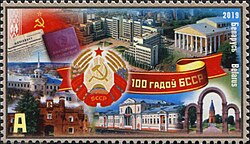
The Formation of the SSRB and the Litbel Experiment
On December 31, 1918, the Soviet Socialist Republic of Byelorussia (SSRB) was proclaimed in Smolensk, later moving its capital to Minsk. Initially consisting of seven districts, the republic sought to establish a socialist constitution and expand its reach westward.
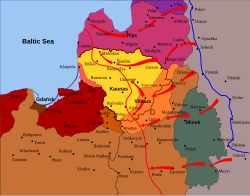
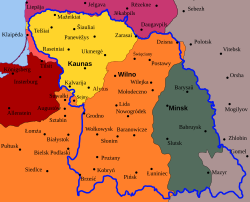
In an attempt to garner local support and secure the "borderlands," the Bolsheviks merged the Belarusian and Lithuanian republics on February 28, 1919, creating the Lithuanian–Belorussian Soviet Socialist Republic (Litbel). This entity, headquartered in Vilna, was short-lived. Internal opposition from Belarusian nationalists and a powerful Polish offensive forced Litbel to evacuate its capital and eventually collapse as Polish forces captured Minsk in August 1919.
The Polish-Soviet War and the Treaty of Riga
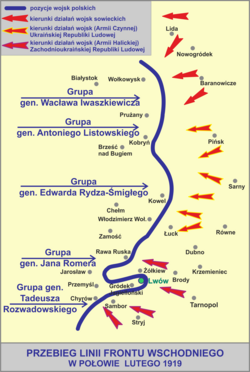
The struggle for Belarus became a central front in the Polish-Soviet War. While the Red Army briefly retook Minsk in July 1920, their ambitions were halted by the decisive Polish victory at the Battle of Warsaw. Following the Battle of the Niemen River, the Soviets were forced to retreat from Western Belarus.
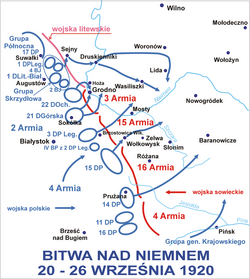
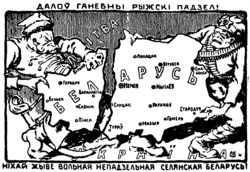
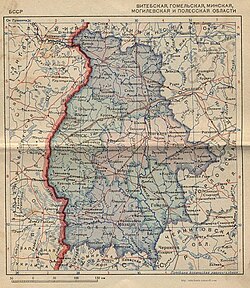
The conflict concluded with the Treaty of Riga in February 1921. This agreement effectively split the region: Western Belarus was ceded to Poland, while Eastern Belarus remained under Soviet control. The remaining SSRB was a small entity of 52,400 square kilometers with a population of 1.544 million.
Integration into the USSR and National Policies
Despite its small size, the BSSR's strategic location made it a founding member of the Soviet Union in 1922. Under Joseph Stalin's policy of "Socialism in One Country," the republic's borders were expanded in 1924 and 1926, incorporating territories from the RSFSR to make the region more economically viable.
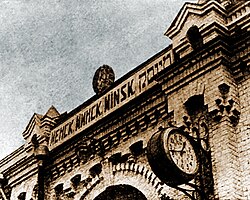
During the mid-1920s, the BSSR implemented Korenizatsiya (indigenization), a policy promoting Belarusian language and culture to appeal to nationalists and counter Polish influence. The republic was remarkably multicultural, recognizing four official languages: Belarusian, Russian, Yiddish, and Polish. The Jewish population, particularly in urban areas, played a significant role in society and economy, supported by affirmative action programs like Belkomzet, which allocated land to Jewish families.
The Era of Repressions and World War II
The 1930s brought a dark turn as Stalinist repressions peaked. Estimates suggest between 600,000 and 1.4 million people fell victim to terror, including mass executions and the deportation of kulaks (prosperous peasants). This period saw a forced shift toward Russification.
In 1939, following the Molotov-Ribbentrop Pact, the Soviet Union annexed West Belarus from Poland, significantly expanding the BSSR's territory.
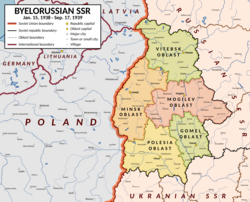
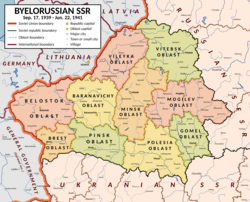
The Nazi German occupation (1941–1944) was catastrophic. Approximately 2 million people—nearly a quarter of the population—were killed. This included the murder of 800,000 Belarusian Jews and the total annihilation of over 600 villages, such as Khatyn.
Path to Independence
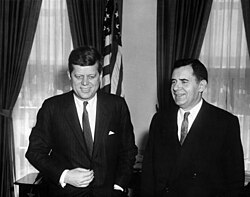
Following the war, the BSSR remained a key Soviet republic. Notable figures from the region, such as Andrei Gromyko, rose to the highest levels of Soviet diplomacy.
As the Soviet Union began to crumble during perestroika, the BSSR declared sovereignty in 1990. On August 25, 1991, it proclaimed independence, renaming itself the Republic of Belarus. The process culminated in the Belovezha Accords of December 1991, which formally dissolved the USSR.
Key Facts
- Founding: Proclaimed as the SSRB on December 31, 1918; became a founding member of the USSR in 1922.
- Litbel: A short-lived merger of Lithuanian and Belarusian Soviet republics (1919).
- Treaty of Riga (1921): Divided Belarus between Poland and the Soviet Union.
- Demographics: In 1925, the population was 83% rural, with a significant Jewish urban presence.
- WWII Loss: Approximately 2 million people died during the Nazi occupation, including 90% of the Jewish population.
- Independence: Formally achieved on December 25, 1991.
| Period/Event | Approx. Area (sq km) | Approx. Population | Key Status |
|---|---|---|---|
| Post-Treaty of Riga (1921) | 52,400 | 1.544 Million | Small Union Republic |
| Post-1924 Expansion | 110,600 | 4.2 Million | Economic Consolidation |
| Post-1926 Expansion | 126,300 | 4.98 Million | National Territorial Unit |
Frequently Asked Questions
What was Litbel?
Litbel was the Lithuanian–Belorussian Soviet Socialist Republic, a short-lived entity created by the Bolsheviks in February 1919 to merge the two republics and gain regional support. It collapsed later that year due to Polish military advances.
What was the significance of the Treaty of Riga?
Signed in 1921, the Treaty of Riga ended hostilities between Poland and Soviet Russia, effectively splitting Belarusian lands. Western Belarus became part of Poland, while Eastern Belarus remained under Soviet administration.
What was Korenizatsiya?
Korenizatsiya, or "indigenization," was a Soviet policy in the 1920s that promoted local languages and cultures. In the BSSR, this meant prioritizing the Belarusian language and folklore to win over the population and counter foreign influence.
How did World War II affect the BSSR?
The impact was devastating; nearly 25% of the population perished. The Nazi regime destroyed thousands of settlements and murdered 800,000 Jews, nearly wiping out the Jewish community in the region.
When did the BSSR become the Republic of Belarus?
The republic proclaimed its independence on August 25, 1991, and officially changed its name to the Republic of Belarus on September 19, 1991, shortly before the final dissolution of the Soviet Union.