Butler Institute of American Art: A Legacy of American Creativity
Located in Youngstown, Ohio, the Butler Institute of American Art (BIAA) holds a distinguished place in cultural history as the first museum dedicated exclusively to American art. Founded in 1919 by Joseph G. Butler, Jr., a local philanthropist and industrialist, the institution has operated pro bono for over a century, providing the public with free access to a vast array of national masterpieces.
The museum's physical presence is as significant as its collection. The original structure was designed by the renowned architectural firm McKim, Mead & White in the Second Renaissance Revival style—an architectural movement characterized by its inspiration from 16th-century Italian palazzos. Due to its historical and architectural importance, the building was added to the National Register of Historic Places on October 29, 1974.
Key Facts
- Established: 1919 by Joseph G. Butler, Jr.
- Location: 524 Wick Avenue, Youngstown, Ohio.
- Architectural Style: Second Renaissance Revival.
- Distinction: The first museum in the U.S. dedicated solely to American art.
- Accessibility: Operates pro bono (free of charge).
- Historic Status: Listed on the National Register of Historic Places (NRHP reference No. 74001567).
Masterpieces of the Permanent Collection
The Butler Institute houses a diverse range of works that capture the evolution of the American spirit, from early frontier life to modern abstraction.
Classic American Narratives
One of the museum's most prized possessions is Winslow Homer's Snap the Whip, which depicts the nostalgic era of the one-room schoolhouse. While the Metropolitan Museum of Art holds another version of this painting, the Butler's version is distinct for its inclusion of mountains in the background.
In 2007, the museum expanded its collection by acquiring Norman Rockwell's Lincoln the Railsplitter for $1.6 million from businessman and former presidential candidate Ross Perot. This impressive work measures 84.5 by 44.5 inches.
Historical and Regional Perspectives
The collection also delves into the complexities of American history through works such as:
- The Oregon Trail, 1869 by Albert Bierstadt.
- Youngstown Strike by William Gropper, which interprets the violent Little Steel Strike of 1937.
- A unique collection of paintings featuring southwestern Native Americans, originally from Joseph Butler's personal collection.
- An iconic depiction of George Washington's wedding.
Modern and Contemporary Art
The gallery of modern art showcases the shift toward abstraction and hyperrealism. Notable inclusions are the works of Abstract Expressionist Robert Motherwell and a life-sized painting by Alfred Leslie titled Americans: Youngstown, Ohio, which portrays figures connected to the museum during the 1970s. Additionally, the museum has hosted traveling exhibitions of Photorealists (artists who study a photograph and then attempt to reproduce the image as realistically as possible), including the work of Denis Peterson in 2009.
Institutional Growth and Modernization
The Butler has evolved through several strategic expansions to better serve its visitors and the academic community.
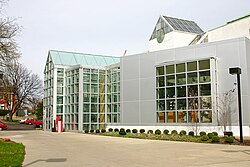
- The Beecher Center (2000): A 19,000-square-foot south wing created in partnership with Youngstown State University to merge art and technology.
- The Andrews Pavilion (2002): A 3,400-square-foot addition featuring a café, gift shop, and a sculpture atrium.
- Education and Performing Arts Center (2006): The conversion of the neighboring First Christian Church facility into a hub for learning and performance.
To maintain its scholarly standards, the museum held an auction in October 2007. Funds raised from 125 supporters were used to hire scholars to produce and publish an updated catalog of the museum's entire collection.
Commitment to Accessibility
In December 2021, the Butler Institute embraced assistive technology by partnering with Aira Tech Corp. Through the Aira app, visually impaired patrons can connect with a live agent who provides real-time descriptions of the artwork, ensuring the museum's treasures are accessible to all.
| Category | Details |
|---|---|
| Director | Anastasia James |
| Architect | McKim, Mead & White |
| Key Works | Snap the Whip, Lincoln the Railsplitter, The Oregon Trail |
| NRHP Date | October 29, 1974 |
| Website | www.butlerart.com |
Frequently Asked Questions
What makes the Butler Institute of American Art unique?
It was the first museum in the United States dedicated exclusively to American art and has operated pro bono since its founding in 1919.
How does the Butler's version of 'Snap the Whip' differ from the one at the Met?
The version held by the Butler Institute features mountains in the background, which are absent in the version housed at the Metropolitan Museum of Art.
Who designed the original museum building?
The original structure was designed by the architectural firm McKim, Mead & White in the Second Renaissance Revival style.
How does the museum support visually impaired visitors?
The museum uses the Aira app, which connects visually impaired patrons with agents who can describe the artwork in detail.
What is the Beecher Center?
The Beecher Center is a 19,000-square-foot south wing established in 2000 in conjunction with Youngstown State University, focusing on the intersection of art and technology.