Bureau of International Information Programs: History and Evolution of U.S. Public Diplomacy
The Bureau of International Information Programs (IIP) served as a critical arm of the U.S. Department of State, designed to manage the infrastructure and content necessary to engage foreign audiences. By leveraging physical spaces, digital platforms, and expert speakers, the IIP worked to build the reputation of the United States abroad through sustained conversation and transparency.
History and Organizational Evolution
The origins of the IIP are rooted in the Foreign Affairs Reform and Restructuring Act of 1998. This legislation led to the abolition of the United States Information Agency (USIA) on October 1, 1999. Following this dissolution, the USIA's broadcasting functions were transferred to the newly formed Broadcasting Board of Governors (BBG), while its non-broadcasting information functions were assigned to the Under Secretary of State for Public Diplomacy and Public Affairs. It was within this restructuring that the Bureau of International Information Programs was established.
For two decades, the IIP operated as one of three bureaus reporting to the Undersecretary for Public Diplomacy and Public Affairs, alongside the Bureau of Educational and Cultural Affairs and the Bureau of Public Affairs. This structure remained until May 28, 2019, when the IIP and the Bureau of Public Affairs merged to create the Bureau of Global Public Affairs. Consequently, the duties of the IIP Coordinator were merged into the role of the Assistant Secretary of State for Global Public Affairs.
Key Facts
- Dissolved: May 28, 2019 (Merged into the Bureau of Global Public Affairs).
- Budget: Annual budget of $55 million.
- Staffing: 458 employees as of 2013.
- Global Reach: Managed over 700 American Spaces across 169 countries.
- Digital Impact: Oversaw a social media community of over 12 million followers.
- Engagement: Facilitated more than 16 million annual visits to American Spaces.
Mission and Core Responsibilities
The primary mission of the IIP was to provide the content and infrastructure required for meaningful dialogue with foreign populations. This was achieved through three primary pillars of operation:
Digital Diplomacy
The IIP managed the Department of State's embassy and consulate websites, providing information in over 60 languages. To expand its reach, the bureau supported social media efforts in six languages and launched ShareAmerica in September 2014 to distribute public diplomacy content. Additionally, the bureau operated a web-chat platform that connected foreign audiences with U.S. government officials and subject matter experts through more than 800 annual programs.
American Spaces
American Spaces are physical hubs located in embassies, libraries, schools, and other partner institutions. These spaces promote the democratic tenet of free access to information, offering resources on U.S. policy, culture, and values. They also serve as centers for English language learning and support for international visitor program alumni.
Public Diplomacy (PD) Content and Analytics
The bureau curated a vast array of content—including videos, print publications, and audiobooks—reaching over one billion people annually. Each year, the IIP produced more than 125 video products and recruited over 650 speakers, ranging from Supreme Court justices to entrepreneurs, to engage approximately 160,000 people via in-person and virtual events. To measure success, the IIP utilized advanced analytics to track over 2,000 social media properties and analyze campaign performance.
Specialized Units and Sub-Agencies
One notable component of the IIP was the Counter Misinformation Team (CMT). Originally established during the Cold War to combat Soviet misinformation, the CMT was tasked with responding to disinformation regarding the U.S. government. A prominent example of its work was the August 28, 2006, report titled "The Top September 11 Conspiracy Theories," aimed at debunking myths surrounding the 9/11 attacks. The CMT was eventually discontinued at the end of the George W. Bush administration.
The Bureau of Public Affairs (PA)
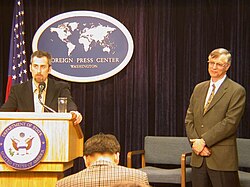
Before its merger into the Bureau of Global Public Affairs, the Bureau of Public Affairs (PA) focused on the domestic side of diplomacy. Its mandate was to help American citizens understand the importance of foreign policy. The PA Bureau managed press briefings, conducted media outreach, and handled public inquiries via phone and email.
The PA Bureau included the Office of Regional Media Outreach (RMO), which connected journalists with Department newsmakers through a searchable database of experts, and the Office of Electronic Information and Publications, which oversaw the State Department's primary website and printed documents.
| Feature | Bureau of International Information Programs (IIP) | Bureau of Public Affairs (PA) |
|---|---|---|
| Primary Audience | Foreign audiences (International) | American citizens (Domestic) |
| Key Infrastructure | American Spaces, Embassy websites | Press briefings, Domestic media outreach |
| Budget (Approx.) | $55 million | $13.5 million (FY 2009) |
| Staffing | 458 (as of 2013) | 209 (as of 2010) |
Frequently Asked Questions
What happened to the Bureau of International Information Programs?
On May 28, 2019, the IIP merged with the Bureau of Public Affairs to form the Bureau of Global Public Affairs.
What are American Spaces?
American Spaces are physical locations in 169 countries—often hosted in libraries or embassies—that provide the public with free access to information about U.S. policy, culture, and values.
What was the purpose of the Counter Misinformation Team?
The Counter Misinformation Team (CMT) was designed to respond to and debunk misinformation and disinformation regarding the United States government, a mission that began during the Cold War.
How did the IIP reach foreign audiences digitally?
The IIP operated embassy and consulate websites in over 60 languages, maintained social media accounts in six languages, and utilized the ShareAmerica platform to distribute content.
What was the difference between the IIP and the Bureau of Public Affairs?
The IIP focused on public diplomacy aimed at foreign audiences to build America's reputation abroad, while the Bureau of Public Affairs focused on informing the American public about the importance of U.S. foreign policy.