Brushy Peak Regional Preserve: A Journey Through California History
Nestled within the Diablo Range, Brushy Peak Regional Preserve stands as a testament to the diverse layers of California's heritage. Reaching an elevation of 1,702 feet (519 m), this landmark is more than just a scenic vista; it is a site of deep spiritual significance, a crossroads for ancient trade, and a sanctuary for wildlife and history alike.
From its origins as a sacred space for Native American tribes to its role as a hideout for legendary outlaws, the preserve offers a window into the evolution of the Livermore Valley and the surrounding East Bay region.
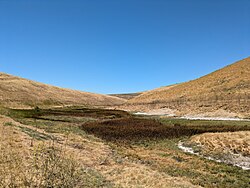
Key Facts
- Peak Elevation: 1,702 feet (519 m).
- Indigenous Connection: Historically linked to the Ssaoam tribe of the Ohlone people.
- European Arrival: First explored by Pedro Fages in 1772.
- Outlaw History: Served as a hideout for Joaquin Murietta during the Gold Rush.
- Conservation: Managed through a partnership between LARPD and EBRPD.
Pre-Contact and Indigenous Heritage
Long before European settlers arrived, Brushy Peak was a vital hub for the indigenous peoples of the region. It served as a focal point for trade routes connecting the Bay Area Ohlones, Bay Miwoks, and Northern Valley Yokuts.
The Ssaoam tribe, a subset of the Ohlone people, maintained the closest connection to the area. They inhabited the dry hills and small valleys surrounding the peak and the nearby Altamont Pass. Due to the seasonal nature of the environment, Ssaoam populations typically dispersed during the dry summer months and reconverged at various camps throughout the year.
To honor this legacy and protect grounds that remain sacred to ancient Native American tribes, public access to the summit of the mountain is currently closed.
European Settlement and the Rancho Era
European exploration of the Livermore Valley began in 1772 when Pedro Fages passed through the region while returning from Monterey. The landscape shifted further with the founding of Mission San Jose in present-day Fremont in 1797. Between 1806 and 1836, the Ssaoam people lived at the mission.
As the Mexican government transitioned mission lands into ranchos (large land grants), many indigenous people left the mission to work as laborers on these estates. The land surrounding Brushy Peak likely served as grazing territory for cattle belonging to Rancho Cañada Los Vaqueros.
The Era of Outlaws and Socialites
During the tumultuous years of the California Gold Rush, the rugged terrain of Brushy Peak provided an ideal sanctuary for bandits. Most notably, the infamous Joaquin Murietta (1829–1853) used the peak as a hideout. However, by the 1870s, an influx of immigrants from the East made the area less hospitable to outlaws.
By the turn of the century, the peak's reputation shifted from a den of thieves to a place of leisure. In 1900 and 1901, the San Francisco-based Bohemian Club hosted outings at the summit.
Modern Preservation and Conservation
The transition of Brushy Peak into a protected public space began in the early 1970s. The Livermore Area Recreation and Park District (LARPD) identified the area as a potential city park, acquiring 507 acres (205 ha) in 1974.
In 1997, a formal cooperation agreement was established between LARPD and the East Bay Regional Park District (EBRPD) to ensure the continued acquisition, planning, and protection of the preserve. Conservation efforts expanded further on April 3, 2014, when the Center for Biological Diversity and the Alameda Creek Alliance acquired "Eddie's Flat," a 79-acre (32 ha) parcel adjacent to the preserve's western boundary.
| Category | Details |
|---|---|
| Elevation | 1,702 feet (519 m) |
| Primary Indigenous Tribe | Ssaoam (Ohlone) |
| First European Explorer | Pedro Fages (1772) |
| Notable Historical Figure | Joaquin Murietta |
| Management Agencies | LARPD and EBRPD |
Frequently Asked Questions
Can I hike to the top of Brushy Peak?
No, access to the summit is closed to the public to protect grounds that are sacred to ancient Native American tribes.
Who were the original inhabitants of the Brushy Peak area?
The area was primarily linked to the Ssaoam tribe of the Ohlone people, though it also served as a trade connection for the Bay Miwoks and Northern Valley Yokuts.
What is the significance of Joaquin Murietta to the preserve?
During the California Gold Rush, the rugged terrain of Brushy Peak served as a hideout for Murietta and other bandits.
How is the preserve managed today?
The preserve is managed through a cooperative agreement between the Livermore Area Recreation and Park District (LARPD) and the East Bay Regional Park District (EBRPD).
What is Eddie's Flat?
Eddie's Flat is a 79-acre land parcel adjacent to the western boundary of the preserve, acquired in 2014 by the Alameda Creek Alliance and the Center for Biological Diversity for conservation purposes.