Brittle Stars: The Flexible Wonders of the Ocean Floor
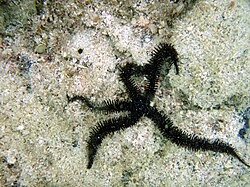
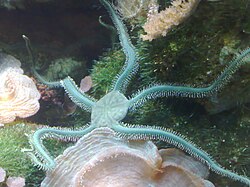
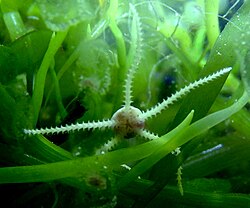
Brittle stars, also known as serpent stars or ophiuroids, are fascinating marine invertebrates belonging to the class Ophiuroidea. Named for their serpent-like arms (from the Greek óphis for serpent and ourá for tail), these echinoderms are distinct from their sea star cousins. While they share a similar radial symmetry, brittle stars are characterized by their highly flexible, whip-like arms and a central disk that houses most of their vital organs.
These creatures are master navigators of the seabed, using their arms to crawl across the ocean floor with surprising agility. With over 2,000 known species, they are among the most abundant echinoderms on Earth, inhabiting every major marine province from the frozen poles to the tropical reefs.
Key Facts
- Temporal Range: They have existed from the Early Ordovician period (488 million years ago) to the present.
- Diversity: Over 2,000 species exist, with more than 1,200 residing in deep waters (below 200 meters).
- Physicality: Most possess five slender arms that can reach up to 60 cm in length.
- Habitat: Found globally, including abyssal depths exceeding 6,000 meters and occasionally in brackish water.
- Defense: Capable of autotomy (shedding arms) to escape predators and regenerating them later.
Classification and Diversity
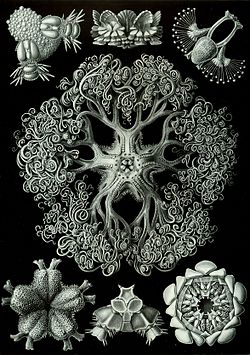
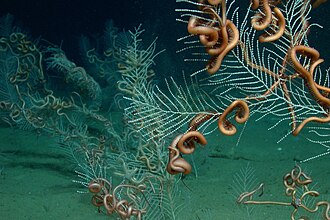
The class Ophiuroidea is divided into two primary clades: the Ophiurida (traditional brittle stars) and the Euryalida (basket stars). While brittle stars are often found hiding under rocks or within other organisms in reef communities, basket stars typically inhabit deeper waters and possess arms that are flexible in all directions, allowing them to create a complex web for feeding.
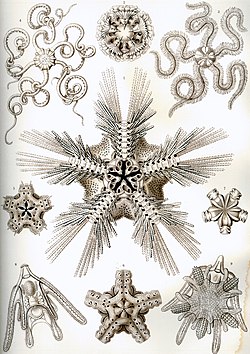
Taxonomically, they are grouped into approximately 270 genera across 16 families. Some families, such as the Amphiuridae (frail brittle stars), are highly species-rich, with 467 species known to live buried in sediment.
Anatomy and Biological Systems
The Musculoskeletal System
The skeleton of a brittle star is composed of calcium carbonate in the form of calcite. These ossicles (small bony plates) fuse to form a protective armor known as the test. The arms are supported by internal vertebral ossicles that articulate via ball-and-socket joints, providing the strength and flexibility needed for locomotion.
Water-Vascular and Nervous Systems
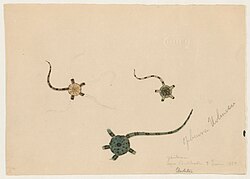
Like other echinoderms, ophiuroids utilize a water-vascular system ending in tube feet. Unlike sea stars, their tube feet lack suckers and ampullae. While most lack specialized eyes, they are highly sensitive to their environment. Their epidermis contains nerve endings that detect chemicals, touch, and light, allowing them to retreat into crevices when threatened.
Digestion and Feeding
The mouth is surrounded by five jaws and serves a dual purpose for both ingestion and egestion (acting as an anus). Digestion occurs in the stomach cavity, specifically within ten pouches or ceca. Most brittle stars are scavengers or detritivores, using their tube feet to move organic particles toward the mouth. Basket stars, however, are often suspension feeders, using mucus-coated arms to trap plankton and bacteria.
Reproduction and Life Cycle
Most species have separate sexes and utilize external fertilization, releasing gametes through genital bursae (pouches between the arms). However, some species exhibit fissiparity, a form of asexual reproduction where the central disk splits in half. For example, the West Indian brittle star (Ophiocomella ophiactoides) frequently reproduces this way, with a division cycle occurring roughly every 89 days.
Lifespan and Regeneration
Most brittle stars reach sexual maturity in two to three years and live up to five years, though some Euryalida species, such as Gorgonocephalus, may live significantly longer. One of their most remarkable traits is the ability to regenerate lost arm segments. Some members of the Amphiuridae family can even regenerate lost fragments of their gut and gonads.
Ecology and Behavior
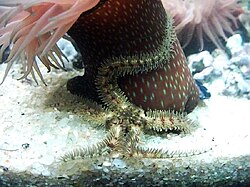
Brittle stars occupy a wide range of marine environments. Shallow-water species, such as the green brittle star (Ophioderma brevispina) and the common European brittle star (Ophiothrix fragilis), often live among sponges or coral. In the deep sea, the long-armed brittle star (Amphipholis squamata) is particularly widespread.
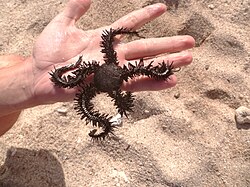
Interestingly, over 60 species are bioluminescent, typically emitting green or blue light to deter predators. This ability is found in both shallow and deep-sea varieties.
Fossil Record and Human Interaction
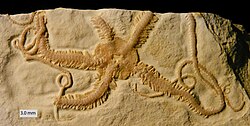
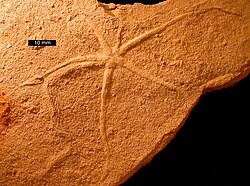
The fossil record for ophiuroids is challenging because their bodies tend to disarticulate after death. However, evidence dates back to the Early Ordovician. Notable finds include Ophiopetra lithographica from the Upper Jurassic of Germany and trace fossils known as Asteriacites.
Humans generally do not eat brittle stars due to their rigid skeletons, though they are non-toxic and non-venomous. In the hobby of marine fishkeeping, they are popular additions to saltwater tanks because they are active and generally do not threaten coral.
| Feature | Brittle Stars (Ophiurida) | Basket Stars (Euryalida) |
|---|---|---|
| Arm Flexibility | Primarily side-to-side | Flexible in all directions |
| Feeding Method | Scavenging / Detritivory | Suspension feeding |
| Typical Habitat | Diverse (Reefs to Abyssal) | Generally deeper waters |
| Arm Length | Up to 60 cm | Up to 60 cm |
Frequently Asked Questions
Are brittle stars the same as sea stars?
No. While both are echinoderms, brittle stars (Ophiuroidea) have a distinct central disk and highly flexible, whip-like arms, whereas sea stars (Asteroidea) have arms that blend more gradually into the central body and typically possess suckers on their tube feet.
Can brittle stars really grow their arms back?
Yes, ophiuroids can readily regenerate lost arms or arm segments. This is often a defense mechanism used to distract predators, allowing the animal to escape while the predator focuses on the discarded limb.
Are brittle stars dangerous to humans?
No, brittle stars are not venomous and are not known to be dangerous. They lack the toxins found in some other marine invertebrates and rely on camouflage or arm-shedding for protection.
How do brittle stars reproduce asexually?
Some species undergo fissiparity, where the central disk softens and splits in two. Each half then regenerates the missing portion of the disk and the necessary arms to become a complete individual.
Why are some brittle stars bioluminescent?
Bioluminescence, which usually appears as green or blue light, is believed to be a defense mechanism used to deter or confuse predators in the dark environments of the ocean.