British Guiana: The History and Evolution of a Colonial Territory
Before it became the modern state of Guyana, the region was known as British Guiana, a British colony that existed from 1831 to 1966. Its history is a complex tapestry of European competition, agricultural exploitation, and a long struggle for political self-determination. From its origins as a series of Dutch settlements to its eventual independence, the colony served as a critical hub for resource extraction in South America.
The territory was initially settled by the Dutch in the early 17th century, who established the colonies of Essequibo and Berbice, later adding Demerara in the mid-18th century. Through a series of conflicts during the Napoleonic Wars and diplomatic treaties, control shifted to Great Britain, which officially acquired the colonies in 1815.
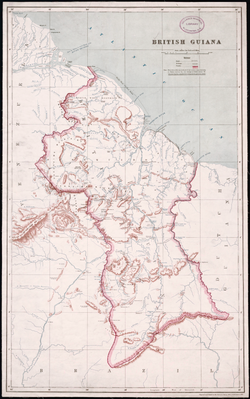
Key Facts
- Established: Consolidated into a single colony on July 21, 1831.
- Capital: Georgetown (formerly known as Stabroek).
- Primary Economy: Originally dominated by sugarcane; later diversified into rice, mining, and forestry.
- Independence: Gained independence from the United Kingdom on May 26, 1966.
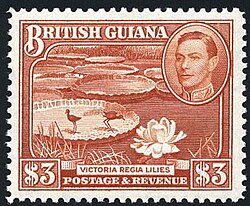
- Notable Asset: Home to the 1c magenta stamp, one of the world's rarest postage stamps.
The Path to Consolidation
The transition from Dutch to British rule was not immediate. While Britain first took over the colonies in 1796, they were briefly returned to the Batavian Republic in 1802 under the Treaty of Amiens. However, the resumption of the Napoleonic Wars led Britain to seize them again in 1803. The 1814 Anglo-Dutch Treaty finally ceded the territories to the United Kingdom.
For several years, the British managed the areas separately. In 1822, Essequibo and Demerara were combined, and by 1831, Berbice was added to the union, creating the colony of British Guiana.
Economy and Social Structure
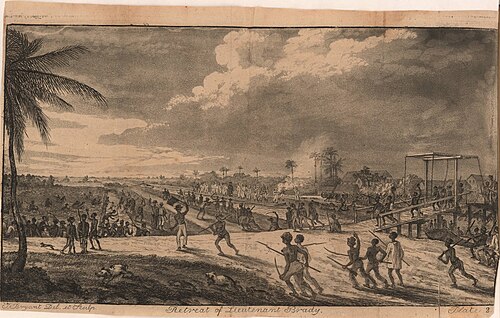
The colonial economy was built upon the cultivation and processing of sugarcane. This industry relied heavily on the labor of enslaved people, primarily of sub-Saharan African descent. Much of the wealth generated by these plantations flowed to absentee owners residing in British cities like Liverpool and Glasgow.
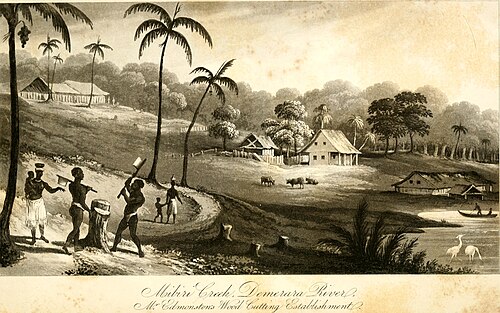
Following the emancipation of enslaved people in the 1830s, the colony faced a labor shortage. Between 1850 and 1920, the British recruited indentured workers—laborers bound by contract—from India. This migration significantly altered the colony's demographics and led to the collapse of the traditional Indian caste system within the territory.
Economic Diversification
By the 1880s, falling sugar prices forced the economy to evolve. The colony shifted toward rice farming, forestry, and mining. Gold and diamond deposits were discovered during this era, including a stone believed to be the world's largest diamond in 1922, though these minerals did not provide the same consistent revenue as agriculture.
Infrastructure and Transport
To support the sugar and mining industries, the British developed a railway system. The first lines opened in 1848, featuring a 98 km standard gauge line from Georgetown to Rosignol and a 31 km line between Vreed en Hoop and Parika. Various narrow-gauge lines were also constructed to serve bauxite mines and sugar estates.
Political Administration and the Road to Independence
For much of its history, British Guiana maintained Dutch-style governance. A Court of Policy handled legislative and executive duties, while a College of Kiezers (an electoral college of wealthy landowners) selected members. This system ensured that sugar planters dominated political power.
Reform began in earnest after the 1938 Moyne Commission investigated social and economic unrest in the Caribbean. By 1943, the Legislative Council became more elective, and restrictions on women and clergy were removed.
The Constitutional Crisis of 1953
The 1953 elections saw the People's Progressive Party (PPP) win 18 of 24 seats. Fearing the PPP's ties to communist organizations, the British government suspended the constitution and militarily occupied the colony on October 9, 1953, imposing direct rule until 1957.
By 1961, British Guiana achieved self-governance in internal affairs, though Britain retained control over defense and external matters. However, racial and social conflicts between 1962 and 1964 delayed full independence. To prevent a PPP majority, Britain introduced a proportional representation system for the 1964 elections. This resulted in a coalition government between the People's National Congress (PNC) and the United Force (UF).
Territorial Disputes
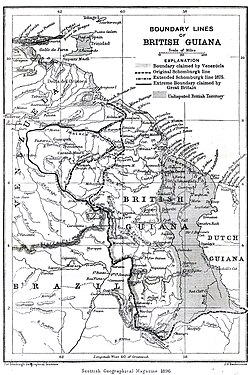
British Guiana was plagued by boundary disputes with its neighbors. The western border with Venezuela was the subject of a major crisis in 1895. An 1899 arbitration tribunal in Paris awarded 94% of the disputed land to British Guiana. However, Venezuela renewed its claim in 1962, alleging the award was the result of a secret deal between Britain and Russia—a claim the British and Guyanese governments rejected.
To the east, a dispute arose with the Dutch colony of Suriname over the source of the Courantyne River. This led to a disagreement over the "New River Triangle," a region claimed by Suriname but held by British Guiana.
Summary of Colonial Profile
| Category | Details |
|---|---|
| Official Language | English (Vernacular: Guyanese Creole) |
| Monarchs | William IV to Elizabeth II |
| Area (1924) | 231,800 km² |
| Population (1924) | 307,391 |
| Currencies | Spanish dollar, British Guiana dollar, British West Indies dollar, East Caribbean dollar |
Frequently Asked Questions
When did British Guiana become independent?
British Guiana became the independent nation of Guyana at midnight on May 26, 1966.
What was the primary economic driver of the colony?
The economy was primarily based on the cultivation and processing of sugarcane, though it later diversified into rice, gold, diamonds, and bauxite mining.
Who were the indentured workers in British Guiana?
Indentured workers were laborers recruited from India between 1850 and 1920 to work on plantations following the emancipation of enslaved Africans.
Why did the British suspend the constitution in 1953?
The British government suspended the constitution and occupied the colony because they feared the People's Progressive Party (PPP), which had won the elections, was too closely aligned with communist organizations.
What is the significance of the 1c magenta stamp?
The 1c magenta is a unique postage stamp from 1856 that is among the rarest and most expensive in the world, selling for US$9.5 million in 2014.