British Army Rank Insignia: History, Structure, and Protocol
The system of rank insignia in the British Army serves as a visual language, allowing personnel to immediately identify the authority and responsibility of an officer. From the intricate gold bullion of ceremonial uniforms to the discreet cloth slides of modern working dress, these symbols have evolved over centuries to meet the changing needs of the battlefield and the barracks.
While the general principles of rank apply across the entire British Army, subtle variations in design and color exist between different regiments, requiring a keen eye to distinguish them all.
Key Facts
- Field Marshal is now an honorary rank; the last active promotion occurred in 1994.
- Subalterns is the collective term for Lieutenants and Second Lieutenants.
- Field Officers include Majors, Lieutenant Colonels, Colonels, and Brigadiers.
- General Officers encompass all ranks above Brigadier.
- Rank placement shifted from sleeves to collars in 1855, and then to shoulders in 1880.
The Hierarchy of Officer Ranks
The British Army organizes its officers into distinct groups based on their level of command and responsibility. These are aligned with NATO codes to ensure interoperability with allied forces.
Junior and Company Officers
At the foundational level are the junior officers, often called subalterns (Second Lieutenants and Lieutenants). Together with Captains, they are known as company officers. These officers typically lead small units, such as platoons or troops, and progress through their ranks based on commissioned service time.
Field Officers
Field officers—Majors, Lieutenant Colonels, Colonels, and Brigadiers—manage larger formations. A Lieutenant Colonel typically serves as the Commanding Officer of a regiment or battalion, while a Brigadier commands a brigade.
General Officers
The highest tier consists of General officers, including Major-Generals, Lieutenant-Generals, Generals, and Field Marshals. These officers hold strategic appointments, such as Division or Army commanders, and the Chief of the General Staff (CGS).
| Rank Group | Rank | NATO Code | Typical Appointment |
|---|---|---|---|
| General Officers | General | OF-9 | Chief of the General Staff / Army Group Commander |
| General Officers | Lieutenant-general | OF-8 | Army or Corps Commander |
| General Officers | Major-general | OF-7 | Division Commander |
| Field Officers | Brigadier | OF-6 | Brigade Commander |
| Field Officers | Colonel | OF-5 | Staff Officer / Medical Corps Field Command |
| Field Officers | Lieutenant colonel | OF-4 | Regiment / Battalion Commanding Officer |
| Field Officers | Major | OF-3 | Squadron / Battery / Company Officer Commanding |
| Junior Officers | Captain | OF-3 | Squadron / Battery / Company 2IC |
| Junior Officers | Lieutenant | OF-2 | Troop / Platoon Commander |
| Junior Officers | Second lieutenant | OF-1 | Troop / Platoon Commander |
Visual Identification and Insignia
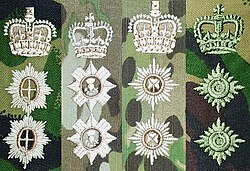
Modern rank insignia are typically worn as cloth slides on the chest for daily working dress, while ceremonial uniforms utilize epaulettes (ornamental shoulder pieces) with metal clips or cloth slides.
A notable distinction exists within the Guards regiments. While most army officers use the Bath star, Guards officers use specific stars based on their regiment: the Grenadier, Coldstream, and Welsh Guards use the Garter star; the Scots Guards use the Thistle star; and the Irish Guards use the Shamrock star.
Motor Car Insignia and Protocol
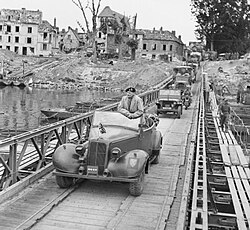
High-ranking officers use specific markers for recognition when on official duties. Star plates are used to denote rank on the vehicle, while car flags (typically 9 x 6 inches) are flown from the bonnet. Only Field Marshals have a permanent assigned rank flag, which is the Union Flag.
General officers and Brigadiers in command of a formation may fly a designated flag or pennant. These are not used on long journeys but are hoisted upon approaching a destination. Use of these flags in foreign Commonwealth countries requires permission from the British ambassador or high commissioner.
Evolution of Rank Badges
The history of British Army insignia is a journey from sleeve laces to shoulder slides. Before 1767, there were no definite badges for general officers; they were instead distinguished by chevron-shaped lace patterns on their sleeves.
Significant changes occurred in the 19th century. In 1810, specific devices were introduced for field officers: the Crown and Garter star for Colonels, the Crown for Lieutenant Colonels, and the Garter star for Majors. By 1855, following the Crimean War, the War Office abolished epaulettes in favor of collar badges, creating the first complete set of rank badges for the army.
In 1880, these badges moved from the collar to the shoulder. During World War I, officers began moving badges back to the shoulder from the cuffs to avoid being targeted by snipers—a practice that became permanent in 1920.
The rank of Brigadier also saw a complex evolution. The rank of Brigadier-General was abolished in 1921 and replaced by titles like Colonel Commandant. However, due to prestige issues—particularly with military attachés and personnel in India—the rank of Brigadier was formally reinstated in 1928.
Frequently Asked Questions
What is the difference between a subaltern and a company officer?
A subaltern is specifically a Lieutenant or Second Lieutenant. Company officers is a broader term that includes subalterns as well as Captains.
Is the rank of Field Marshal still active?
No, Field Marshal is currently an honorary rank. The last active officer to be promoted to this rank was in 1994.
Why do some officers wear different types of stars?
Different stars are used to denote regimental affiliation, particularly in the Guards. For example, the Scots Guards use the Thistle star, while the Irish Guards use the Shamrock star.
Where are rank insignia worn on modern uniforms?
On modern daily working dress, insignia are usually worn as cloth slides on the chest. On ceremonial or parade uniforms, they are worn on the epaulettes.
Who is allowed to fly the Union Flag as a car flag?
In the British Army, only Field Marshals have the Union Flag as their assigned rank flag.