Bornean Bristlehead: The Enigmatic Bird of the Rainforest Canopy
The Bornean bristlehead (Pityriasis gymnocephala) is one of the most unusual avian species in the world. Also known as the bristled shrike, bald-headed crow, or bald-headed wood-shrike, this bird is the sole member of both its genus, Pityriasis, and its family, Pityriasidae. Endemic to the island of Borneo, this vulnerable species spends its life navigating the high canopies of the rainforest in small, social groups.
Key Facts
- Scientific Name: Pityriasis gymnocephala
- Conservation Status: Vulnerable (IUCN 3.1)
- Habitat: Endemic to Borneo's lowland and hilly forests
- Distinctive Feature: A yellow, featherless crown with bristle-like skin projections
- Diet: Primarily large insects, arthropods, and small vertebrates
- Social Structure: Moves in small, noisy flocks of up to 10 birds
Taxonomy and Classification
The taxonomic placement of the Bornean bristlehead has long been a subject of scientific debate. Due to its unique characteristics, researchers have previously attempted to classify it within several different families, including the Corvidae (crows), Cracticidae, Artamidae, and Prionopidae. More recent studies have suggested a relationship with the Tephrodornithidae, a family that includes Hemipus and Tephrodornis.
Physical Description
Measuring approximately 25 cm (9.8 in) in length, the Bornean bristlehead is a chunky, medium-sized bird. Its plumage is predominantly black, contrasted by bright red thighs, throat, neck, and head. It features grey ear-coverts and a massive, heavy black hooked bill. One of its most striking features is the deep yellow, featherless crown. This area is covered in short, 3–4 mm bristle-like skin projections, which give the bird its common name and its genus name, Pityriasis (Greek for "having dandruff"), and species name, gymnocephala (Greek for "bald-headed").
While all females and some males possess red flank patches, these are often hidden by the wings when the bird is perched. In flight, a white wing-patch at the base of the primaries becomes visible. Juveniles differ from adults, exhibiting mostly black thighs, orange-red head and neck, and undeveloped bristles on the crown.
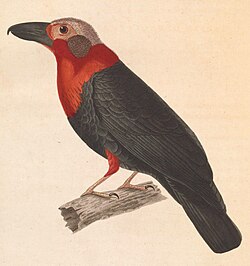
The species is highly vocal, producing a wide array of unmusical sounds. Their repertoire includes high-pitched nasal whining, chattering, whistles, honks, chortles, and harsher notes.
Distribution and Habitat
The Bornean bristlehead is found exclusively on the island of Borneo. While widespread across the island, its occurrence is often sparse and patchy. It primarily inhabits lowland areas but can be found in hilly regions up to 1,200 m (3,900 ft) above mean sea level. Its preferred habitats include the canopies of primary and secondary forests, as well as mangrove forests, mixed dipterocarp forests, and peat swamp forests.
Behavior and Diet
This is a sociable bird that typically moves in garrulous flocks of up to 10 individuals. These groups often join mixed-species feeding flocks, associating with other forest birds such as hornbills, woodpeckers, trogons, drongos, babblers, and malkohas. Their movement through the canopy is characterized as slow and heavy, utilizing a fast, shallow wing-beat during flight.
The bristlehead is primarily insectivorous, feeding on large insects and other arthropods. It also hunts small vertebrates, including frogs and lizards, gleaning prey from trunks, branches, twigs, and foliage. Occasionally, the species supplements its diet with fruit.
Breeding and Life Cycle
Much of the bristlehead's breeding behavior remains a mystery. However, records describe an oviduct egg that is white with grey and brown spots, measuring 31 x 25 mm. Some evidence suggests communal breeding, based on sightings of two females feeding a single fledgling. Additionally, individuals have been observed carrying nesting materials in flight.
Conservation Status
The Bornean bristlehead is currently classified as Vulnerable. The primary threat to its survival is the rapid loss of lowland forests in Borneo, which are disappearing at an estimated rate of 2.5% per year (based on 2015–2020 data). This habitat loss is driven by deforestation and the burning of peat swamp forests. Although the species exists within protected areas, illegal logging continues to threaten these refuges.
| Feature | Details |
|---|---|
| Average Length | c. 25 cm (9.8 in) |
| Primary Habitat | Borneo rainforest canopy (up to 1,200 m) |
| Diet | Insects, arthropods, small vertebrates, occasional fruit |
| Social Unit | Flocks of up to 10 birds |
| Conservation Status | Vulnerable |
Frequently Asked Questions
Why is the bird called a "bristlehead"?
The name comes from the short, 3–4 mm bristle-like skin projections that cover its deep yellow, featherless crown, giving it a bald appearance from a distance.
Where can the Bornean bristlehead be found?
It is endemic to the island of Borneo, where it lives in the mid and upper canopies of primary and secondary forests, including peat swamps and mangroves.
What do Bornean bristleheads eat?
They primarily eat large insects and arthropods, as well as small vertebrates like lizards and frogs, which they glean from the forest canopy. They occasionally eat fruit.
Why is this species considered vulnerable?
The species is vulnerable due to ongoing deforestation and the burning of peat swamp forests in Borneo, with lowland forests being lost at a rate of approximately 2.5% annually.
Is the Bornean bristlehead related to crows?
While it has been placed in the Corvidae (crow) family in the past, its taxonomic relationship has been controversial. It is currently the only member of its own family, Pityriasidae.