Blu-ray Disc Technology: Evolution, Specifications, and Standards
The Blu-ray Disc (BD) is a high-density optical disc format designed to succeed the DVD. Released on June 20, 2006, it was developed through a collaboration between Sony, Panasonic, Philips, Pioneer Corporation, and the Blu-ray Disc Association. By utilizing a shorter wavelength laser, Blu-ray provides significantly higher storage capacities, making it the primary medium for high-definition video, high-resolution audio, and modern gaming consoles.
Unlike its predecessors, the data side of a Blu-ray disc typically exhibits a distinct blue hue, reflecting the specific laser technology used to read and write its surface.

Key Facts
- Laser Technology: Uses a 405 nm blue-violet diode laser for reading and writing.
- Storage Capacity: Ranges from 25 GB (single-layer) up to 128 GB (BDXL quadruple-layer).
- Video Support: Supports HD (1080p) and 4K UHD resolutions.
- Audio Quality: Compatible with lossless formats like Dolby TrueHD and DTS-HD Master Audio.
- Physical Dimensions: Standard discs are 120 mm in diameter and 1.20 mm thick.
Technical Specifications and Architecture
Laser and Optics
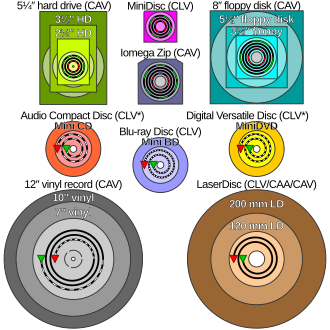
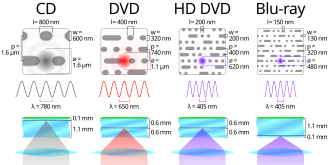
The core innovation of the Blu-ray Disc is the use of a 405 nm diode laser. This shorter wavelength allows the laser to focus on smaller pits and lands, enabling a much higher data density than the red lasers used in DVDs. For writing data, a focused beam with higher power is employed.
Storage Capacity and Media Types
Blu-ray discs are available in several configurations to balance cost and capacity. The standard single-layer disc holds 25 GB, while dual-layer discs provide 50 GB or 66 GB. The BDXL (Blu-ray Disc Extra Large) standard extends this further, offering 100 GB (triple-layer) and 128 GB (quadruple-layer) options.

Beyond standard sizes, mini Blu-ray discs (8 cm) are available, offering 7 GB for single-layer and 15 GB for dual-layer storage.
Drive Performance and Speeds
Data transfer rates are measured in multiples of the base speed (1×), which is 36 Mbit/s (4.5 MB/s). Higher speed drives can reach up to 16×, delivering data at 576 Mbit/s (72 MB/s).

Video and Audio Standards
Video Encoding and Resolution
Blu-ray supports a wide array of codecs to ensure high-quality playback. Standard HD discs typically use H.264/MPEG-4 AVC, VC-1, or H.262/MPEG-2. The Ultra HD Blu-ray extension introduces H.265/HEVC to support 4K resolution (3840 × 2160p) at frame rates up to 60 fps.

Audio Formats
The format supports both compressed and lossless audio. High-fidelity options include LPCM (uncompressed), Dolby TrueHD, and DTS-HD Master Audio, with maximum bitrates reaching up to 24.5 Mbit/s for certain lossless formats.
Advanced Features
- Blu-ray 3D: Supports stereoscopic 3D content.
- BD-Live: Allows players to connect to the internet for bonus content and updates.
- BD-J: A Java-based software interface used for interactive menus and applications.

Data Integrity and Content Protection
To prevent unauthorized copying, Blu-ray employs several layers of Digital Rights Management (DRM). This includes High-bandwidth Digital Content Protection (HDCP) and the Advanced Access Content System (AACS), which uses a complex decryption process to verify player keys.
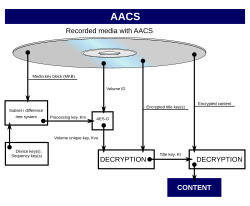
Additionally, the BD+ system can execute native code to patch insecure systems and verify that player keys remain unchanged.
Regional and Physical Standards
Blu-ray discs are divided into three geographical regions (A, B, and C) to control distribution, though some discs are released as "Region Free." Physically, discs are often housed in blue-tinted cases to distinguish them from DVDs.
![Regions for the Blu-ray Disc standard:[204] Region A/1 Region B/2 Region C/3](/images/f7/8b/f78bada95e2884a693f07e557fb4c2ded4241816c3ebcf3dcbcc48d1bc3461cd.webp)

Summary of Blu-ray Disc Variants
| Type | Diameter (cm) | Layers | Capacity (Bytes) |
|---|---|---|---|
| Standard Single Layer | 12 | 1 | 25,025,314,816 |
| Standard Dual Layer | 12 | 2 | 50,050,629,632 |
| BDXL 3 Layer | 12 | 3 | 100,103,356,416 |
| BDXL 4 Layer | 12 | 4 | 128,001,769,472 |
| Mini Single Layer | 8 | 1 | 7,791,181,824 |
| Mini Dual Layer | 8 | 2 | 15,582,363,648 |
Frequently Asked Questions
What is the difference between a standard Blu-ray and BDXL?
A standard Blu-ray disc typically holds 25 GB or 50 GB. BDXL is an extended specification that allows for triple-layer (100 GB) and quadruple-layer (128 GB) discs, providing significantly more storage for data and high-resolution video.
What laser wavelength does Blu-ray use?
Blu-ray uses a 405 nm blue-violet diode laser, which has a shorter wavelength than the red lasers used in DVDs, allowing for tighter focus and higher data density.
Can Blu-ray discs store more than just movies?
Yes. Blu-ray is used for high-resolution audio (such as High Fidelity Pure Audio), large-scale data storage, and as the primary game medium for consoles like the PlayStation 3, PlayStation 4, Xbox One, and Xbox Series X.
What is Ultra HD Blu-ray?
Ultra HD Blu-ray is an extension of the Blu-ray format that supports 4K resolution (3840 × 2160p) and utilizes the H.265/HEVC codec for superior image quality compared to standard HD Blu-ray.
How does region coding work on Blu-ray?
The world is divided into three regions: Region A, Region B, and Region C. A disc coded for one region will generally only play on players assigned to that same region, unless the disc or player is "Region Free."