Black Hills Expedition: The Role of Bloody Knife and George Armstrong Custer
In 1874, the United States launched the Black Hills Expedition, a massive military and scientific venture into the rugged terrain of the Black Hills. This expedition comprised over a thousand personnel, including infantry, cavalry, geologists, miners, and reporters. Crucial to the mission's success were sixty-five Arikara scouts—indigenous guides whose knowledge of the land and tracking skills were indispensable to the military command.
Among these scouts was a man known as Bloody Knife, whose relationship with Lieutenant Colonel George Armstrong Custer would define much of the expedition's interpersonal dynamics. The mission took place against a backdrop of intense tribal conflict, as the Arikara sought retribution after a Sioux attack on their village at Fort Berthold, which had resulted in the deaths of five Arikaras and one Mandan, including one of Bloody Knife's sons.
Key Facts
- Expedition Size: Over 1,000 men, including 65 Arikara scouts.
- Primary Objective: Exploration of the Black Hills involving geologists and military forces.
- Key Figures: George Armstrong Custer and the scout Bloody Knife.
- Conflict: Tensions existed between the Arikara scouts and the Oglala Sioux.
- Financial Reward: Bloody Knife received a monthly salary of $75 and a $150 bonus for his assistance.
Tensions and Scouting Missions
Driven by the desire to avenge their fallen kin, many Arikara scouts entered the Black Hills prepared for war, adorning themselves and their horses with war paint and singing war songs. However, Custer maintained a strict policy: scouts were forbidden from attacking the Sioux unless they were fired upon first.
During one scouting mission, Bloody Knife and twenty-five other Arikaras located a small camp of five lodges. After waiting for Custer and his interpreter, Louis Agard, to arrive, the group discovered that the camp consisted of only twenty-seven Oglala Sioux. These individuals were hunting and cutting lodgepoles, intending to return to the Red Cloud Agency 100 miles to the south. Unaware of the military presence, all but one of the Oglala fled as the scouts approached.
The Grizzly Bear Encounter
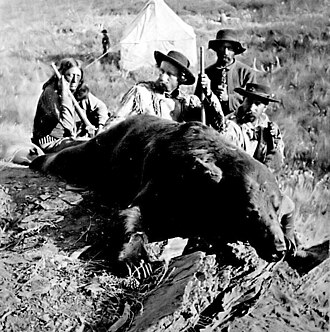
On August 7, 1874, the expedition encountered a grizzly bear approximately seventy-five yards from Custer's intended campsite. Custer, who had long dreamed of killing such a beast, used his Remington rifle to shoot the bear in the thigh. Bloody Knife and Captain William Ludlow assisted in completing the kill.
The animal was an 800-pound (360 kg) old male, characterized by broken teeth and a body covered in scars. While Custer claimed credit for the kill, historical accounts vary; some suggest Bloody Knife fired the fatal shot, and the 2002 biography The Custer Companion asserts that Bloody Knife delivered the coup de grâce (a final blow to end suffering) by cutting the bear's jugular vein.
Conflict and Reconciliation
The expedition was not without internal strife. When several wagons became stuck at a bank, a scout named Charley Reynolds blamed Bloody Knife for the delay. In a fit of anger, Custer drew his revolver and fired shots toward the two scouts, forcing them to take cover behind trees.
Following the incident, Bloody Knife confronted Custer, stating that if he had been possessed by the same "madness," Custer would not have survived the day. Custer apologized, attributing his actions to the "madness of the moment," and the two reconciled with a handshake.
Compensation and Discharge
Bloody Knife's value to the expedition was reflected in his pay. While standard Indian scouts earned $13 per month—the same as the regular troops—Custer secured a position for Bloody Knife as a guide for the quartermaster. This role paid $75 per month, which is approximately $2,100 in modern currency.
Bloody Knife was discharged from service on November 30, 1874. In recognition of his "invaluable assistance" throughout the Black Hills Expedition, he was awarded an additional payment of $150.
| Category | Details |
|---|---|
| Total Personnel | 1,000+ (Infantry, Cavalry, Geologists, Miners, Reporters) |
| Arikara Scouts | 65 individuals |
| Sioux Encountered | 27 Oglala Sioux |
| Grizzly Bear Weight | 800 lbs (360 kg) |
| Bloody Knife's Monthly Pay | $75 (as Quartermaster Guide) |
| Bloody Knife's Bonus | $150 |
Frequently Asked Questions
Who was Bloody Knife?
Bloody Knife was an Arikara scout who provided invaluable guidance and scouting services to George Armstrong Custer during the 1874 Black Hills Expedition.
Why were the Arikara scouts hostile toward the Sioux?
The Arikara sought revenge after a Sioux attack on their village at Fort Berthold, which killed five Arikaras and one Mandan, including Bloody Knife's son.
How did the encounter with the Oglala Sioux end?
Despite fears of thousands of warriors, the scouts found only twenty-seven Oglala Sioux. All but one of the Oglala fled when approached by the scouts and interpreter Louis Agard.
Who actually killed the grizzly bear?
While Custer took official credit after shooting the bear in the thigh, some believe Bloody Knife fired the fatal shot or delivered the final blow to the jugular vein.
How much was Bloody Knife paid for his services?
He earned $75 per month as a guide for the quartermaster and received a final bonus of $150 upon his discharge on November 30, 1874.