Bernhard von Bülow: The Architect of Germany's Weltpolitik
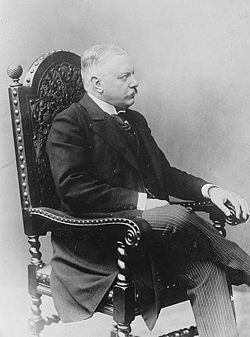
Bernhard von Bülow was a pivotal figure in the early 20th century, serving as the Imperial Chancellor of the German Empire and the Minister-President of Prussia from 1900 to 1909. A sophisticated diplomat and ambitious politician, Bülow sought to elevate Germany from a continental power to a global hegemon. While his tenure saw significant economic growth and scientific advancement, his aggressive approach to foreign policy left a legacy of international tension that contributed to the onset of World War I.
Bülow's political philosophy was centered on Weltpolitik (World Policy), a strategic ambition to transform Germany into a global power through naval expansion and colonial acquisition. This shift in direction marked a departure from the more cautious diplomacy of the Bismarck era, aiming instead for a "place in the sun" for the German Empire.
Key Facts
- Role: Imperial Chancellor of Germany and Minister-President of Prussia (1900–1909).
- Core Strategy: Championed Weltpolitik to establish Germany as a global superpower.
- Key Alliance Impact: His bellicose policies alienated Great Britain, France, and Russia.
- Naval Policy: Supported Admiral Tirpitz's naval expansion to challenge British maritime dominance.
- Later Life: Served as interim ambassador to Italy (1914–1915) during the early stages of WWI.
Early Life and Diplomatic Ascent
Born on May 3, 1849, in Klein-Flottbeck, Duchy of Holstein, Bernhard Heinrich Karl Martin von Bülow was groomed for diplomacy. His father served as State Secretary for Foreign Affairs under Otto von Bismarck, providing Bülow with an entry point into the diplomatic corps. His early career was characterized by a series of postings to major European capitals, including Rome, St. Petersburg, Vienna, and Athens.
By 1876, Bülow was an attaché in Paris and later a secretary at the Congress of Berlin. His time in St. Petersburg as first secretary and chargé d'affaires (a diplomat who temporarily heads a diplomatic mission) revealed a complex personality; while Bismarck admired his calm demeanor, colleagues often viewed him as a schemer. During his Russian tenure, he advocated for the ethnic cleansing of Poles from German territories in the event of future conflict.
Strategic Marriage and Career Maneuvering
Bülow's personal life was often intertwined with his professional ambitions. In 1886, he married Maria Beccadelli di Bologna, a well-connected Italian princess and pupil of Franz Liszt. This marriage was strategically intended to further his career, eventually helping him secure the prestigious appointment as ambassador to Rome in 1893, a post he coveted for years due to his wife's social connections.
The Chancellorship and Global Ambitions
Bülow rose to the position of State Secretary for Foreign Affairs in 1897 before becoming Imperial Chancellor on October 17, 1900, under Emperor Wilhelm II. His administration was defined by a desire to project German power on a global scale.
Naval Expansion and the British Rift
To support his global vision, Bülow encouraged Admiral Alfred von Tirpitz's policy of massive naval expansion. He believed that a powerful navy would not only secure colonies but also serve a domestic purpose: by appealing to nationalistic emotions, he hoped to steer the working class away from Social Democracy and toward the monarchical order.
However, this strategy backfired. By challenging British naval supremacy, Bülow inadvertently pushed Great Britain closer to France and Russia, creating a diplomatic encirclement of Germany that would prove fatal in 1914.
Domestic Scandals and Political Decline
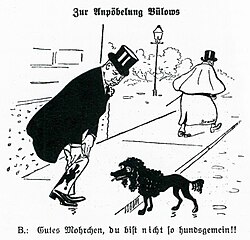
Bülow's tenure was not without controversy. In 1907, he became entangled in the Harden–Eulenburg Affair. He was accused by Adolf Brand of engaging in homosexual practices—which were illegal under Paragraph 175 of the German penal code—and being subject to blackmail. Although Bülow prevailed in court and Brand was imprisoned for slander, the scandal tarnished his public image.
His political standing further eroded following the "Daily Telegraph Affair," eventually leading to his resignation on July 14, 1909. He was succeeded by Theobald von Bethmann Hollweg.
Final Years and Wartime Diplomacy
After resigning, Bülow retired to Rome. However, the outbreak of World War I brought him back into the political fray. In 1914, he served as the interim ambassador to Italy. His primary mission was to persuade King Victor Emmanuel III to align Italy with the Central Powers.
Bülow's efforts were unsuccessful. Italy, despite being part of the Triple Alliance, found the Austro-Hungarian ultimatum to Serbia provocative. Following internal political shifts and popular demonstrations in Rome, Italy declared war on Austria-Hungary on May 23, 1915. Bülow left Rome the following day, privately criticizing the German political leadership as "Z-Minus" while praising the morale of the German people as "A-1." He died in Rome on October 28, 1929, at the age of 80.
Summary of Political Career
| Office | Tenure | Key Focus/Outcome |
|---|---|---|
| State Secretary for Foreign Affairs | 1897–1900 | Preparation for Imperial Chancellorship |
| Imperial Chancellor | 1900–1909 | Implementation of Weltpolitik and naval growth |
| Minister-President of Prussia | 1900–1909 | Domestic administration of the Prussian state |
| Ambassador to Italy | 1914–1915 | Failed attempt to keep Italy in the Central Powers |
Frequently Asked Questions
What was Weltpolitik?
Weltpolitik, or "World Policy," was the strategic aim of the German Empire under Bernhard von Bülow to transform Germany into a global power through the acquisition of colonies and the expansion of the Imperial Navy.
How did Bülow's policies affect the start of World War I?
His aggressive foreign policy and naval buildup alienated Great Britain, France, and Russia, contributing to the formation of the Triple Entente and increasing the international tensions that led to the war.
What was the Harden–Eulenburg Affair?
It was a political scandal involving allegations of homosexuality among members of Emperor Wilhelm II's inner circle. Bülow was accused of being blackmailed due to his own alleged practices, though he successfully sued for slander.
Why did Bülow fail as an ambassador to Italy in 1914?
He was unable to overcome Italy's objections to Austria-Hungary's aggressive actions in the Balkans and the internal Italian political pressure to join the Allied powers for territorial compensation.
Who succeeded Bülow as Chancellor?
Theobald von Bethmann Hollweg succeeded Bernhard von Bülow as Imperial Chancellor in July 1909.