Bergenia: The Hardy and Versatile Elephant's Ears
Whether you are looking for a resilient groundcover or a striking evergreen accent for your garden, Bergenia is an exceptional choice. Known by several descriptive common names, including "elephant's ears" due to its leaf shape and "pigsqueak" because of the sound produced when its leaves rub together, this genus offers a blend of architectural foliage and vibrant spring blooms.
Belonging to the Saxifragaceae family, Bergenia consists of ten species of flowering plants native to the diverse landscapes of central Asia, stretching from Afghanistan to China and across the Himalayan region. These plants are prized by gardeners for their ability to thrive in challenging conditions while providing year-round visual interest.
Key Facts
- Common Names: Elephant's ears, pigsqueak, and large rockfoil.
- Native Range: Central Asia, including China, Afghanistan, and the Himalayas.
- Hardiness: Extremely resilient, surviving temperatures from -35°F (-37°C) to 115°F (46°C).
- Foliage: Evergreen, leathery leaves that can turn red or bronze in cold weather.
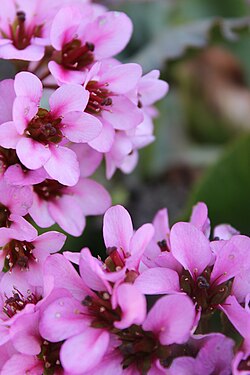
- Flowers: Pink to ruby red blooms produced in a cyme (a flat-topped or convex flower cluster).
- Growth Habit: Clump-forming and rhizomatous, meaning they spread via underground stems.
Botanical Characteristics
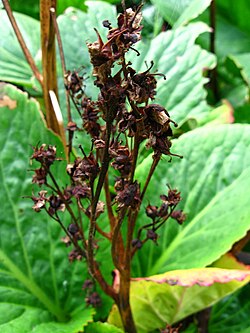
Bergenia plants are evergreen perennials that grow in a spirally arranged rosette. Their leaves are a standout feature: large, leathery, and either ovate (egg-shaped) or cordate (heart-shaped), typically measuring 6–35 cm in length and 4–15 cm in width. While they remain a glossy green for most of the year, those grown in cooler climates often transition to stunning shades of red or bronze during the autumn.
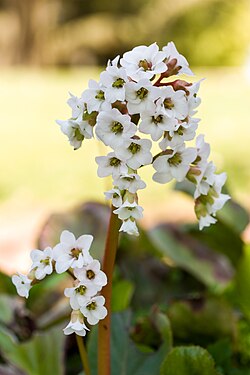
The flowering process is equally distinctive. The blooms emerge on stems that resemble rhubarb stalks, supporting cone-shaped flowers. These blossoms appear in various shades of pink, ranging from nearly white to deep ruby red and purple. The genus was named in 1794 by Conrad Moench to honor the German physician and botanist Karl August von Bergen.
Species and Varieties
There are ten accepted species within the Bergenia genus, each with unique regional distributions and characteristics. One of the most prominent is Bergenia crassifolia (often synonymized with Bergenia cordifolia), which is the most widely grown garden variety. This species typically grows to about 30 cm tall and is celebrated for its winter-hardy leaves that shift toward rust-brown or brown-red hues.
Other notable species include:
- Bergenia purpurascens: Reaching 30–40 cm in height, it features carmine-red flowers and oval leaves. Its variety, delavayi, can grow up to 50 cm with rosy red flowers.
- Bergenia ciliata: Native to the western Himalayas and southwestern Nepal, known for the cultivar 'Superba'.
- Bergenia stracheyi: Found from eastern Afghanistan to Nepal, with cultivars such as 'Alba' and 'Afghanica'.
- Regional Species: Other species are localized to specific regions, such as B. emeiensis and B. tianquanensis in China, and B. hissarica and B. ugamica in Uzbekistan.
Cultivation and Garden Care
Bergenia is highly adaptable and robust. While these plants prefer full sun, they are equally capable of growing in shady areas. They generally reach a maximum size of 24 inches (61 cm) in both height and width.
For optimal growth, moist, humus-rich soil is preferred. While they can survive in most soil types, very dry soil or excessive exposure may stunt their growth, although this can sometimes intensify the red winter colors of the foliage. In regions with harsh, cold winter winds, providing some shelter is recommended. Propagation is straightforward, achieved through division or by planting rooted sections of the rhizome.
Many cultivars have earned the Royal Horticultural Society's (RHS) Award of Garden Merit, including 'Bressingham White', 'Eroica', 'Claire Maxine', and 'Wintermärchen'.
Pests, Diseases, and Medicinal Uses
Bergenia is generally a low-maintenance plant and free from major diseases. The primary pest concern is the adult vine weevil, which feeds on the edges of the leaves. This creates a "notched" or indented outline that, while not fatal to the plant, can diminish its aesthetic appeal.
Beyond the garden, certain species have significant medicinal value. Bergenia ciliata, Bergenia ligulata, and the rhizomes of Bergenia stracheyi contain chemical compounds known as bergenin (a C-glycoside of 4-O-methyl gallic acid) and norbergenin. In Ayurveda, these are known as Paashaanbhed and are recognized for their potent immunomodulatory effects, which help regulate the immune system.
Bergenia Quick Reference Guide
| Feature | Details |
|---|---|
| Family | Saxifragaceae |
| Temperature Tolerance | -35°F to 115°F (-37°C to 46°C) |
| Leaf Type | Evergreen, leathery, cordate or ovate |
| Flower Color | White, pink, ruby red, purple |
| Preferred Soil | Moist, humus-rich |
| Primary Pest | Vine weevils |
Frequently Asked Questions
Why is Bergenia called "pigsqueak"?
It is called pigsqueak because of the distinct sound produced when two of its thick, leathery leaves are rubbed together.
Can Bergenia grow in the shade?
Yes. While Bergenia prefers sunny locations, it is versatile and will grow well in shady areas of the garden.
How do I propagate Bergenia plants?
Bergenia can be propagated through division of the plant or by using rooted sections of the rhizome (the underground stem).
What causes the leaves of my Bergenia to look notched?
This is typically caused by adult vine weevils, which eat the edges of the leaves, leaving behind an indented outline.
What are the medicinal properties of Bergenia?
Certain species contain bergenin and norbergenin, compounds used in Ayurveda (as Paashaanbhed) for their immunomodulatory effects.
Do Bergenia leaves change color?
Yes, in cooler climates, the glossy green leaves often turn shades of red or bronze during the fall and winter months.