Batumi History: From Ancient Greek Colony to Modern Georgian Port
Batumi, a vibrant coastal city in Georgia, serves as a critical gateway between Central Asia and the Black Sea. Its strategic location has made it a prize for empires for millennia, evolving from a modest ancient harbor into a modern hub of international investment and tourism. The city's identity is a tapestry of Greek, Roman, Georgian, Ottoman, and Russian influences.
Ancient Origins and Early Governance
The foundations of Batumi lie in the ancient Greek colony of Colchis, where it was known as Bathus or Bathys. The name is derived from the Ancient Greek bathus limen, meaning "deep harbor," a testament to its natural geographic advantage. During the reign of Hadrian (c. 117–138 AD), the settlement was transformed into a fortified Roman port. However, it was later abandoned in favor of the fortress of Petra, established during the time of Justinian I (c. 527–565).
For centuries, the region was a point of contention. It was formally held by the kingdom of Lazica before a brief Arab occupation. By 780, Lazica fell to the kingdom of Abkhazia through a dynastic union, which eventually paved the way for the unification of the Georgian monarchy in the 11th century. From 1010, the city was governed by an eristavi (viceroy) representing the king of Georgia.
In the late 15th century, following the fragmentation of the Georgian kingdom, Batumi passed to the mtavari (princes) of Guria, a western Georgian principality under the sovereignty of the kings of Imereti.
A notable historical curiosity occurred in 1444 when a Burgundian flotilla, led by the knight Geoffroy de Thoisy, entered the Black Sea after a failed crusade against the Ottoman Empire. While engaging in piracy along the coast, de Thoisy was ambushed during a raid on "Vaty" (the European name for Batumi) and taken captive, only to be released later through the mediation of Emperor John IV of Trebizond.
The Era of Ottoman and Russian Rule
The 15th century marked the beginning of Ottoman interest in the region. While early attempts to hold the town under Prince Kakhaber Gurieli failed, the Ottomans returned a century later, defeating Georgian armies at Sokhoista. Despite several Georgian recaptures—most notably by Prince Rostom Gurieli in 1546 and Mamia II Gurieli in 1609—Batumi became a permanent part of the Ottoman Empire in 1703. Over the next 150 years, it grew into a provincial port and underwent a process of Islamization.
The tide shifted following the Russo-Turkish War of 1877–78. Under the Treaty of San Stefano, Batumi was annexed by the Russian Empire on August 28, 1878. It was initially declared a free port until 1886 and later became the center of the Batum Oblast under the direct administration of the Viceroy of the Caucasus.
Russian rule triggered a period of rapid industrialization. The completion of the Batumi–Tiflis–Baku Transcaucasus Railway in 1883 and the opening of the Baku–Batumi pipeline in 1907 transformed the city into the primary Russian oil port on the Black Sea. This economic boom led to a population explosion; the city grew from 8,671 inhabitants in 1882 to 16,000 by 1902, with 1,000 workers employed at Baron Rothschild's refinery.
During this era, Batumi also served as a departure point for religious minorities. In the late 1880s, over 7,400 Doukhobors—a group that refused military service—emigrated to Canada (specifically Manitoba and Saskatchewan) with the help of Quakers and Tolstoyans.
Revolution, Conflict, and the Soviet Era
At the turn of the 20th century, Batumi became a site of political unrest. In 1901, Joseph Stalin lived in the city, where he organized labor strikes. The aftermath of World War I saw the city change hands rapidly: it returned to the Ottoman Empire via the Treaty of Brest-Litovsk (1918), was controlled by the British from December 1918 to July 1920, and was then transferred to the Democratic Republic of Georgia.
In 1921, Kemal Atatürk ceded the northern part of Adjara, including Batumi, to the Bolsheviks on the condition that the region be granted autonomy to protect its Muslim population. This established the Adjarian Autonomous Soviet Socialist Republic within the Georgian Soviet Socialist Republic.
When Georgia regained independence from the USSR in 1991, Aslan Abashidze took control of Adjara. While other regions like Abkhazia and South Ossetia sought secession, Abashidze kept Adjara within Georgia but ruled it as a personal fiefdom. This era ended in May 2004, when mass protests in Batumi forced Abashidze to flee to Russia.
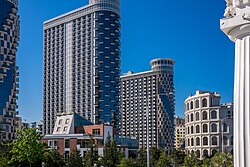
Modern Batumi and Economic Growth
Today, Batumi is a cornerstone of the Georgian economy. Its port can accommodate 80,000-ton tankers, facilitating the transport of oil from Central Asia and the export of regional agricultural products. By 2001, freight conversion reached approximately 8 million tons, with annual port revenues estimated between $200 million and $300 million.
Since 2004, the city has seen a surge in international investment. Real estate prices have trebled since 2001, and the city has expanded its luxury hospitality sector with the opening of the Sheraton (2010) and Radisson Blu (2011). To stimulate regional development, the seat of the Constitutional Court of Georgia was moved from Tbilisi to Batumi in 2007. Additionally, the city's casinos have become a major draw for tourists from neighboring Turkey.
The city also saw a significant geopolitical shift in 2007. Following the Rose Revolution, the Georgian government negotiated the withdrawal of the Russian 12th Military Base. While the original agreement set a 2008 deadline, the base was officially transferred to Georgia on November 13, 2007.
Key Facts
- Ancient Name: Originally called Bathus or Bathys, meaning "deep harbor."
- Strategic Infrastructure: Home to the Baku–Batumi pipeline (1907) and the Transcaucasus Railway (1883).
- Economic Power: Port handles 80,000-ton tankers with annual revenues of $200–$300 million.
- Political Shift: Transitioned from Ottoman rule to Russian Imperial rule in 1878.
- Modern Status: Capital of the Autonomous Republic of Adjara, Georgia.
| Period | Governing Power / Entity |
|---|---|
| Until 780 | Lazica |
| 780–1010 | Kingdom of Abkhazia |
| 1010–1455 | Kingdom of Georgia |
| 1455–1703 | Kingdom of Imereti (via Guria) / Ottoman contests |
| 1703–1878 | Ottoman Empire |
| 1878–1918 | Russian Empire |
| 1918–1920 | British Empire |
| 1920–1921 | Democratic Republic of Georgia |
| 1921–1991 | USSR (Adjarian ASSR) |
| 1991–Present | Georgia (Autonomous Republic of Adjara) |
Frequently Asked Questions
What does the name Batumi mean?
The name is derived from the Ancient Greek words bathus limen or bathys limēn, which translates to "deep harbor."
Why was Batumi important to the Russian Empire?
Batumi served as the chief Russian oil port on the Black Sea, supported by the construction of the Transcaucasus Railway and the Baku–Batumi pipeline.
Who were the Doukhobors and why did they leave Batumi?
The Doukhobors were a religious minority who came into conflict with the Imperial Russian government due to their refusal to serve in the military. Over 7,400 of them emigrated from Batumi to Canada in the late 1880s.
What was the 2004 Adjara crisis?
The crisis involved mass protests in Batumi against Aslan Abashidze, who had ruled the region as a personal fiefdom since 1991. The protests ended when Abashidze fled to Russia in May 2004.
What is the current economic significance of Batumi's port?
The port is a major hub for shipping oil from Central Asia via 80,000-ton tankers and exporting regional agricultural products, generating estimated annual revenues between $200 million and $300 million.