Battle of Neuve Chapelle
The Battle of Neuve Chapelle, fought from March 10 to 13, 1915, stands as a pivotal moment in the early stages of the First World War. Located in the Artois region of France, this engagement represented the first deliberately planned British offensive of the war. While it resulted in the capture of Neuve-Chapelle village, it ultimately highlighted the brutal realities of position warfare—the static, defensive struggle characterized by trench systems—that would dominate the Western Front for years to come.
Key Facts
- Date: 10–13 March 1915
- Location: Artois region, France
- Primary Objective: Rupture German lines to reach Aubers Ridge and potentially Lille.
- Key Belligerents: British Empire (including UK, Canada, and India) vs. German Empire.
- Outcome: Tactical success in capturing Neuve-Chapelle, but a strategic failure to achieve a breakthrough.
- Major Consequence: Triggered the "Shell Crisis of 1915" in Britain due to extreme ammunition shortages.
Strategic Objectives and Planning
The British high command aimed to create a rupture in the German lines, which they hoped to exploit by rushing toward the Aubers Ridge and the city of Lille. This was intended to be a coordinated effort with the French; a planned French assault at Vimy Ridge on the Artois plateau was meant to threaten German junctions at La Bassée from the south while the British attacked from the north.
However, coordination faltered. The French portion of the offensive was cancelled because the British could not relieve the French IX Corps north of Ypres. Consequently, the French Tenth Army's role was reduced to providing heavy artillery support. Despite this, the British First Army, under Sir Douglas Haig, prepared their attack with meticulous detail.
For the first time, the Royal Flying Corps (RFC) utilized aerial photography to map the attack front to a depth of 1,500 yards. This allowed for the distribution of 1,500 detailed 1:5,000 scale maps to each corps, providing a level of intelligence previously unavailable to ground commanders.
The Assault: Success and Stagnation
The battle began at 7:30 a.m. on March 10 with a concentrated 35-minute artillery bombardment. Ninety 18-pounder field guns targeted the German wire, destroying it within ten minutes, while howitzers hammered the front-line trenches. To prevent German reinforcements from entering the sector, the 1st Canadian Division provided diversionary artillery and machine-gun fire from Fleurbaix.
At 8:05 a.m., the infantry advanced. The Indian Corps played a central role; the Lahore battalions swiftly crossed no man's land and overran German infantry, capturing Neuve-Chapelle village by 9:00 a.m. with 200 prisoners and five machine guns. However, the Garhwal Brigade on the right lost direction, creating a 250-yard gap in the line that the Germans were able to exploit.
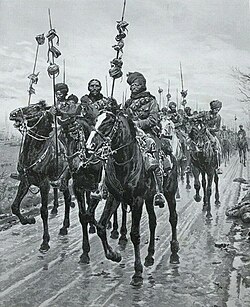
By 10:00 a.m., the center of the German defense had been overrun. Field Marshal Sir John French released the 5th Cavalry Brigade to exploit the breakthrough, but the momentum stalled. Communication failures—specifically the collapse of the telephone system—meant that commanders could not coordinate their movements. This lack of synchronization gave the German 6th Army, commanded by Crown Prince Rupprecht, time to bring in reinforcements and establish a new defensive line.
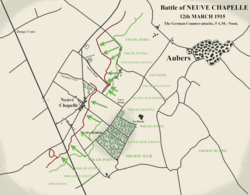
The Counter-Attack and Collapse
On March 12, the Germans launched a massive counter-attack involving twenty infantry battalions (approximately 16,000 men). Although this attack was a costly failure for the Germans, it forced the British to expend the remainder of their artillery ammunition to hold their ground.
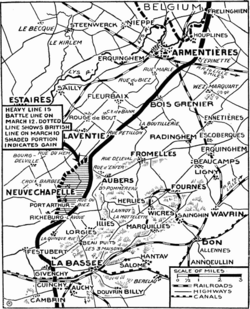
With an acute shortage of shells, Sir Douglas Haig was forced to cancel further attacks. A final local effort by the 7th Division also ended in failure. By March 15, the offensive was officially abandoned. The British had recaptured roughly 2 kilometers of ground, but the strategic goal of a breakthrough remained unfulfilled.

Analysis and Aftermath
While the battle had no significant strategic effect, it altered the perceptions of the belligerents. The French became cautiously optimistic about the British Empire's ability to conduct offensive operations. Conversely, the Germans realized the British were more capable of attacking than previously assumed and hurriedly strengthened their defenses.
The most lasting impact was political. The expenditure of 30% of the First Army's field-gun ammunition in a single day revealed a catastrophic supply failure. This led to the Shell Crisis of 1915, which contributed to the fall of Prime Minister H. H. Asquith's Liberal government and the appointment of David Lloyd George as Minister of Munitions. This marked the beginning of the total mobilization of the British economy for war.
| Category | Details |
|---|---|
| British/Imperial Strength | 4 Divisions |
| German Strength | 2 Divisions |
| British/Imperial Casualties | c. 11,200 (British: 7,000; Raj: 4,200) |
| German Casualties | 8,500 – 10,000 |
| Territorial Gain | Capture of Neuve-Chapelle village (approx. 2 km) |
Frequently Asked Questions
What was the primary goal of the Battle of Neuve Chapelle?
The primary goal was to rupture the German lines in the Artois region, allowing British forces to advance toward Aubers Ridge and potentially capture Lille, while coordinated French attacks threatened German junctions at La Bassée.
Why did the British fail to exploit the initial breakthrough?
The failure was primarily due to communication breakdowns, specifically the failure of the telephone system, and unexpected delays that allowed the German army to bring in reinforcements and dig new defensive lines.
What was the "Shell Crisis of 1915"?
The Shell Crisis was a political and military scandal triggered by the discovery that the British army had an inadequate supply of artillery ammunition, which had forced the suspension of the Neuve Chapelle offensive.
What role did the Indian Corps play in the battle?
The Indian Corps was central to the initial success, with the Lahore battalions swiftly capturing Neuve-Chapelle village. The battle is commemorated today by the Neuve-Chapelle Indian Memorial, honoring 4,700 soldiers and laborers with no known graves.
How did the battle affect British military tactics?
The battle reinforced the tactical belief that infantry offensives, when supported by heavy artillery barrages, could potentially break the stalemate of trench warfare, though it also highlighted the need for better communication and supply chains.