Baronetcy: The History and Traditions of the British Hereditary Title
A baronetcy is a unique hereditary title awarded by the British Crown. While it carries the prefix "Sir" or "Dame," it occupies a distinct space in the British honors system. Positioned below barons and the knights of the Garter and Thistle, but above all other knights, a baronet is technically a commoner rather than a peer of the realm.
Though the term appeared as early as the 14th century, the modern baronetcy was formalized in 1611 by King James I. Originally designed as a mechanism to raise funds for the crown, the title has evolved into a rare mark of hereditary distinction. Today, the Official Roll of the Baronetage is overseen by the Ministry of Justice to ensure that claims to these titles are officially proven.
Key Facts
- Nature: A hereditary state order awarded by the British monarch.
- Rank: Below barons and the highest orders of knighthood, but above all other knights.
- Origins: Re-established in 1611 (England), 1619 (Ireland), and 1625 (Scotland).
- Current Status: Extant, though the last new baronetcy was created in 1990.
- Post-nominals: Bt or Bart (for men) and Btss (for baronetesses).
- Prevalence: Approximately 1,200 families hold these titles, representing less than 0.01% of UK families.
The Evolution of the Baronetage
Medieval Origins and the 17th Century Revival
The term "baronet" was used in the 1300s; for instance, Sir Thomas de La More mentioned baronets fighting in the Battle of Boroughbridge in 1322. However, the current system began in 1611 when James I granted letters patent to 200 gentlemen of good birth. To receive the honor, candidates needed an annual income of at least £1,000 (roughly £237,000 in 2025) and were required to pay £1,095 (roughly £260,000 in 2025) to fund the Plantation of Ulster—the organized colonization of Northern Ireland.
Following this, James I established the Baronetage of Ireland in 1619, and Charles I created the Baronetages of Scotland and Nova Scotia in 1625. These later creations required a payment of 2,000 marks (approximately £477,000 in 2025) or the support of six colonial settlers for two years.
Unification and Modernization
As the British Isles unified, so did the titles. After the Union of England and Scotland in 1707, new titles became "baronets of Great Britain." Following the Union of Great Britain and Ireland in 1801, they were styled as "baronets of the United Kingdom." Over time, certain privileges—such as the automatic knighthood of the eldest son—were revoked, notably by George IV in 1827.
Titles, Styles, and Conventions
Baronets are addressed as "Sir" followed by their first name. A woman holding a baronetcy in her own right is a baronetess and is addressed as "Dame." It is a common misconception that the wife of a baronet is a baronetess; by courtesy, she is addressed as "Lady" followed by her husband's surname.
The Baronetess
Historically, very few women have held these titles in their own right. Notable examples include Dame Mary Bolles (the only woman apparently created a baronetess of Nova Scotia) and Dame Anne Christian Maxwell Macdonald. As of 2025, there are no living baronetesses.
Heraldry and the Baronets' Badge
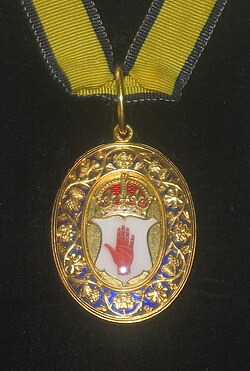
One of the most distinguishing features of a baronetcy is the right to use specific heraldic augmentations. Most baronets may display the Red Hand of Ulster—a red left hand on a silver field—which commemorates the title's origins in the Plantation of Ulster.
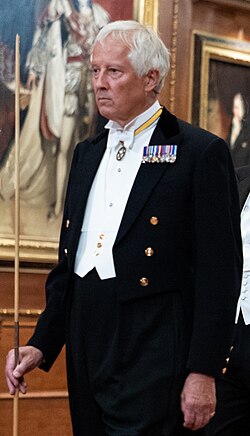
Since 1929, baronets (excluding those of Nova Scotia) have been permitted to wear a neck badge. This badge features the Red Hand of Ulster within a border decorated with motifs reflecting the wearer's specific baronetcy: roses for England, shamrocks for Ireland, and combinations of roses, thistles, and shamrocks for Great Britain and the United Kingdom. The badge is suspended from an orange ribbon with dark blue edges.
Baronets of Nova Scotia use a different badge depicting the arms of Nova Scotia: a blue saltire on a silver field with the Royal Arms of Scotland in the center, suspended from a plain orange ribbon.
The Current State of the Baronetage
The number of extant baronetcies has declined since the mid-20th century due to extinction or dormancy. From 1,490 in 1965, the number dropped to approximately 1,204 by 2017. New creations have almost entirely ceased; the last baronetcy was created in 1990 for Sir Denis Thatcher, husband of former Prime Minister Margaret Thatcher.
The Premier Baronet is an unofficial title given to the holder of the oldest extant baronetcy in a specific realm. Currently, Sir Nicholas Bacon holds the title of Premier Baronet of England.
| Class of Creation | Total Created | Extant Baronets | Held by Peers |
|---|---|---|---|
| England | 134 | 84 | 50 |
| Ireland | 57 | 34 | 23 |
| Nova Scotia | 103 | 73 | 30 |
| Great Britain | 121 | 90 | 31 |
| United Kingdom | 777 | 671 | 106 |
| Total | 1,192 | 952 | 240 |
Frequently Asked Questions
Is a baronet a peer?
No. A baronetcy is not a peerage. Baronets are commoners and do not hold a seat in the House of Lords, unlike barons, viscounts, earls, marquesses, and dukes.
How is a baronet addressed?
A baronet is addressed as "Sir [First Name]." His wife is addressed as "Lady [Surname]." A woman who holds the title in her own right is addressed as "Dame [First Name]."
What is the Red Hand of Ulster?
The Red Hand of Ulster is a heraldic badge (a red left hand on a silver field) that baronets of England, Ireland, Great Britain, and the United Kingdom are permitted to display in their coats of arms.
Can a baronetcy be passed to a woman?
Generally, baronetcies follow male primogeniture. However, some Scottish baronetcies have "special remainders" that allow the title to pass through female lines, though this is rare.
Who manages the list of current baronets?
The Ministry of Justice oversees the Official Roll of the Baronetage. A person must be listed on this roll to be officially recognized as a baronet in a formal capacity.