Banana: History, Cultivation, and Global Impact
The banana is one of the world's most recognizable and consumed fruits. Belonging to the genus Musa, these plants are not trees in the botanical sense, but rather giant herbaceous perennials. From their origins in the wild to their current status as a global commodity, bananas have shaped economies, diets, and cultural traditions across multiple continents.
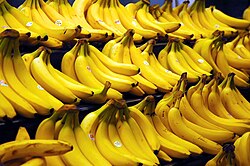
While the modern supermarket banana is often uniform in appearance, the species encompasses a vast array of cultivars, including the starchy plantains used as staples in many tropical regions and the sweet dessert bananas enjoyed worldwide.
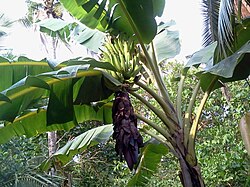
Key Facts
- Botanical Genus: Musa.
- Primary Market Variety: The Cavendish group dominates global trade.
- Top Producer: India is the world's leading producer of bananas.
- Key Nutrients: Rich in potassium, vitamin B6, and manganese.
- Major Threat: Panama disease (Fusarium wilt) poses a significant risk to monoculture plantations.
Evolution and Domestication
Modern edible bananas evolved from wild ancestors that were vastly different from the seedless fruits we eat today. Wild-type bananas are characterized by numerous large, hard seeds that make the fruit difficult to consume.
![Original native ranges of the ancestors of modern edible bananas.[32]](/images/5d/8d/5d8d4e57f99616999b08ad43114c337bf5d41b92ce492977afe1edaccb2e75d9.webp)
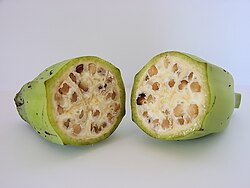
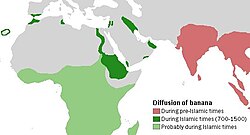
Through domestication, humans selected for seedless varieties. The spread of these plants followed the migration of people, particularly the Austronesian peoples across the Indo-Pacific, and later through the Arab Agricultural Revolution between 700 and 1500 CE, which helped diffuse the crop across Africa and the Middle East.
![Chronological dispersal of Austronesian peoples across the Indo-Pacific[39]](/images/51/a5/51a509718f66d677530bc1f3da68d56963068ef77721ffd7ac0d6769e09c7527.png)
Cultivation and Production
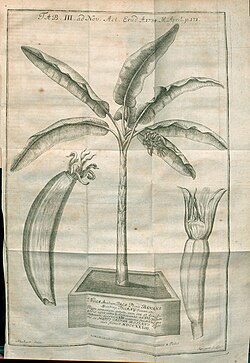
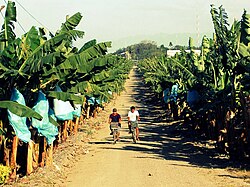
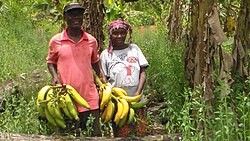
Banana cultivation ranges from massive industrial plantations to small-scale subsistence farming. In the modern era, the Cavendish cultivar has become the industry standard due to its suitability for transport and storage, though this reliance on a single genetic variety creates vulnerability to disease.
Global Production Statistics
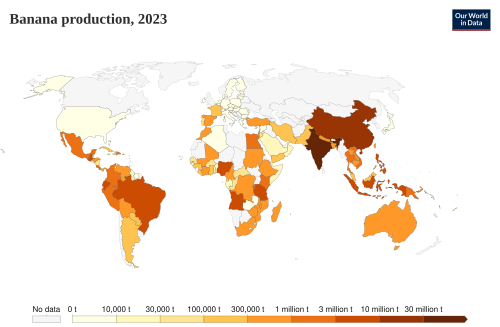
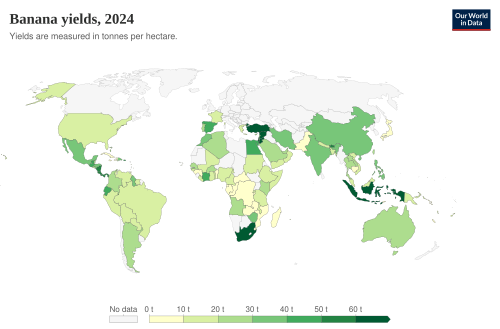
Production is concentrated in tropical regions, with India, China, and Uganda leading the world in tonnage.
| Country | Bananas (Million Tonnes) | Plantains (Million Tonnes) | Total (Million Tonnes) |
|---|---|---|---|
| India | 34.5 | - | 34.5 |
| China | 11.8 | - | 11.8 |
| Uganda | 10.4 | - | 10.4 |
| Indonesia | 9.2 | - | 9.2 |
| Philippines | 5.9 | 3.1 | 9.0 |
| Nigeria | - | 8.0 | 8.0 |
| Ecuador | 6.1 | 0.9 | 6.9 |
| World Total | 135.1 | 44.2 | 179.3 |
Pests and Diseases
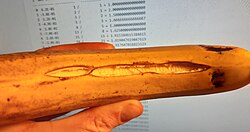
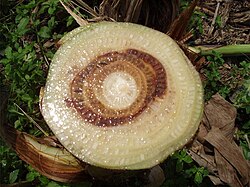
Because many commercial bananas are clones, they lack genetic diversity, making them susceptible to widespread epidemics. One of the most devastating is Panama disease, caused by the Fusarium fungus, which attacks the plant's vascular system.
Other significant threats include:
- Black Sigatoka: A fungal leaf spot disease that reduces fruit yield.
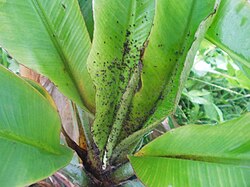
- Banana Bunchy Top Virus: Spread by aphids, causing stunted growth.
- Nematodes: Microscopic worms like Radopholus similis that cause root rot.
- Banana Borer: An insect that tunnels into the plant's core.
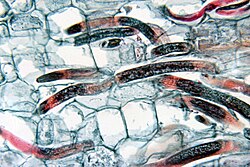
![The banana borer is a destructive pest that tunnels inside the plant.[91]](/images/b4/91/b4910d6e183b7acbaad599daac6f8d6bf06d3ba39281f7e461134bbdfb07d797.jpg)

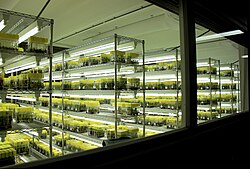
To combat these threats, organizations like Bioversity International maintain germplasm transit centres to conserve genetic diversity and breed more resilient varieties.
Nutrition and Versatility
Bananas are a dense source of energy and essential micronutrients. They are particularly valued for their potassium and vitamin B6 content.
Nutritional Value (per 100g)
- Energy: 89 kcal
- Carbohydrates: 22.84 g (including 12.23 g of sugars)
- Dietary Fiber: 2.6 g
- Potassium: 12% DV
- Manganese: 12% DV
- Vitamin B6: 7% DV
Diverse Uses
Beyond the fruit, almost every part of the Musa plant is utilized in various cultures.
Culinary Uses
While the fruit is eaten raw or cooked (as in curries or sweets), the banana flower is used in Filipino and Thai dishes. The leaves serve as biodegradable plates or wrappers for steaming foods like Nacatamales.
Textiles and Industry
Certain species, such as abacá (endemic to the Philippines), are grown specifically for their strong fibers. These are used to create Manila hemp fabric and traditional textiles like the Banton Burial Cloth.
![The Banton Burial Cloth (c. 1200–1300 AD) of the Philippines, the oldest surviving example of banana textile (and the oldest example of warp ikat weaving in Southeast Asia). It is made from abacá,[149] a species of banana endemic to the Philippines.](/images/e5/d9/e5d9b0bf6ef6588bf81841b30e9476b3407754137b517a531328337acfb49c3a.jpg)
Cultural and Religious Significance
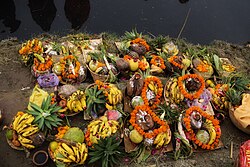
Bananas hold deep symbolic meaning. In India, they are used in Hindu festivals such as Chhath. In Thai folklore, the ghost Nang Tani is said to haunt banana plants.

Frequently Asked Questions
What is the difference between a banana and a plantain?
While both belong to the genus Musa, bananas are typically eaten raw as sweet fruits, whereas plantains are starchier and are usually cooked before consumption, serving as a staple vegetable.
Why is the Cavendish banana so common?
The Cavendish variety is preferred for global trade because it is resistant to the first wave of Panama disease and is more durable during long-distance shipping and storage.
What is Panama disease?
Panama disease is a soil-borne fungal infection caused by Fusarium wilt. It blocks the plant's ability to transport water and nutrients, eventually killing the plant.
Can other parts of the banana plant be eaten?
Yes. Depending on the region, people eat the banana flowers (heart), the inner core of the trunk (as in Thai curries), and use the leaves for cooking and serving.
What is abacá?
Abacá is a species of banana endemic to the Philippines. Unlike dessert bananas, it is primarily cultivated for its strong leaf fibers used in paper and textile production.