Automotive Engineering Terms and Components
Modern vehicles are complex assemblies of mechanical, electrical, and structural systems working in harmony. From the structural integrity of the frame to the precision of the engine's internal movements, understanding the specific terminology of automotive engineering is essential for grasping how a vehicle operates, handles, and maintains efficiency.
Key Facts
- Chassis serves as the primary load-bearing framework for all mechanical parts and the vehicle body.
- Camber and Caster are critical wheel alignment angles that affect vehicle handling and stability.
- The Crankshaft is the component responsible for converting linear piston motion into rotational energy.
- Coolants regulate engine temperature using liquids like water mixed with ethylene glycol or methanol.
- Carputers are specialized onboard computers used for everything from diagnostics to precision driver controls.
Vehicle Structure and Alignment
The foundation of any vehicle is its chassis (also known as the vehicle frame). This is the structural lower part of the vehicle that supports the running gear and the body. Without a rigid chassis, the mechanical components would lack the necessary support to function under load.
Beyond the frame, the way wheels are positioned relative to the vehicle's axis significantly impacts performance. This is measured through specific angles:
- Camber Angle: The angle between the wheel's circumference plane and the vertical axis of the chassis. Positive camber occurs when the top of the wheel tilts outward, while negative camber occurs when it tilts inward. Most road vehicles aim for neutral camber, where wheels are perpendicular to the road.
- Caster Angle: The angular displacement of the steering axis from the vertical axis of a steered wheel, viewed from the side of the vehicle.
Internal Combustion Engine Mechanics
The heart of the vehicle is the engine, where chemical energy is converted into mechanical motion. This process occurs within the combustion chamber—the space bounded by the cylinder head and the top of the piston at its highest point (top dead center). The design and volume of this chamber directly influence fuel efficiency, power output, and emissions.
Two critical measurements define the efficiency of this process: the clearance volume (the space remaining above the piston at top dead center) and the compression ratio, which is the ratio between the maximum and minimum combined volume of the cylinder and combustion chamber.
To manage the air-fuel mixture, some engines use a choke (or choke valve). This valve restricts air intake during the induction stroke to enrich the fuel-to-air ratio, making it easier to start the engine when it is cold.
The Role of the Crankshaft
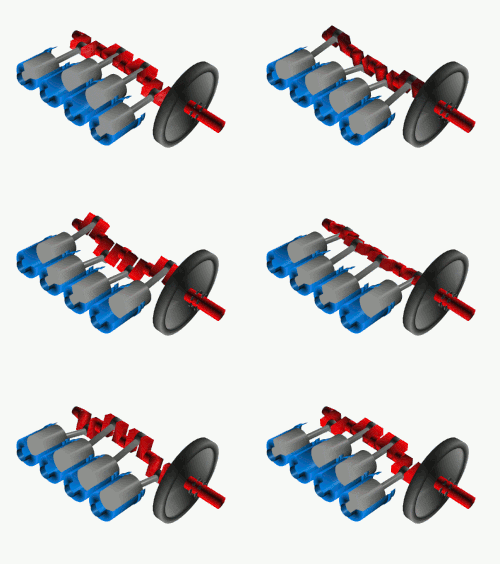
The crankshaft is a linear shaft that translates the reciprocating (forward-and-back) motion of the pistons into rotational motion. This is achieved through crank throws (or crankpins), which are offset bearing surfaces attached to the piston connecting rods. The crankshaft throw is the lateral distance between the shaft centerline and the furthest offset of the journal, representing half the length of a piston stroke.
The crankshaft rotates within a crankshaft journal in a main bearing and is typically housed within the crankcase. To smooth out the pulsations of four-stroke cycles, it is often paired with a flywheel and vibrational dampers.
Cooling, Protection, and Electronics
High-performance engines generate immense heat, requiring a coolant to regulate temperature. Coolants are liquids—typically water mixed with additives like methanol or ethylene glycol to prevent corrosion and adjust freezing/boiling points—that absorb excess heat and dissipate it into the surrounding air.
To protect these sensitive components from debris and water, a cowling is used. This is a removable covering that shelters the engine while still allowing for necessary airflow and heat dissipation.
Modern vehicles also integrate a carputer. These are specialized computers with compact sizes and low power requirements. While some act as simple networks for on-board diagnostics, others provide complex precision controls for the driver.
Braking and Maintenance
In disc brake systems, the caliper (also called a floating or swinging caliper) is the mechanism that clamps the brake pads against the disc to slow or stop the vehicle.
Regarding vehicle history and maintenance, the term clocking refers to the illegal act of tampering with a vehicle's odometer to misrepresent its total mileage.
| Term | Primary Function/Definition | Key Characteristic |
|---|---|---|
| Chassis | Main load-bearing framework | Supports body and running gear |
| Crankshaft | Motion translation | Reciprocating to Rotational |
| Camber | Wheel alignment angle | Positive (out) or Negative (in) |
| Coolant | Temperature regulation | High thermal capacity liquid |
| Caliper | Braking mechanism | Clamping action on discs |
Frequently Asked Questions
What is the difference between positive and negative camber?
Positive camber occurs when the top of the wheel tilts outward, away from the vehicle body. Negative camber occurs when the top of the wheel tilts inward, toward the body.
How does a crankshaft work?
A crankshaft uses offset crank throws to convert the linear, up-and-down motion of the engine's pistons into a rotational motion that can eventually turn the wheels.
What is the purpose of a choke valve?
A choke valve restricts the amount of air entering the engine during the induction stroke, which increases the fuel-to-air ratio to help the engine start more easily, particularly in cold conditions.
What is a carputer?
A carputer is a specialized onboard computer designed for automotive use. It can range from a simple diagnostic monitoring system to a complex interface for precision vehicle controls.
Why is the compression ratio important?
The compression ratio—the ratio between the maximum and minimum volume of the cylinder and combustion chamber—greatly affects the engine's power, fuel efficiency, and emissions.