Australian and New Zealand Socket Outlet Variants
In Australia and New Zealand, the standard single-phase 230 V domestic socket outlet is rated at 10 A. While this suffices for most household electronics, certain heavy-duty applications require higher current capacities to operate safely. To accommodate these needs, a series of variants exist, ranging from 10 A up to 32 A.
The design of these outlets incorporates a physical safety mechanism: as the current rating increases, the dimensions and shapes of the pins change. This ensures that a high-current plug cannot be inserted into a low-rated socket, preventing potential electrical overloads.
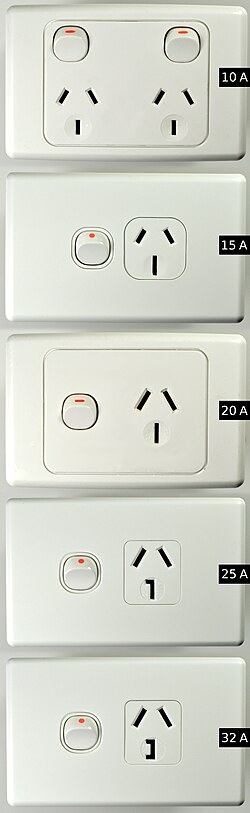
Current Rating Variants
The progression of socket ratings is managed through specific modifications to the earth, line, and neutral pins. This hierarchy allows for backward compatibility, meaning a lower-rated plug can fit into a higher-rated socket, but not vice versa.
- 10 A: The standard domestic rating.
- 15 A: Features a wider earth pin than the 10 A version.
- 20 A: Features both a wider earth pin and wider line and neutral pins.
- 25 A: Utilizes wider line and neutral pins and an inverted L-shaped earth pin.
- 32 A: Utilizes wider line and neutral pins and a sideways U-shaped earth pin.
Because of this design, a 10 A plug is compatible with all five socket types, whereas a 32 A plug can only be inserted into a 32 A socket.
Common Applications and Usage
In most domestic and commercial settings, only 10 A and 15 A outlets are commonly encountered. Higher-rated sockets are typically reserved for specific high-power appliances, such as electric ovens in home kitchens. In industrial environments, these high-rated sockets are less common, as AS/NZS 3123 weather-proof sockets are generally preferred for their durability and protection.
Specialized Plug Types
Beyond standard ratings, there are several specialized variants used for specific functions:
- Socket Adapter Plugs: These feature a socket on the back to allow a second appliance to be connected. Known colloquially as "piggy-back plugs" in Australia and "tap-on" plugs in New Zealand. In Australia, these are primarily available via special order or as part of pre-assembled extension cords, while re-wireable PDL 940 "tap-on" plugs are more common in New Zealand.
- Round Earth Pin Outlets: A 10 A variant with a round earth pin used for "special use" circuits, such as classroom storage heaters.
- 110 V 10 A Version: This variant features round active and neutral pins with a flat earth pin. It is specifically rated for 110 V to prevent the insertion of certain foreign 110 V plugs and is often used for PAR 64 lights (where two 1000 watt lamps are used in series).
Technical Specifications and Safety
When viewing the front of a socket-outlet, the active terminal (the pin that carries the current) is the first socket encountered when moving clockwise from the earth socket. It is critical to ensure wiring is correct, as faulty wiring or adherence to Argentinian standards may swap the active and neutral pins.
Users should also be cautious of the 10 A round-pin version in commercial or industrial settings in the Americas. It is physically compatible with, but electrically incompatible with, the NEMA 7–15 connector used for 277 V 15 A connections.
Since the 1960s, it has become standard practice for sockets in Australia and New Zealand to be installed with the earth pin facing downwards. This orientation ensures the longer earth pin is the last to lose contact if a plug is tugged downwards. Consequently, many "side-entry" plugs and extra low voltage "plug packs" are designed specifically for this downward-facing orientation.
Key Facts
- Standard domestic outlets are rated at 10 A.
- Higher rated plugs cannot be inserted into lower rated sockets.
- The 32 A socket is the highest standard variant, featuring a sideways U-shaped earth pin.
- "Piggy-back" (AU) or "tap-on" (NZ) plugs allow for two appliances per outlet.
- Standard installation places the earth pin facing downwards for increased safety.
| Rating | Earth Pin Characteristic | Line/Neutral Pins | Common Use |
|---|---|---|---|
| 10 A | Standard | Standard | General domestic use |
| 15 A | Wider | Standard | Heavy duty domestic/commercial |
| 20 A | Wider | Wider | Specialized high-power |
| 25 A | Inverted L-shape | Wider | High-power appliances |
| 32 A | Sideways U-shape | Wider | Electric ovens / Industrial |
Frequently Asked Questions
Can I plug a 10 A appliance into a 15 A socket?
Yes. Any plug can be inserted into a socket outlet of the same or higher current rating.
Why can't a 15 A plug fit into a 10 A socket?
The 15 A plug has a wider earth pin, which physically prevents it from entering a 10 A socket to avoid overloading the circuit.
What is a "piggy-back" plug?
A piggy-back plug (or "tap-on" plug in New Zealand) is a socket adapter plug that has an additional socket on the back, allowing two appliances to share one wall outlet.
Why is the earth pin usually facing downwards in these sockets?
This orientation ensures that if a plug is accidentally pulled downwards, the longer earth pin remains in contact with the socket the longest, maintaining safety.
What is the purpose of the 110 V 10 A socket variant?
It is used for specific equipment like PAR 64 lights and is designed with round active and neutral pins to prevent the insertion of incompatible foreign 110 V plugs.