Atlantic Period Fauna: Wildlife of the Mesolithic Ertebølle Culture
During the Atlantic Period, the landscape of Denmark was vastly different from today, existing more as an archipelago of islands than a contiguous landmass. The most vivid records of this era's wildlife come from kitchen middens—ancient refuse heaps—left behind by the Ertebølle culture. These coastal inhabitants lived in harmony with a diverse ecosystem, exploiting the rich bounty of the shorelines, marshes, and dense forests.
Key Facts
- Denmark was an archipelago during the Atlantic Period, providing diverse marine and terrestrial habitats.
- The Ertebølle culture relied heavily on marine resources, including fish, seals, and whales.
- The Baltic Sea supported species now rare in the region, such as the anchovy.
- Large mammals like the aurochs and wild horses inhabited open forests and meadows.
- The Dalmatian pelican, now restricted to south-eastern Europe, once resided in Denmark.
Marine and Aquatic Life
Higher water levels during this period mitigated the impact of the submarine toxic zone in the Baltic Sea, allowing a wide variety of fish to thrive. Among these were the three-spined stickleback (Gasterosteus aculeatus) and the anchovy (Engraulis encrasicolus), both of which are now rare in these waters. Other common catches for Mesolithic humans included cod, ling, whitefish, and pike.
Beyond fish, the estuaries were hunting grounds for larger marine mammals. Three species of seals—the grey, harp, and ringed seals—were prevalent, and whales were also hunted along the coastlines.
Avian Diversity
The bird population was dominated by maritime species. The gannet, red-throated diver, and black-throated diver were common sights. Notably, the Dalmatian pelican (Pelecanus crispus), which currently only reaches as far north as south-eastern Europe, has been identified in the Danish record.
Inland, the forested regions were home to the capercaillie, a large forest grouse that continues to inhabit such environments today.
Forest and Terrestrial Wildlife
The forests of the Atlantic Period were stratified ecosystems. In the high canopy, smaller animals flourished, most notably the ubiquitous red squirrel (Sciurus vulgaris). The skies and trees also supported Daubenton's bat (Myotis daubentonii).
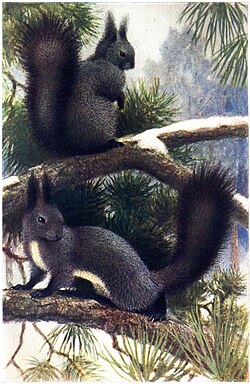
Predators prowled both the canopy and the forest floor. The pine marten, wildcat, wolf, and the common polecat (Mustela putorius) were the primary hunters of the woodlands.
Large Mammals and Browsers
The forest floor supported large browsers and rooters, including wild boar, roe deer, and red deer. Interestingly, the region also maintained populations of plains mammals in open meadows and forest clearings. This included the aurochs (the wild ancestor of modern cattle) and the wild horse.
The presence of wild horses is a significant discovery, as it proves they were not confined to the eastern plains, nor were they exclusively associated with Indo-European cultures; the Mesolithic Ertebølle people actively hunted them within Denmark.
Summary of Atlantic Period Species
| Habitat | Key Species |
|---|---|
| Marine/Estuary | Anchovy, Three-spined stickleback, Cod, Ling, Grey/Harp/Ringed Seals, Whales |
| Avian | Dalmatian pelican, Gannet, Red-throated diver, Black-throated diver, Capercaillie |
| Forest Canopy/Air | Red squirrel, Daubenton's bat |
| Forest Floor/Meadows | Aurochs, Wild horse, Red deer, Roe deer, Wild boar, Wolf, Pine marten, Polecat, Wildcat |
Frequently Asked Questions
What was the Ertebølle culture?
The Ertebølle culture was a Mesolithic society in Denmark that lived primarily along shorelines, utilizing kitchen middens to dispose of waste and leaving behind a rich archaeological record of the fauna they consumed.
Which fish species were present in the Baltic Sea during this time?
The Baltic Sea contained pike, whitefish, cod, and ling, as well as species that are now rare in the area, such as the anchovy and the three-spined stickleback.
Were wild horses present in Mesolithic Denmark?
Yes, wild horses inhabited the open forests and meadows of Denmark and were hunted by the Ertebølle people, contradicting the idea that they were limited to eastern plains or specific later cultures.
What unusual bird species has been found in Denmark from this period?
The Dalmatian pelican (Pelecanus crispus) has been found in Denmark, despite its current range being limited to as far north as south-eastern Europe.
What role did the geography of Denmark play in its fauna?
Because Denmark was more of an archipelago during the Atlantic Period, it provided a diverse mix of marine, marsh, and forest environments, supporting everything from whales and pelicans to aurochs and wolves.