Atilio Malinverno: The Philosopher of Trees
Atilio Malinverno was a distinguished Argentine painter who left an indelible mark on the landscape art of the early 20th century. A practitioner of Post-Impressionism—an art movement that emerged at the turn of the century to extend Impressionism through more emotional and structured forms—Malinverno earned the nickname "the philosopher of trees" for his profound devotion to the natural world.
While he maintained a professional career running an advertising agency, Malinverno dedicated his free time exclusively to capturing the diverse terrains of South America. His work is characterized by a deep connection to the land, blending technical skill with a philosophical appreciation for nature.

Key Facts
- Full Name: Atilio Malinverno
- Lifespan: April 20, 1890 – June 21, 1936
- Artistic Style: Post-Impressionism
- Specialization: Landscape painting
- Notable Work: Los Eucaliptos
- Education: Asociación de Estímulo de Bellas Artes (Fine Arts Association)
Artistic Journey and Education
Born in Buenos Aires, Malinverno developed his craft at the Asociación de Estímulo de Bellas Artes. Under the guidance of esteemed teachers such as Reinaldo Giudici, Ernesto de la Cárcova, and Eduardo Sívori, he honed the techniques that would define his career. His commitment to studying the environment led him on extensive artistic journeys through the Argentine interior, as well as Bolivia, Chile, and Uruguay.
Malinverno's career began with early promise; at just 20 years old in 1910, he submitted a work to the Centennial International Exhibition. He later spent a significant period living in the Córdoba hills, where he practiced en plein air (painting outdoors) to capture the authentic light and atmosphere of the region. Upon returning to Buenos Aires, his exhibitions were met with great success, often selling out completely.
Notable Works and Subject Matter
Malinverno's portfolio is a geographic survey of the Southern Cone. He focused his attention on several key regions, including:
- The hills of Córdoba and the mountains of Tandil
- The vast Pampas plains
- The coast of Quilmes and the ravines of San Isidro along the Río de la Plata
- Piriapolis in Uruguay
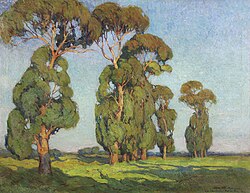
One of his most recognized pieces, Los Eucaliptos, exemplifies his ability to translate the serenity and structure of nature onto canvas.
Exhibitions and Recognition
Throughout the 1920s, Malinverno received numerous accolades and held exhibitions across Argentina. He won a Silver Medal at the National Exhibition of Decorative Art in 1922, a Gold Medal at the Centenary Exhibition in Tandil in 1923, and a Bronze Medal at the Community Exhibition in 1924. He also received the Estímulo del Salón Nacional prize in 1927.
Following his death in 1936 at the age of 46, a major posthumous exhibition was organized in 1937 at the Müller Gallery by a committee led by his disciple, the actor and painter Enrique Muiño. In more recent decades, his legacy has been kept alive through repeated exhibitions at the Alvear de Zurbarán Collection between 1982 and 1998, and the "Italian Roots in Argentine Art" exhibition in 1986.
Summary of Career and Legacy
| Category | Details |
|---|---|
| Primary Style | Post-Impressionism |
| Key Locations Painted | Córdoba, Tandil, Quilmes, San Isidro, Piriapolis |
| Major Awards | Gold Medal (Tandil 1923), Silver Medal (Decorative Art 1922) |
| Key Mentors | Reinaldo Giudici, Ernesto de la Cárcova, Eduardo Sívori |
Present Displays
Today, Malinverno's work can be found in several prestigious institutions and locations, ensuring his vision of the Argentine landscape remains accessible to the public:
- The Blue Room of the Casa Rosada presidential palace, Buenos Aires
- Museo de Arte del Tigre (Permanent collection)
- Eduardo Sívori Museum, Buenos Aires
- Museo Nacional de Bellas Artes, Buenos Aires
- Museo de Arte Hispanoamericano Isaac Fernandez Blanco, Buenos Aires
Frequently Asked Questions
What was Atilio Malinverno's artistic style?
Malinverno was a Post-Impressionist painter, a movement that evolved from Impressionism to emphasize more structured forms and emotional expression.
Why was he called "the philosopher of trees"?
He earned this nickname due to his exclusive devotion to landscape painting and his deep, contemplative approach to depicting nature.
Where did Malinverno study art?
He studied at the Asociación de Estímulo de Bellas Artes (Fine Arts Association) under the tutelage of Reinaldo Giudici, Ernesto de la Cárcova, and Eduardo Sívori.
Which regions influenced his work the most?
His work was heavily influenced by the hills of Córdoba, the Pampas plains, the mountains of Tandil, the coast of Quilmes, the ravines of San Isidro, and Piriapolis in Uruguay.
Where can I see his paintings today?
His works are displayed at the Casa Rosada's Blue Room, the Museo de Arte del Tigre, the Eduardo Sívori Museum, the Museo Nacional de Bellas Artes, and the Museo de Arte Hispanoamericano Isaac Fernandez Blanco.