Asynchronous Module Definition (AMD) for JavaScript Development
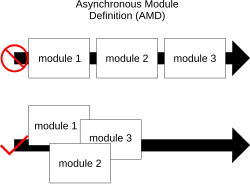
In the early days of web development, managing large amounts of JavaScript often meant loading massive files in a specific order to avoid errors. Asynchronous Module Definition (AMD) emerged as a specification to solve these challenges. It provides an Application Programming Interface (API) that allows developers to define code modules and their dependencies, loading them asynchronously—meaning they can be fetched in the background without blocking the rest of the page from loading.
Key Facts
- AMD is a JavaScript specification for defining modules and their dependencies.
- It enables asynchronous loading to improve website performance.
- It reduces page errors by ensuring dependencies are loaded before a module executes.
- It allows for code encapsulation similar to languages like Java.
- Popular implementations include RequireJS and the Dojo Toolkit.
How AMD Improves Web Development
AMD changes how JavaScript is delivered to the browser. Instead of a single, monolithic file, developers can break their code into smaller, logically organized files. This modular approach mirrors the structure found in other professional programming languages, such as Java.
One of the primary advantages is the impact on performance. Because AMD implementations load smaller files only when they are actually needed, the initial page load is often faster and more efficient.
Reducing Runtime Errors
A common issue in traditional JavaScript is the "dependency error," where a script tries to call a function from another file that hasn't finished loading yet. AMD solves this by allowing developers to explicitly define which dependencies must be present before a specific module is executed. This ensures that the necessary outside code is always available, leading to fewer page errors.
Deployment and Interoperability
While AMD encourages splitting code into many small files during development, it does not force this structure upon the production environment. For deployment, developers can concatenate (combine) and minify (remove unnecessary characters) these modules into a single file, maintaining the same efficiency as traditional JavaScript delivery.
AMD also offers interoperability with CommonJS, another module system. It supports a similar require() and exports interface, although the AMD-specific define() interface is the more fundamental and preferred method for its specifications.
| Feature | Benefit | Implementation Detail |
|---|---|---|
| Asynchronous Loading | Faster Page Performance | Loads files only when needed |
| Dependency Management | Fewer Runtime Errors | Ensures dependencies load before execution |
| Code Encapsulation | Better Organization | Similar to Java's modular structure |
| Production Optimization | Efficient Delivery | Supports concatenation and minification |
Frequently Asked Questions
What is Asynchronous Module Definition (AMD)?
AMD is a JavaScript specification that defines an API for creating code modules and managing their dependencies, allowing them to be loaded asynchronously.
Which libraries implement the AMD specification?
The AMD specification is implemented by libraries such as RequireJS and the Dojo Toolkit.
How does AMD improve website performance?
It improves performance by loading smaller JavaScript files and only fetching them at the moment they are required by the application.
Can AMD modules be combined for production?
Yes, developers can concatenate and minify AMD modules into a single file for production and deployment, similar to traditional JavaScript workflows.
Does AMD work with CommonJS?
Yes, AMD provides some interoperability with CommonJS by allowing the use of a similar require() and exports interface, though define() is preferred.