Askari: The History and Role of Local Soldiers in Colonial Africa
The term askari (or ascari) refers to local soldiers recruited by European colonial powers to serve in their armies across Africa, particularly in Central Africa, Northeast Africa, and the African Great Lakes region. Derived from the Swahili and Arabic word ʿaskarī, meaning "soldier" or "military," the term has been adopted into several languages, including English, German, Italian, Portuguese, and Urdu.
Throughout the colonial era, askaris were indispensable to European powers. They were initially employed to facilitate the conquest of various territories and later served as garrison forces and internal security. Their influence extended beyond Africa, as many units were deployed to Asia and the Middle East during both World Wars.
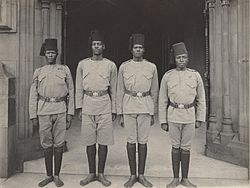
Key Facts
- Etymology: Rooted in the Persian word ʿaskarī (soldier), which derives from the Middle Persian lashkar (army).
- Colonial Use: Employed by British, German, Italian, Belgian, and Portuguese empires.
- World War I: Played a pivotal role in the East African Campaign, notably under German command.
- Modern Usage: Still used informally in some regions to describe security guards, police, or gendarmerie.
- South African Context: Refers to defectors from liberation movements who joined Apartheid security forces.
The Askari in European Colonial Armies
British Colonies
The Imperial British East Africa Company first raised askari units from Sudanese, Somali, and Swahili populations between 1888 and 1896. Initially, these forces lacked standardized uniforms and weaponry, often campaigning in native dress. By 1895, they were reorganized into the East Africa Rifles, which later became part of the multi-battalion King's African Rifles. This designation persisted until the independence of Kenya, Tanganyika, and Uganda between 1961 and 1963.
German Colonies
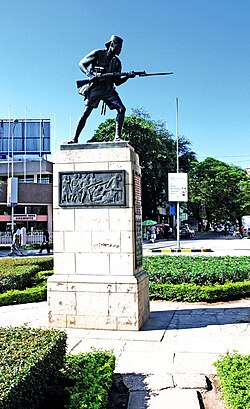
In German East Africa (modern-day Tanzania), the Schutztruppe (colonial army) utilized highly trained native troops. Originally recruited as Sudanese mercenaries, the force later included the Angoni and Wahehe tribal groups. These soldiers were known for rigorous discipline and high pay.
During World War I, approximately 11,000 askaris and porters under Paul Emil von Lettow-Vorbeck conducted a successful guerrilla campaign against British, Belgian, and Portuguese forces until 1918.
Italian Colonies
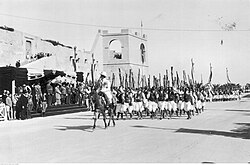
The Italian Colonial Army recruited heavily from Eritrea, Somalia, Libya, and Ethiopia. Starting in 1888, Eritrean battalions were formed, eventually expanding into infantry, cavalry (including the Penne di Falco), and mountain artillery. By 1922, camel cavalry known as meharisti were added.
Italian officers often viewed askaris as expendable, leading to higher casualty rates among native troops. By the 1935 invasion of Ethiopia, the force had grown to 60,000 soldiers, many of whom were conscripted.
Belgian, Portuguese, and Spanish Forces
- Belgian Congo: Askaris formed a combined military and police force commanded by Belgian officers.
- Portuguese Africa: Local recruits were used for peacekeeping. Until 1960, the army was strictly segregated into three classes based on race and social status.
- Spanish Morocco: The term was used for a locally recruited gendarmerie known as the Mehal-la Jalifianas and the desert police in the Spanish Sahara.
Askari in Apartheid South Africa
In a different context, the term "askari" was used during the Apartheid era, particularly in the 1980s, to describe former members of liberation movements (such as uMkhonto we Sizwe or APLA) who defected to the government's Security Branch.
These individuals were often "turned" through interrogation, abduction, or torture. They were used as infiltrators to identify and trace former comrades. While some were paid from secret funds, others were eventually integrated into the South African Police as constables. They often operated out of the Vlakplaas base.
Modern Applications: Post-2003 Iraq War
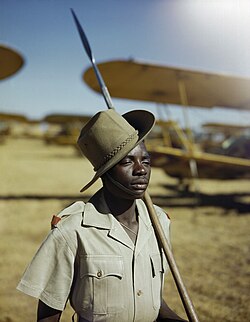
In recent history, the term has been applied to Ugandan private security guards deployed to Iraq. These guards were hired through various recruiting agencies to provide security for U.S. Department of Defense sites, such as Camp Victory in Baghdad. This modern usage highlights the transition of the term from colonial military service to private security contracting.
Summary of Askari Roles by Power
| Colonial Power / Regime | Primary Region | Key Unit/Characteristic | Primary Role |
|---|---|---|---|
| British | East Africa | King's African Rifles | Garrison and Internal Security |
| German | German East Africa | Schutztruppe | Guerrilla Warfare (WWI) |
| Italian | Horn of Africa | Meharisti (Camel Cavalry) | Colonial Conquest/Expansion |
| Portuguese | West/East Africa | Segregated Class System | Peacekeeping |
| Apartheid SA | South Africa | Security Branch | Infiltration and Intelligence |
Frequently Asked Questions
What does the word askari mean?
The word is derived from the Persian ʿaskarī, meaning "soldier," and is used in Swahili, Arabic, and Somali to refer to military or police personnel.
How were German askaris treated after World War I?
The Weimar Republic and Nazi Germany provided pensions to German askaris. In 1964, West Germany funded back pay for surviving veterans, verifying their identity through service certificates, uniforms, or their ability to perform the manual of arms in German.
What was the role of askaris in the Italian army?
They served as infantry, cavalry, and artillery. While they were essential for Italian colonial expansion, they were often subjected to strict discipline (including corporal punishment with a curbasc whip) and suffered higher casualties than Italian soldiers.
How did the meaning of askari change in South Africa?
Unlike the colonial military meaning, in South Africa it referred to political defectors from liberation movements who worked as spies and operatives for the Apartheid government's security forces.
Are askaris still employed today?
While the colonial armies are gone, the term is still used informally for security guards and police in some African countries, and was recently used to describe Ugandan security contractors in Iraq.