Arturo Merino Benítez International Airport
Serving as the primary gateway to Chile, the Arturo Merino Benítez International Airport (SCL) is a critical piece of infrastructure located in Pudahuel, within the Santiago Metropolitan Region. As a dual-purpose public and military facility, it connects the heart of Chile to the rest of the world, spanning destinations across the Americas, Europe, Oceania, Asia, and Africa.
The airport is currently operated by the Nuevo Pudahuel consortium—comprising Aéroports de Paris, Vinci Airports, and Astaldi—under the ownership of the Ministry of Public Works. Its strategic location makes it the primary maintenance center and hub for major regional carriers, most notably LATAM Chile, which handles approximately 82% of the airport's commercial operations.
Key Facts
- IATA Code: SCL | ICAO Code: SCEL
- Annual Passengers: 25,840,584 (2024 statistics)
- Primary Hub For: LATAM Chile, JetSmart, and Sky Airline
- Runways: Two parallel asphalt runways, each 3,800 meters (12,467 ft) long
- Elevation: 1,555 ft (474 m) above mean sea level
- Operator: Nuevo Pudahuel consortium
History and Evolution
Early Years and Naming
Construction began in 1961, focusing on the original terminal, the eastern runway (17L/35R), and essential cargo facilities. The airport officially opened on February 2, 1967, as the Aeropuerto Internacional de Pudahuel. In 1980, it was renamed in honor of Arturo Merino Benítez, the founder of the Chilean Air Force and the original carrier LAN Chile (now LATAM).
Expansion and Resilience
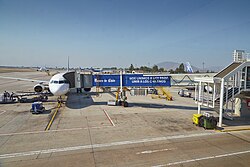
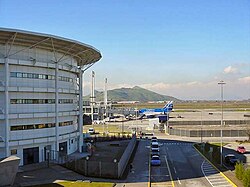
A significant expansion occurred in 1994 with the addition of a 90,000-square-meter international terminal inspired by the Marseille Provence Airport in France. This phase introduced jetways, a duty-free zone, and a new control tower. In 2000, the airport became a key hub for the Oneworld alliance, marking its first such presence in Latin America.
The airport's resilience was tested during the 2010 Chile earthquake. While the terminal suffered internal damage and a pedestrian bridge collapsed, the runways and control tower remained intact. This allowed the Chilean Air Force to establish a vital humanitarian air-bridge to Concepción. The efficiency of the recovery earned the airport and the DGAC (Chile's air navigation service provider) an IATA Exceptional Recognition Award in 2011.
The 2020 Master Plan
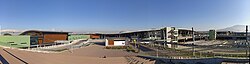
By 2008, the airport had reached its design capacity of 9.5 million passengers. To address this, the Ministry of Public Works implemented a master plan to scale capacity to 30 million passengers by 2022, with long-term goals of reaching 50 million by 2045. This led to the 2015 concession awarded to Nuevo Pudahuel, resulting in the construction of a massive new terminal.
Modern Facilities
Terminal 1: Domestic Operations
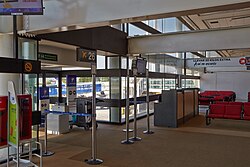
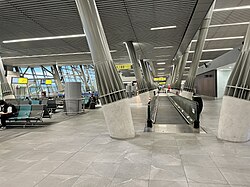
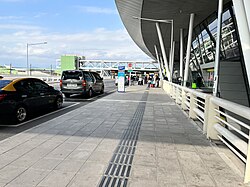
Formerly used for both domestic and international flights, Terminal 1 now primarily handles domestic traffic. It is organized across four levels:
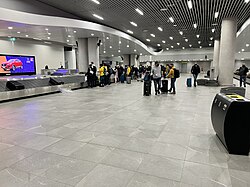
- Ground Floor: Arrivals, baggage claim, transport services, and hotel access.
- First Floor: Administrative offices and VIP lounge access.
- Second Floor: Departures, check-in, baggage drop-off, and boarding gates.
- Third Floor: Restaurants and LATAM VIP check-in.
Terminal 2: International Gateway
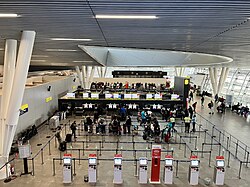
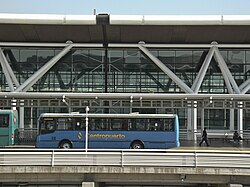
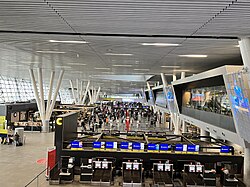
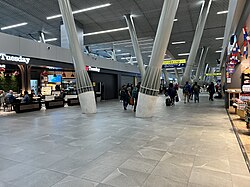
Opened in 2022, Terminal 2 is a state-of-the-art facility covering over 200,000 square meters, representing a $900 million USD investment. It features a central processor (T2M) for arrivals and departures, connected to four specialized piers.
Pier C, opened in 2018, is inspired by Easter Island (Rapa Nui) and features green design elements and 10 boarding bridges. Pier D, opened in 2021, serves both domestic and international flights with warm colors inspired by the Atacama region. Pier F, also opened in 2021, is dedicated to international flights and uses cold colors to evoke the landscapes of Patagonia.
Additional Services and Military Use
The airport is home to a Holiday Inn hotel, internally connected to both terminals, and a widebody aircraft maintenance facility operated by American Airlines. Beyond commercial use, the airport serves as the headquarters for the Chilean Air Force II Air Brigade and the 10th Aviation Group, which manages presidential transport and emergency medical flights using aircraft such as the C-130 Hercules and F-16 Fighting Falcon.
Airport Specifications Summary
| Feature | Details |
|---|---|
| Runways | 17R/35L and 17L/35R (Both 3,800m Asphalt) |
| ILS Category | CAT II & IIIb (Runway 17L) |
| Terminal 2 Area | > 200,000 sq meters |
| Annual Capacity | Increased from 16 to 38 million passengers |
| Main Hubs | LATAM Chile, JetSmart, Sky Airline |
Frequently Asked Questions
Which airlines use SCL as a primary hub?
LATAM Chile, JetSmart, and Sky Airline use the airport as a hub, with LATAM accounting for roughly 82% of all commercial operations.
What is the difference between Terminal 1 and Terminal 2?
Terminal 1 is now primarily used for domestic flights, while the newer, larger Terminal 2 is dedicated to international operations (though Pier D can handle both).
How did the 2010 earthquake affect the airport?
The terminal building suffered internal damage and a pedestrian bridge collapsed, but the runways and control tower remained operational, allowing the airport to serve as a humanitarian air-bridge.
What military units are based at the airport?
The airport hosts the Chilean Air Force II Air Brigade and the 10th Aviation Group, which provides strategic transport and presidential flight services.
What are the design inspirations for the Terminal 2 piers?
The piers are inspired by Chilean geography: Pier C represents Easter Island, Pier D represents the Atacama region, and Pier F represents Patagonia.