Arthur Witty: The British Pioneer of FC Barcelona
In the early days of Spanish football, few figures were as influential as Arthur Witty, also known as Don Arturo. A British-born entrepreneur and athlete, Witty played a pivotal role not only as a player and president of FC Barcelona but also as a commercial bridge between the United Kingdom and Spain. His legacy extends from the pitch to the boardroom, helping shape one of the most famous sporting institutions in the world.
Key Facts
- Full Name: Arthur Witty Cotton.
- Role: Player, President, and Businessman.
- Club Presidency: Served as FC Barcelona president from 1903 to 1905.
- Footballing Achievement: Played in the first-ever Copa del Rey final in 1902.
- Business Legacy: Founded the Witty Group, a shipping and trading company still operating today.
- Lifespan: 1878–1969.
Early Life and British Influence
Arthur Witty was born in Barcelona in 1878 to Frederick Witty, a British entrepreneur from Yorkshire. Frederick had originally intended to move to Argentina but settled in Spain instead, founding a shipping agency in 1873. This business, later known as Witty Sociedad Anónima (Witty S.A.), established vital trade links between Spain and the UK.
Arthur and his brother, Ernest, were educated at the Merchant Taylors' School in Merseyside. At the time, the school viewed sport as essential for a young man's development. During his studies, Arthur played as a forward for Waterloo FC, a local rugby union team. This sporting foundation proved crucial when the brothers returned to Barcelona to join the family business.
The Birth of a Football Legend
Upon returning to Spain, the Witty brothers found a lack of suitable pitches for rugby union. To fill this void, they began organizing football matches between various company employee teams. Through Ernest's connection with Joan Gamper—the founder of FC Barcelona in October 1899—the brothers became deeply involved with the new club.
The Wittys provided the club with essential equipment, importing regulation balls, nets, and referees' whistles from England. There is also a long-standing legend that the club's iconic blaugrana (blue and red) colors were inspired by the Merchant Taylors' rugby team, though other sources credit FC Basel or the canton of Zurich. Regardless of the origin, the Old Merchant Taylors' BaaBarians hockey team continues to wear FC Barcelona shirts as their away strip in honor of Arthur Witty.
On-Field Success
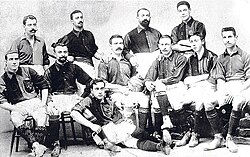
Witty's playing career was marked by several milestones. In December 1899, he scored the only goal in a 1–0 victory for an "English Select" team against FC Barcelona (a game in which he actually played for the opposition). He made his official debut for the club on Christmas Eve 1899 in a 3–1 win over Català SC.
As a primarily full-back (a defensive position), Witty helped the club secure its first trophy, the Copa Macaya, in 1902. That same year, he competed in the inaugural Copa del Rey, where Barcelona defeated Madrid FC 3–1 before falling 2–1 to Club Vizcaya in the final. He also contributed to winning the Copa Barcelona in 1903, totaling 74 appearances between 1899 and 1905.
Presidency and Club Growth
On September 17, 1903, Arthur Witty was appointed president of FC Barcelona. His tenure was characterized by modernization and expansion. He introduced young reserve players, including Romà Forns, and moved home games to the Carrer Muntaner to accommodate a growing fan base.
Witty was also responsible for the club's first international venture. On May 1, 1904, FC Barcelona traveled abroad to defeat Stade Olympien des Étudiants Toulousains 3–2. The French team later visited Barcelona for the inaugural game at Carrer Muntaner, which the home side won 4–0. Witty concluded his presidency on October 6, 1905.
Business Career and Later Years
Beyond sports, Witty was a titan of industry. Alongside his son, Frederick Jr., he expanded the family business to introduce global brands like Cadburys, Unilever, Bovril, and Johnnie Walker to the Spanish market. He also led the Barcelona Ship Agents Association until 1936.
His relationship with FC Barcelona cooled in 1924 following a controversy involving the British Royal Marine band. After the band was jeered for attempting to play the Spanish national anthem and subsequently played "God Save the Queen," Witty became disillusioned with the politicization of the club. While he remained a fan, he distanced himself from official club affairs.
During the Spanish Civil War, the Witty company avoided takeover by workers' committees because of its British ownership. Although he left Spain during World War II, Witty returned during the Franco era to resume his role as a leading shipping agent and open a successful sports shop with his brother.
Career Summary
| Category | Details / Achievements |
|---|---|
| Playing Position | Full-back / Forward |
| Club Appearances | 74 total (41 domestic league) |
| Presidency Term | 1903–1905 |
| Major Trophies | Copa Macaya (1902), Copa Barcelona (1903), Campionat de Catalunya (1905) |
| Business Ventures | Witty Group (Shipping & Trading) |
Frequently Asked Questions
Who was Arthur Witty?
Arthur Witty was a British-born businessman and athlete who served as both a player and the president of FC Barcelona in the early 20th century.
Did Arthur Witty influence FC Barcelona's colors?
According to legend, the Witty brothers imported the blaugrana colors from their former school, Merchant Taylors'. However, this is debated, as other sources suggest the colors were inspired by FC Basel or the canton of Zurich.
What was Witty's contribution to the club's equipment?
Using his family's shipping business, Witty imported essential football gear from England, including regulation balls, nets, and referees' whistles.
Why did Arthur Witty distance himself from FC Barcelona?
Witty became disillusioned with the club's increasing politicization following a 1924 incident where a British Royal Marine band was jeered while playing the Spanish national anthem.
What happened to the Witty family business?
The family company, the Witty Group, successfully introduced several major international brands to Spain and continues to operate today.