Artamidae: The Diverse World of Butcherbirds, Woodswallows, and Currawongs
The Artamidae are a fascinating family of passerine (perching) birds primarily found across Australia, Southern Asia, and the Indo-Pacific region. This diverse group encompasses 24 extant species divided into six genera and three distinct subfamilies. From the melodic songs of the butcherbirds to the nomadic flights of the woodswallows, these birds occupy a wide array of ecological niches.
Historically, the family was monotypic, consisting only of woodswallows. However, in 1994, the family was expanded to include the Cracticidae (butcherbirds and currawongs), though some researchers continue to treat them as separate entities. Whether grouped together or apart, these birds are renowned for their intelligence, varied diets, and complex social behaviors.
Key Facts
- Distribution: Primarily Australasia, including Australia and New Guinea.
- Diversity: 24 living species across three subfamilies: Artaminae, Cracticinae, and Peltopsinae.
- Diet: Omnivorous, ranging from nectar-feeding woodswallows to predatory currawongs.
- Unique Trait: Some woodswallows possess powder down, specialized feathers that create a keratin dust for preening.
- Evolution: DNA analysis suggests the lineage has existed in Australasia for 33.7 to 45 million years.
Taxonomy and Evolutionary History
Introduced by Irish zoologist Nicholas Aylward Vigors in 1825, the Artamidae belong to the superfamily Malaconotoidea. This lineage is widespread throughout Australasia and consists of a variety of carnivorous and omnivorous songbirds. Modern genetic research, specifically the analysis of mitochondrial and nuclear DNA, indicates that the group dates back to the late Eocene.
The fossil record also provides insight into their history. Kurrartapu, a species from the Early Miocene found in central Queensland, shared physical characteristics with both Strepera and Cracticus and was similar in size to the black butcherbird.
Distribution and Habitat
While most artamids are found in Australia and New Guinea, their habitat preferences are broad. Many are ecological generalists, thriving in rainforests, woodlands, coastal scrub, pastoral lands, and even urban environments. Some species have adapted remarkably well to city landscapes, despite the fragmentation of native vegetation.
Social structures and movement patterns vary significantly across the family. The black butcherbird is largely solitary or lives in pairs, whereas the white-breasted woodswallow forms flocks or loose colonies. Some species are sedentary, while others, like the masked woodswallow, are nomadic, moving in response to temperature and rainfall changes.
Physical Characteristics
Artamids exhibit a wide range of sizes. The Fiji and ashy woodswallows are relatively small, measuring about 19 cm and weighing 40 g. In contrast, the grey currawong can reach 50 cm in length and weigh up to 440 g.
Their beaks are strong and robust. Members of the Cracticinae subfamily possess a specialized hook-like tooth—a sharp projection on the upper mandible and a notch on the lower—used to sever the bodies of lizards, insects, and small mammals.
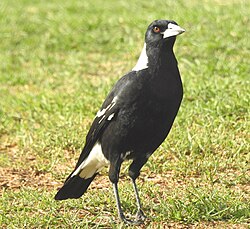
Like all passerines, they have anisodactyl feet (three toes forward, one backward), which allows them to perch effectively on branches and wires. They also possess a syrinx (the vocal organ of birds), enabling the complex and beautiful songs associated with the Australian magpie and pied butcherbird. Osteologically, they feature a notarium, a fused shoulder vertebra that braces the chest against the force of wing movement.
Behavior and Diet
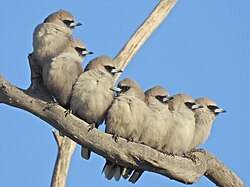
Social clustering is a notable behavior, particularly among woodswallows. By huddling together during the day and night, they retain body heat and utilize a form of social camouflage.
One of the most famous behaviors is the "swooping" of humans by Australian magpies. Research suggests this aggression may be linked to hormone levels, specifically the stress hormone corticosterone.
Feeding strategies are divided into vertical zones. Woodswallows typically occupy the upper canopy, feeding on pollen and insects. Magpies and currawongs generally forage on the ground or swoop from the mid-story. Their diets are opportunistic: woodswallows consume nectar and insects, while larger species like the grey currawong may prey on frogs, skinks, and small birds such as the house sparrow.
Conservation Threats
The primary threat to Artamidae is habitat destruction and fragmentation. The loss of vegetation corridors restricts breeding and travel, often forcing birds into urban areas. This increases the risk of roadkill, as opportunistic feeders may swoop at insects without noticing oncoming traffic.
Additionally, introduced species pose a significant risk. In Australia, feral cats are a major threat, particularly to ground-foraging species like the magpie.
Summary of Artamidae Classification
| Subfamily | Key Genera | Example Species | Primary Diet |
|---|---|---|---|
| Peltopsinae | Peltops | Mountain peltops | Insects/Omnivorous |
| Cracticinae | Cracticus, Gymnorhina, Strepera | Australian magpie, Pied currawong | Meat, Fruit, Insects |
| Artaminae | Artamus | Masked woodswallow | Insects, Nectar |
Frequently Asked Questions
What is the difference between butcherbirds and woodswallows?
Butcherbirds (Cracticinae) are generally larger, more sedentary, and more predatory, often using a hooked beak to kill prey. Woodswallows (Artaminae) are typically smaller, more social, and often nomadic, feeding heavily on insects and nectar.
Why do Australian magpies swoop humans?
While not fully understood, evidence suggests that swooping is influenced by hormone levels, specifically the stress hormone corticosterone, likely as a means of territorial or brood defense.
What is powder down?
Powder down consists of specialized feathers found in some woodswallows. The tips of the barbules disintegrate into a fine keratin powder, which the birds spread across their plumage during preening.
Are Artamidae birds endangered?
While the family as a whole is widespread, many species face localized threats from habitat fragmentation and predation by introduced species like feral cats.
What is an anisodactyl foot?
An anisodactyl foot is an arrangement where three toes point forward and one points backward, a characteristic of passerines that allows them to grip horizontal perches like tree branches.