Arnold Constable & Company: The Rise and Fall of a New York Retail Empire
Long before the era of modern shopping malls, Arnold Constable & Company stood as a titan of American retail. From its humble beginnings as a small dry goods store in lower Manhattan to its status as one of the largest business establishments in the world, the company mirrored the growth and shifting demographics of New York City itself.
The Early Years and Founding
The story began in 1825 when Aaron Arnold, an immigrant from the Isle of Wight, opened a small dry goods store—businesses specializing in textiles, clothing, and household linens—at 91 Front Street. As the business grew, Arnold moved to a larger space on Pine Street and partnered with his nephews, George and James Hearn. This partnership operated as Arnold and Hearn until 1842.
A pivotal shift occurred in 1842 when James Mansell Constable, an employee who married Arnold's daughter, became a partner. By 1853, the firm officially adopted the name Arnold Constable & Company, setting the stage for an era of unprecedented expansion.
Strategic Migrations and the "Palace of Trade"
In 1857, the company moved to a four-story white marble building at 309-311 Canal Street, featuring frontages on Howard and Mercer Streets. During a period of national inflation, the store innovated by issuing monthly charge bills of credit to customers, replacing the traditional bi-annual system.
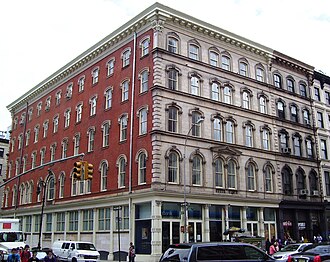
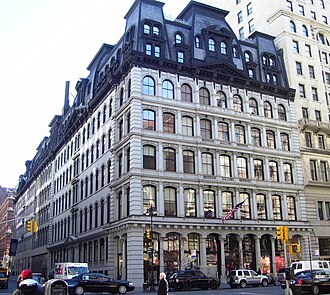
By 1862, the firm added a five-story building at 307 Canal and added a fifth floor to the original structure. However, the company's ambition soon outgrew Canal Street. In 1869, they moved to Broadway and East 19th Street into a marble building designed by Griffith Thomas. This move helped establish the Ladies' Mile, a premier shopping district for high-end fashion.
Newspapers dubbed this new location the "Palace of Trade." The facility expanded in 1872 to include upholstery and carpets, and by 1877, it extended through the block to Fifth Avenue to house a wholesale department. By 1897, the New York Herald reported that the company was the fifth largest real-estate owner in New York City, owning an office building at Fifth Avenue and East 18th Street that connected to the main emporium.
Global Reach and the Move Uptown
The company's influence extended beyond American shores thanks to Clark Lawrence Sharpstein. After serving as a clerk and driving the move to Broadway, Sharpstein was sent to Paris on buying trips. In 1855, he established a Paris branch and became a partner in the firm. The company also operated a store in London, a testament to its international prestige.
As New York's wealthy population migrated north, Arnold Constable followed. In 1914, the company moved to a massive space at Fifth Avenue and 40th Street, occupying the site of the former Vanderbilt mansion. This location is now home to the Mid-Manhattan Library of the New York Public Library.
Key Facts
- Founded: 1825 by Aaron Arnold at 91 Front Street.
- Innovation: One of the first retailers to offer monthly credit bills to combat inflation.
- Real Estate: Ranked as the 5th largest real-estate owner in NYC by 1897.
- Global Presence: Operated branch stores in Paris and London.
- Legacy Site: Their 1914 flagship location is now the Mid-Manhattan Library.
The Transition to Suburbs and Final Years
The mid-20th century brought a shift in consumer habits. In 1925, Arnold Constable partnered with specialty retailer Stewart & Company to expand into the suburbs. Starting with a New Rochelle location in 1937, the company opened branches in Manhasset, Hempstead, Upper Darby Township, and New Jersey.
| Era/Date | Location/Milestone | Key Development |
|---|---|---|
| 1825 | 91 Front Street | Company founded by Aaron Arnold |
| 1857 | Canal Street | Move to white marble "dry goods palace" |
| 1869 | Broadway & E 19th St | Pioneered the "Ladies' Mile" district |
| 1914 | Fifth Ave & 40th St | Move to former Vanderbilt mansion site |
| 1937+ | Suburban Branches | Expansion into NY, NJ, and PA |
| 1975 | Main Store | Complete closure of the flagship store |
By the 1960s, the rise of shopping malls led to the decline of standalone stores. The company had 11 to 12 American stores during this decade, but eventually, the 10 suburban branches closed. In 1961, the main store was sold to the New York Public Library, though the company leased back the lower floors until 1974. The flagship finally closed in March 1975.
The company attempted to pivot with mall stores under the Garment District and NoName brands—the latter of which famously featured no logo or name on its storefronts. In the 1990s, the remaining operations were sold to the Canadian retailer Y M Inc., which currently operates the Annie Sez, Mandee, and Afaze chains.
Frequently Asked Questions
What was the "Palace of Trade"?
The "Palace of Trade" was the nickname given by newspapers to Arnold Constable's marble building on Broadway and East 19th Street, which opened in 1869 and became a cornerstone of the Ladies' Mile Shopping District.
How did Arnold Constable innovate customer payments?
During a period of inflation, the store became one of the first to issue charge bills of credit to customers on a monthly basis, rather than the standard bi-annual billing cycle.
Where is the 1914 flagship store located today?
The site of the 1914 store at Fifth Avenue and 40th Street (the former Vanderbilt mansion) is now the Mid-Manhattan Library of the New York Public Library.
Did Arnold Constable operate outside of the United States?
Yes, the company expanded into Europe, establishing a branch in Paris in 1855 and operating a store in London.
What happened to the "NoName" stores?
The NoName stores were a later attempt to survive in malls; they literally had no name or logo on their storefronts. The remaining operations were eventually sold to Y M Inc. in the 1990s.