Aristotle's Politics: A Comprehensive Analysis of Governance and Statecraft
Aristotle's Politics is a foundational work of political science that examines the nature of the state, the structure of various constitutions, and the requirements for human flourishing within a community. Spanning Bekker sections 1252a to 1342b, the work is divided into eight books, moving from the smallest unit of society—the household—to the complex dynamics of the polis (the Greek city-state).
Key Facts
- The State's Purpose: The state is a creation of nature intended to enable its members to live well and achieve a self-sufficient life.
- Constitutional Hierarchy: Aristotle ranks constitutions from best to worst: Monarchy, Aristocracy, Polity, Democracy, Oligarchy, and Tyranny.
- Wisdom of the Crowd: Collectively, a large group of ordinary people may make better decisions than a small group of experts.
- Political Stability: Instability often arises from factionalism driven by perceived inequality in power, status, or resources.
- Civic Virtue: The ultimate goal of a good state is to promote the virtues of its citizens.
The Foundation of Society: Household and Nature
Aristotle begins by analyzing the components of the household. He argues that the state is a natural evolution of human association. However, he makes a sharp distinction between different types of rule: rule over slaves is despotic, rule over children is kingly, and rule over a wife is political.
A significant portion of Book I is dedicated to the concept of natural slavery. Aristotle suggests that only those who lack the capacity for self-governance—differing from free humans as much as beasts differ from humans—are slaves by nature. He acknowledges that many are slaves solely by law or convention, though he personally believed natural slaves existed.
Aristotle also distinguishes between oikonomikē (household management) and chrematistics (the art of wealth accumulation). He criticizes the pursuit of excessive wealth and the practice of charging interest, arguing that money is merely a symbol of wealth and that interest is "contrary to nature" because it grows by itself rather than through exchange.
Classifying Constitutions and Governance
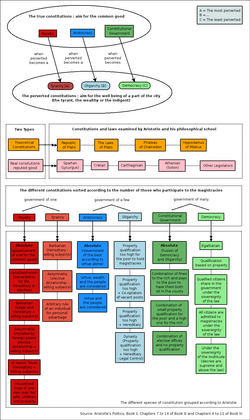
Aristotle categorizes governments based on who holds power and whether that power is used for the common good (good form) or selfish interest (bad form).
| Who Rules? | Good Form (Virtuous) | Bad Form (Corrupt) |
|---|---|---|
| One Person | Monarchy | Tyranny |
| Few People | Aristocracy | Oligarchy |
| Many People | Polity / Timocracy | Democracy |
The Dynamics of State Decay
Aristotle proposes a natural lifecycle for states. A state often begins as a monarchy founded by an outstanding individual. As more virtuous people emerge, it shifts toward an aristocracy. However, corruption typically leads to an oligarchy, which may then devolve into tyranny and eventually democracy. He notes that democracy is often hard to avoid in this cycle.
The Role of the Demagogue
In decaying democracies, Aristotle identifies the demagogue as a primary catalyst for instability. Much like toadies in a monarchy, demagogues flatter the rulers or the masses to exercise power irresponsibly, often leading the state toward tyranny or provoking an oligarchic coup.
Political Instability and Maintenance
Factionalism is the primary driver of political instability. Aristotle observes that people are naturally biased toward self-interest and will join factions if they feel they are not receiving the power or resources they deserve. When two closely matched factions struggle for power without a buffer institution, the state becomes highly volatile.
Strategies for Stability
- Inclusive Governance: Give non-citizens a voice and avoid locking the masses out of the economy.
- Middle-Class Strength: Strengthen the middle class to prevent extreme polarization between the very wealthy and the very poor.
- Anti-Corruption: Ensure political offices are not sources of financial profit.
- Strategic Rhetoric: Rulers should project an image that appeals to the faction they do not represent (e.g., an oligarch calling himself a champion of the common man).
The Mechanics of the Polis
Aristotle suggests that the ideal polis should borrow elements from both oligarchy and democracy. He notes that democracies thrive in agricultural communities where citizens are too busy with their farms to interfere daily in government, allowing wealthy urbanites to manage affairs while the people retain the right to audit them.
He outlines a necessary bureaucracy for any functioning state, including officials to oversee religion, defense, the treasury, commerce, land management, courts, records, and audits. Interestingly, he recommends that law enforcement be handled by rotating militia members rather than professionals, as the nature of the work often attracts the "worst sort" of people.
Human Flourishing and Education
The ultimate purpose of the state is to promote human flourishing. This requires biological survival, a good character (virtues), and material comforts. Aristotle argues that material goods should only be pursued as a means to practice virtue, not as an end in themselves.
To achieve this, the state must prioritize education. Aristotle recommends starting with gymnastic training at a young age, followed by intellectual and musical education, emphasizing moderation to avoid the extremes seen in societies like Sparta.
Frequently Asked Questions
What is the difference between a Polity and a Democracy in Aristotle's view?
A Polity is considered a "good" or virtuous form of rule by the many, focusing on the common interest and often blending democratic and oligarchic elements. Democracy, in Aristotle's classification, is the "bad" or corrupt form where the majority rules purely in its own self-interest.
Why did Aristotle believe interest on loans was contrary to nature?
He argued that money is intended to be a medium of exchange, not a productive asset. Because interest allows money to increase by itself without being used in a productive exchange of goods or services, he viewed it as an unnatural use of wealth.
How does the "wisdom of the crowd" apply to Aristotle's politics?
Aristotle suggested that while individual ordinary citizens might not be as qualified as a few experts, collectively they can be better. This provides a justification for broad political participation in decision-making.
What are the essential components of a successful state?
According to Aristotle, a state needs a reliable food supply, a skilled workforce, arms, money, a dedicated priesthood, a clear decision-making process, and a comfortably wealthy ruling class to function effectively.
How should a tyrant maintain power according to Aristotle?
Aristotle advises tyrants to bestow honors personally but delegate punishments to others to avoid being hated. He also suggests identifying the most powerful faction (either the common people or the propertied class) and declaring themselves the champion of that group.