Argentina's 20th Century Coups and Military Dictatorships
Throughout the 20th century, Argentina experienced a turbulent political landscape marked by seven distinct coups d'état. Between 1930 and 1983, the nation cycled through periods of democratic governance and military rule, with the military holding power for a total of 25 years. During this 53-year span, 14 different dictators assumed the title of "president," averaging one new leader every 1.7 years.
These interventions evolved over time. While the early coups typically established interim governments, the later regimes adopted a bureaucratic-authoritarian state model—a system characterized by permanent military rule and a structured, technocratic approach to governance. The most severe of these periods involved state terrorism and the systematic violation of human rights, known as the Dirty War.
Key Facts
- Total Coups: Seven occurred between 1930 and 1981.
- Duration of Rule: Military regimes governed for 25 years out of a 53-year period.
- Regime Evolution: Shifted from provisional interim dictatorships to permanent bureaucratic-authoritarian states.
- Human Rights: The final two major dictatorships conducted a "Dirty War" involving tens of thousands of forced disappearances.
- International Context: Later regimes were part of Operation Condor, a coordinated repression effort among South American militaries and the US.
The Early Interim Dictatorships (1930–1962)
The Coup of 1930
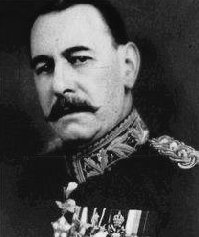
On September 6, 1930, General José Félix Uriburu led a military uprising that overthrew the democratically elected President Hipólito Yrigoyen of the Radical Civic Union. In a significant break from precedent, Uriburu dissolved Parliament. Ironically, Uriburu had previously helped organize the Revolution of the Park, the very movement that had originally empowered the Radical Civic Union.
The Revolution of '43
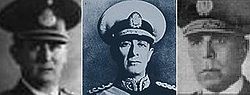
The coup of June 4, 1943, established a military government that differed from its predecessors by eventually facilitating a return to democracy. This period ended with elections on February 24, 1946, which were widely accepted as fair. Juan Domingo Perón won these elections and assumed the presidency on June 4, 1946, though he would later be overthrown himself in 1955.
The Revolución Libertadora (1955)
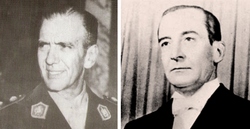
Between September 16 and 23, 1955, a coup known as the Revolución Libertadora overthrew Juan Domingo Perón. Eduardo Lonardi was sworn in as president and dissolved Congress. A pivotal institutional change during this regime was the abolition of the 1949 Constitution, which was replaced by the 1853 text. Later, in 1957, a Constitutional Convention added "article 14bis" to the constitution, though the Justicialist Party was prohibited from participating in the convention.
The 1962 Coup and the Civilian Exception
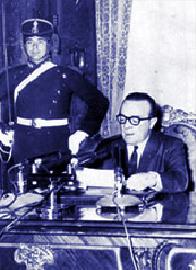
The coup of March 29, 1962, which ousted Arturo Frondizi, was unique because power was not seized by a military officer. Following the uprising led by General Raúl Poggi, Frondizi was arrested and held at Isla Martín García. While the military leaders hesitated to formally assume power, José María Guido, a senator and temporary president of the senate, was sworn in as president on March 30. Guido remains the only civilian dictator in this series of coups.
The Rise of the Bureaucratic-Authoritarian State (1966–1983)
The Argentine Revolution (1966–1973)
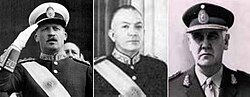
On June 28, 1966, General Juan Carlos Onganía overthrew President Arturo Illia. Unlike previous coups, this regime—calling itself the "Argentine Revolution"—did not claim to be provisional. It established a permanent government based on the bureaucratic-authoritarian state model, characterized by a fascist-Catholic-anticommunist ideology and support from the United States and Europe.
This regime introduced a statute that held superior judicial authority over the constitution. Internal military conflicts led to three successive dictators: Juan Carlos Onganía, Marcelo Levingston, and Alejandro Agustín Lanusse. Facing popular insurrection, the regime eventually held elections in 1973, won by Héctor José Cámpora, who later resigned to allow Juan Perón to return to power.
The National Reorganization Process (1976–1983)
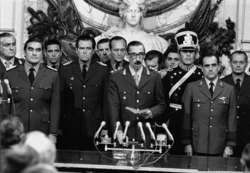
The most brutal period began on March 24, 1976, when a military uprising overthrew President Isabel Perón. This regime, the "National Reorganization Process," was governed by a military junta representing three military factions. This period was defined by state terrorism and the "Dirty War," involving systematic human rights violations and forced disappearances.
The regime was managed by four successive juntas, starting with Jorge Rafael Videla. This dictatorship coordinated repression with other South American military regimes through Operation Condor. The regime's collapse was triggered by the defeat in the 1982 Falklands War against the United Kingdom. This led to elections on October 30, 1983, won by Raúl Alfonsín, marking the return to democracy.
The Internal Coup of 1981
Within the National Reorganization Process, an internal power struggle occurred in late 1981. The junta declared President Roberto Eduardo Viola incapable of serving due to health issues, specifically coronary insufficiency and hypertension. After Viola refused to resign, he was relieved of his duties, and General Leopoldo Fortunato Galtieri took office on December 22, 1981.
Summary of Argentine Military Coups
| Year | Regime/Event Name | Type of Government | Key Figure(s) |
|---|---|---|---|
| 1930 | Coup of Sept 6 | Interim | José Félix Uriburu |
| 1943 | Revolution of '43 | Interim | Rawson, Ramírez, Farrell |
| 1955 | Revolución Libertadora | Interim | Eduardo Lonardi |
| 1962 | Coup of March 29 | Interim (Civilian) | José María Guido |
| 1966 | Argentine Revolution | Permanent (BA State) | Onganía, Levingston, Lanusse |
| 1976 | National Reorganization Process | Permanent (BA State) | Videla, Viola, Galtieri |
| 1981 | Internal Junta Shift | Permanent (BA State) | Leopoldo Galtieri |
Legal and Constitutional Aftermath
The cycle of coups created significant legal challenges, most notably the "de facto government doctrine" used by the Supreme Court. There was a clear escalation in violence and a decline in legal adherence as the century progressed. To prevent future collapses of the constitutional order, the 1994 amendment to the Argentine Constitution introduced Article 36, specifically designed for the defense of democracy and the constitutional order.
Frequently Asked Questions
What is a bureaucratic-authoritarian state?
It is a model of permanent military dictatorship, analyzed by political scientist Guillermo O'Donnell, where the military establishes a structured, long-term government rather than a provisional one, often utilizing technocratic management and suppressing political opposition.
Who was the only civilian to lead a coup-installed government?
José María Guido was the only civilian dictator. He assumed the presidency on March 30, 1962, after the military overthrew Arturo Frondizi but before the military leaders had formally organized their own takeover.
What was Operation Condor?
Operation Condor was a coordinated campaign of political repression and state terrorism conducted by the right-wing military dictatorships of South America (including Argentina, Brazil, Chile, and others) with the support of the United States.
How did the Falklands War affect the military regime?
The military defeat in the 1982 Falklands War against the United Kingdom severely undermined the legitimacy of the third military junta, sparking the eventual fall of the dictatorship and leading to the democratic elections of 1983.
What is the significance of Article 36 of the National Constitution?
Added during the 1994 constitutional amendment, Article 36 serves as a legal mechanism to defend democracy and the constitutional order, specifically aimed at preventing the establishment of future de facto governments.