Anyang Halla: The Rise of a South Korean Ice Hockey Powerhouse
Founded in 1994 by the Halla Group, Anyang Halla was established with a dual purpose: to promote the sport of ice hockey within South Korea and to fulfill the group's corporate social responsibility to the community. Originally known as "Mando Winia"—named after the Halla subsidiary Mando and the Winia air conditioner brand—the team's early years were marked by both triumph and turbulence.
The team's resilience was tested during the 1997 Asian financial crisis, which led to a brief disbandment. However, the commitment of Halla Group Chairman Chung Mong-won ensured the team's survival. During its tenure in the Korean Ice Hockey League, the club secured five championships and eventually rebranded as "Halla Winia" before transitioning to the international stage.
Key Facts
- Founded: 1994 by the Halla Group.
- First International Leap: Founding member of the Asia League Ice Hockey (ALIH) in 2003.
- Historic Milestone: First non-Japanese team to finish first in the regular season (2008–09) and win the Championship Cup (2009–10).
- Notable Players: Brock Radunske, Patrik Martinec, and Song Dong-hwan.
- Back-to-Back Titles: Co-champion in 2010 and 2011.
Transition to Asia League Ice Hockey (2003–2007)
In 2003, the team became a founding member of the Asia League Ice Hockey (ALIH). The initial transition was challenging, with the team failing to achieve a .500 winning percentage in a shortened 16-game inaugural season. To accelerate growth, the club recruited Esa Tikkanen, a 20-season NHL veteran, to serve as both a player and coach.
Under the guidance of Tikkanen and later the legendary Czech coach Otakar Vejvoda, the team's performance climbed. By the 2005–06 season, Anyang Halla finished second in the league. This era saw the emergence of star players like Song Dong-hwan, who led the league in goals (31), and Patrik Martinec, who ranked second in assists (44). The city of Anyang was even recognized as "The best Hockey Town in Asia" during this period.
Despite these individual successes, the team struggled in the playoffs. They were eliminated by Kokudo in 2006 and later swept by Kangwon Land and the Nippon Paper Cranes in subsequent years. A recurring strength during this period was their efficiency in short-handed goals (goals scored while the team is playing with fewer players due to a penalty), frequently leading the league in this category.
The Era of Dominance and Championship Glory
A strategic shift occurred in 2007 when head coach Shim Eui-Sik took over. Shim, a former Halla player, aimed to reorganize the squad and move away from a heavy Czech influence. The team hired Samuel H. Kim as a scout and integrated North American talent, bringing in Brock Radunske, Brad Fast, and Jon Awe.
This pivot paid dividends in the 2008–09 season. Anyang Halla finished first in the regular season with 76 points, becoming the first non-Japanese team to do so. Brock Radunske dominated the league, leading in both goals (29) and total points (57). Although they lost a grueling seven-game semi-final to the Nippon Paper Cranes, the foundation for a title was set.
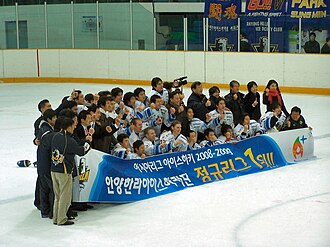
The 2009–10 season was a testament to the team's depth. Despite a wave of injuries to key imports like Jon Awe and Brad Fast, the team clinched first place for the second consecutive year. They eventually defeated their rivals, High1, in the semi-finals to reach the Championship Cup.
In a historic final against the Nippon Paper Cranes, Anyang Halla won the series in five games, with Brock Radunske scoring two overtime winners. This victory marked the first time a non-Japanese team won the Asia League Championship. Radunske was named MVP, and Shim Eui-Sik was named Coach of the Year.
The 2011 Co-Championship
Halla continued its success into the 2010–11 season, defending their Korea Domestic Championship title. Although they finished fourth in the regular season, they displayed strong defensive play, allowing the second-fewest goals in the league.
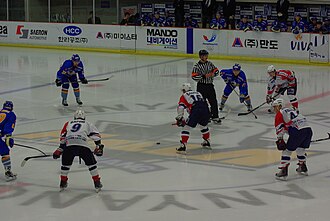
After defeating the Oji Eagles in the first round of the playoffs, Halla prepared to face the Tohoku Free Blades in the finals in Sendai, Japan. However, a magnitude 9.0 earthquake struck the region shortly after the team's arrival. Due to the disaster, the league cancelled the final series and awarded co-championship titles to both Anyang Halla and the Tohoku Free Blades, making Halla a back-to-back champion.
Team Performance Summary
| Season/Period | Key Achievement | Notable Stat/Player |
|---|---|---|
| 1994–2003 | 5 Korean League Titles | Founded as Mando Winia |
| 2005–06 | 2nd Place (ALIH) | Song Dong-hwan (31 goals) |
| 2008–09 | 1st Place Regular Season | Brock Radunske (57 points) |
| 2009–10 | ALIH Champions | First non-Japanese winner |
| 2010–11 | Co-Champions | Awarded due to Sendai earthquake |
Frequently Asked Questions
Why was the team originally called Mando Winia?
The name was derived from the Halla Group's business interests: Mando is a subsidiary company of Halla, and Winia is a brand of air conditioners sold by the company.
Who was the first non-Japanese player to lead the league in points for Halla?
Brock Radunske led the league in both goals (29) and points (57) during the 2008–09 season.
How did Anyang Halla achieve back-to-back championships in 2010 and 2011?
They won the 2009–10 Championship Cup outright by defeating the Nippon Paper Cranes. In 2011, they were awarded a co-championship with the Tohoku Free Blades after the finals were cancelled due to a 9.0 magnitude earthquake in Sendai.
What role did Patrik Martinec play in the team's success?
Martinec was a consistent offensive force, leading the league in assists and points in multiple seasons, and was named MVP and Best Playmaking during the 2009–10 season. He later transitioned into an assistant coaching role.
What is the significance of the 2008–09 regular season?
It was the first time in the history of the Asia League that a non-Japanese team finished the regular season in first place.