Antimony: Properties, Production, and Industrial Applications
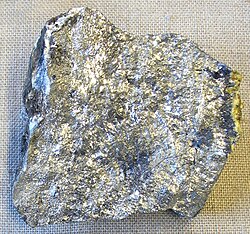
Antimony (symbol Sb, atomic number 51) is a silvery, lustrous gray metalloid located in group 15 of the periodic table, known as the pnictogens. Characterized by its brittle nature and unique chemical versatility, antimony plays a critical role in modern industry, ranging from safety-critical flame retardants to advanced infrared technology.
The element's name is thought to derive from the Greek words anti ("not") and monos ("alone"), reflecting the fact that it is rarely found occurring alone in nature. Its chemical symbol, Sb, comes from the Latin word stibium, referring to the mineral stibnite.

Key Facts
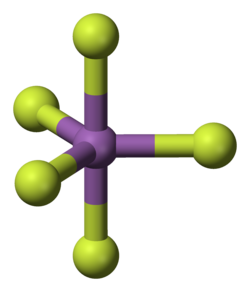
- Atomic Number: 51
- Standard Atomic Weight: 121.760 ± 0.001
- Primary Ore: Stibnite (Sb2S3)
- Classification: Metalloid (p-block)
- Major Use: Flame retardants and alloys
- Critical Status: Recognized as a critical raw material by the European Union
Physical and Chemical Properties
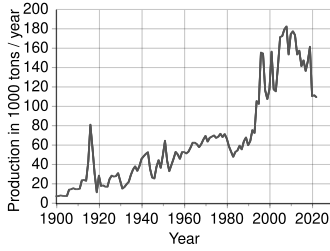
![World antimony output in 2010[66]](/images/a3/a3/a3a31de3af3710867db5a5dbf9bcf07d3a06a7d7ce3e51d2f7dfb5fa2bf66089.webp)
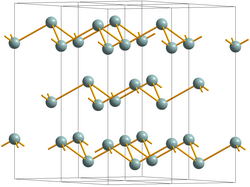
At standard temperature and pressure, antimony is a solid with a rhombohedral crystal structure. It is diamagnetic and possesses a Mohs hardness of 3.0. While it is highly brittle in its crystalline form, historical artifacts suggest ancient civilizations may have possessed a lost art of rendering the metal malleable.
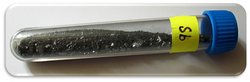
Chemically, antimony exhibits several oxidation states, most commonly −3, +3, and +5. It is primarily found in the Earth's crust at a concentration of approximately 0.2 parts per million, making it the 63rd most abundant element. Although not highly abundant, it is present in over 100 different mineral species.
Isotopes of Antimony
Antimony has two stable isotopes: 121Sb (57.21% abundance) and 123Sb (42.79% abundance). There are also 37 known artificial radioactive isotopes, with 125Sb being the longest-lived fission product, featuring a half-life of 2.758 years.
Occurrence and Production
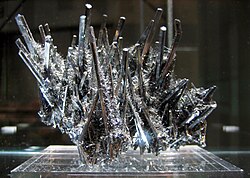
The predominant ore mineral for antimony is stibnite (Sb2S3), a sulfide mineral. Other sulfide minerals containing antimony include pyrargyrite, zinkenite, jamesonite, and boulangerite.
Production typically involves the reduction of stibnite with iron or the reduction of antimony oxides with carbon. In 2022, global production was dominated by China, which accounted for 54.5% of the total output, followed by Russia (18.2%) and Tajikistan (15.5%).
| Country | Production (Tonnes) | Percentage of Total |
|---|---|---|
| China | 60,000 | 54.5% |
| Russia | 20,000 | 18.2% |
| Tajikistan | 17,000 | 15.5% |
| Myanmar | 4,000 | 3.6% |
| Australia | 4,000 | 3.6% |
| Total World | 110,000 | 100% |
Industrial Applications
Antimony is indispensable in several high-tech and safety sectors. One of its most prominent uses is in the production of flame retardants, particularly antimony trioxide, which is used in plastics and textiles.
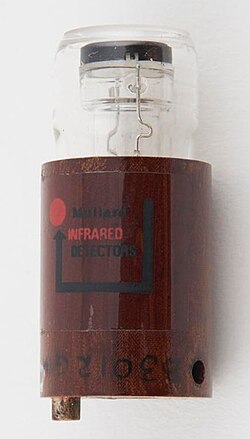
In the electronics sector, indium antimonide (InSb) is utilized in the manufacture of infrared detectors. Additionally, antimony is used in various alloys, including pewter, and as a clarifying agent in glass manufacturing.
History and Etymology
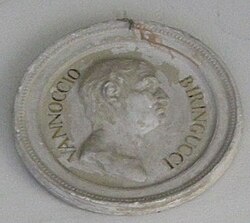
The use of antimony dates back to antiquity. Artifacts from Telloh, Chaldea (modern-day Iraq) dating to 3000 BC, and copper objects plated with antimony from Egypt (2500–2200 BC) indicate early human interaction with the element. In 1540, the Italian metallurgist Vannoccio Biringuccio described a specific procedure to isolate the metal.

Safety and Toxicity
Antimony is classified as a hazardous substance. According to the GHS (Globally Harmonized System), it carries the signal word "Danger" and is associated with toxicity if swallowed or inhaled, as well as potential organ damage through prolonged exposure.

Environmental agencies maintain strict limits on antimony levels in drinking water to prevent toxicity. These limits vary by region, with the European Union and German Federal Ministry of Environment setting a limit of 5 μg/L, while the US EPA and Health Canada set it at 6 μg/L.
Frequently Asked Questions
What is the primary source of antimony?
The primary ore mineral used to extract antimony is stibnite (Sb2S3), a sulfide mineral found in various geological deposits.
Why is antimony considered a critical raw material?
It is considered critical, particularly by the European Union, because it is essential for defense, automotive, construction, and textile industries, yet often relies heavily on imports from a few specific countries.
What are the most common uses of antimony today?
The most common applications include the production of flame retardants for plastics and textiles, the creation of specialized alloys, and the manufacturing of infrared detectors.
Is antimony toxic?
Yes, antimony and its compounds are toxic. They can cause respiratory irritation and organ damage, which is why international health organizations regulate its concentration in drinking water.
Which country is the largest producer of antimony?
China is the world's leading producer, accounting for over 50% of the total global antimony production as of 2022.