Angels in Religious Tradition and Theology
The concept of angels—spiritual messengers and guardians—has persisted across millennia, evolving from early philosophical musings into complex theological systems. From the thinkers of antiquity to the structured doctrines of modern faith traditions, the perception of these non-corporeal beings reflects humanity's enduring attempt to understand the bridge between the divine and the earthly.
Angels in Antiquity
Belief in guardian angels (beings assigned to protect or guide individuals) is not exclusive to modern religion. In antiquity, figures such as Menander and Plutarch, as well as Neo-Platonists like Plotinus, held the view that such beings existed. Early Christian leaders also integrated these ideas into their teachings.
Ignatius of Antioch provided early listings of angels, while Clement of Rome encouraged the faithful to join angels in praising God. Clement of Alexandria described angels as influences that "breathe" into human thoughts and reasonings to provide strength and keener perception. Similarly, Evagrius Ponticus viewed angels as companions and models for human behavior.
Augustine of Hippo further expanded these views, suggesting that "good" angels constantly work to direct humans toward God, the true source of happiness, and encourage the act of worship.
The Pseudo-Dionysian Hierarchy
Around the turn of the 6th century CE, a writer known as Pseudo-Dionysius the Areopagite authored De Coelesti Hierarchia (On the Celestial Hierarchy). This work became one of the most influential frameworks for understanding angelic structure in Christian theology.
Pseudo-Dionysius proposed a system consisting of three levels, or "spheres," with each sphere containing three distinct orders of angels. For centuries, the author's claim to be a convert of Paul the Apostle lent the work immense authority, until the 16th century when Erasmus raised doubts regarding the actual age and authorship of the text.
Perspectives from Major Faith Traditions
The Catholic Church
The Catholic Church defines the existence of angels as a truth of faith. According to the Catechism of the Catholic Church (CCC), the witness of Sacred Scripture and the unanimity of Tradition confirm the existence of these spiritual, non-corporeal beings.
Catholic doctrine teaches that human life is surrounded by the watchful care and intercession of angels from birth until death. Central to this worldview is the belief that Christ is the center of the angelic world; angels belong to Him because they were created through and for Him.
The New Church (Swedenborgianism)
Based on the writings of Emanuel Swedenborg, the New Church offers a distinct interpretation of the spiritual realm. Adherents believe that angels possess spiritual bodies in human form rather than being formless minds. They reside in various orders across three heavens, often organized into societies that can appear as a single angel.
Key tenets of Swedenborgian angelology include:
- Human Origin: All angels originate from the human race; every angel lived in a material body first.
- Children: All children who die enter heaven and eventually become angels.
- Function: Angelic life is defined by "usefulness." Names like Michael, Gabriel, and Raphael represent specific functions rather than individual identities.
- Interaction: Every person is accompanied by at least two angels and two evil spirits. Conflict between these forces manifests as temptation or pains of conscience.
The Latter Day Saint Movement
In the Latter Day Saint movement, angels are viewed primarily as messengers of God sent to deliver doctrines of salvation, call people to repentance, and provide guidance or priesthood keys.
A defining belief in this tradition is that all angels who minister to earth belong or have belonged to it. They are seen as the spirits of deceased or unborn humans, or resurrected beings with physical bodies of flesh and bones. For example, Adam is identified as the archangel Michael, Noah as Gabriel, and the 5th-century prophet-warrior Moroni as the Angel Moroni.
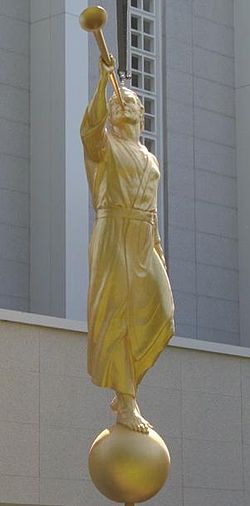
Joseph Smith described his first angelic encounter as a brilliant light filling his room, followed by a personage in a robe of "exquisite whiteness" with a countenance like lightning. Smith and Oliver Cowdery reported visitations from Moroni, John the Baptist, and the apostles Peter, James, and John, as well as later visits from Jesus, Moses, Elias, and Elijah.
Key Facts
- Pseudo-Dionysius established a three-sphere, nine-order hierarchy that dominated Christian angelology for centuries.
- Catholicism views the existence of angels as a fundamental truth of faith and a source of lifelong intercession.
- Swedenborgianism teaches that all angels were once human and that angelic names signify functions rather than individuals.
- Latter Day Saints believe angels are either spirits of humans or resurrected beings with physical bodies.
- Ancient beliefs in guardian angels were shared by Neo-Platonists and early Greek thinkers like Plutarch.
Summary of Angelic Beliefs
| Tradition | Nature of Angels | Origin/Source | Primary Role |
|---|---|---|---|
| Catholicism | Non-corporeal spiritual beings | Created through and for Christ | Intercession and watchful care |
| Swedenborgianism | Human form with spiritual bodies | Former human beings | Usefulness and spiritual guidance |
| Latter Day Saint | Spirits or resurrected humans | Humans (past, present, or future) | Messengers and teachers of doctrine |
| Antiquity | Guardian spirits | Divine/Cosmic order | Protection and moral modeling |
Frequently Asked Questions
Who was Pseudo-Dionysius the Areopagite?
He was a writer around the 6th century CE who created the influential "Celestial Hierarchy." He claimed to be a convert of Paul the Apostle, though Erasmus later questioned the authenticity and age of his works.
Do Swedenborgians believe angels are formless?
No. Adherents of the New Church believe that all angels have a spiritual body in human form and are not merely minds without form.
How does the Latter Day Saint movement view the identity of angels?
They believe angels are humans who are either deceased, not yet born, or have been resurrected. This includes the belief that Adam is Michael and Noah is Gabriel.
What is the role of angels in the Catholic faith?
Angels are seen as powerful helpers who provide watchful care and intercession for human beings from birth until death, centering their existence around Christ.
What is the significance of angelic names in Swedenborgianism?
In this tradition, names such as Michael, Gabriel, and Raphael do not refer to specific individual beings, but rather signify a particular angelic function.