Articles/Amphibians: Biology, Evolution, and Diversity of the World's Semi-Aquatic Vertebrates
amphibiansbatrachologyherpetologyAnuraCaudata
Amphibians: Biology, Evolution, and Diversity of the World's Semi-Aquatic Vertebrates
Amphibians: Biology, Evolution, and Diversity of the World's Semi-Aquatic Vertebrates Amphibians are a unique class of vertebrates that bridge the gap between aquatic and terrestrial life...
Amphibians: Biology, Evolution, and Diversity of the World's Semi-Aquatic Vertebrates
Amphibians are a unique class of vertebrates that bridge the gap between aquatic and terrestrial life. From the tiny frogs of New Guinea to the massive salamanders of China, these creatures exhibit a remarkable range of biological adaptations. The scientific study of amphibians is known as batrachology, while the broader study of both reptiles and amphibians is termed herpetology.
With approximately 8,000 known species, the vast majority—nearly 90%—are frogs. These animals are defined by their ability to live a "double life," often beginning their existence in water and transitioning to land as adults.
Many amphibians—like this Ceratophrys cranwelli—exhibit biofluorescence.[4]: Many amphibians—like this Ceratophrys cranwelli—exhibit biofluorescence.[4]
Key Facts
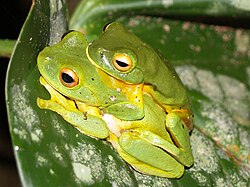
Male orange-thighed frog (Litoria xanthomera) grasping the female during amplexus
Species Count: Approximately 8,000 species, with frogs making up 90% of the population.
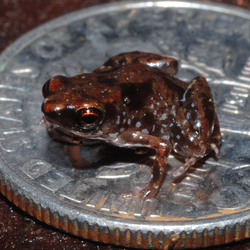
Size Extremes: The smallest vertebrate is the frog Paedophryne amauensis (7.7 mm), while the largest living species is the South China giant salamander (1.8 m).
Temporal Range: They have existed from the Early Carboniferous period (330 Ma) to the present.
Genome Diversity: Amphibians possess some of the largest genomes among vertebrates, particularly salamanders.
Classification: Divided into three modern orders: Anura (frogs), Caudata (salamanders), and Gymnophiona (caecilians).
Classification and Evolutionary History
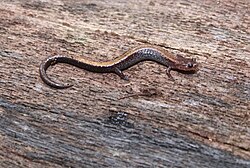
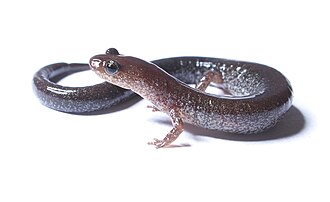
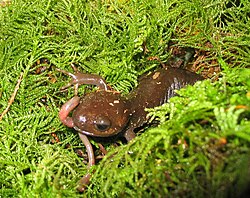
Sexual selection has been studied in the red back salamander
The evolutionary lineage of amphibians is vast, stretching back over 300 million years. They are categorized under the clade Batrachomorpha. While modern amphibians belong to the subclass Lissamphibia, their ancestors included diverse groups such as the Temnospondyli and Lepospondyli.
Prehistoric temnospondyls were often massive predators; for example, Mastodonsaurus could reach lengths of up to 6 meters, dwarfing any living species today.
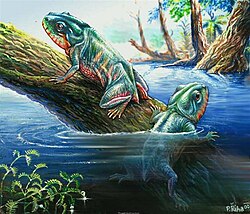
Triadobatrachus massinoti, a proto-frog from the Early Triassic of Madagascar: Triadobatrachus massinoti, a proto-frog from the Early Triassic of Madagascar
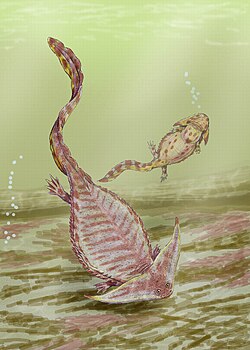
The Permian lepospondyl Diplocaulus was largely aquatic: The Permian lepospondyl Diplocaulus was largely aquatic
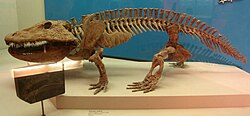
The temnospondyl Eryops had sturdy limbs to support its body on land: The temnospondyl Eryops had sturdy limbs to support its body on land
Modern Amphibian Groups
Anura: This group includes frogs and toads, characterized by a lack of tails in adulthood and specialized limbs for jumping.
Caudata: Salamanders and newts, which typically retain their tails throughout their lives.
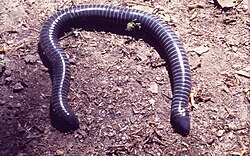
Gymnophiona: Caecilians, which are limbless, serpentine amphibians often found burrowing in soil.
The world's smallest known vertebrate, Paedophryne amauensis, sitting on a U.S. dime. The dime is 17.9 mm in diameter, for scale: The world's smallest known vertebrate, Paedophryne amauensis, sitting on a U.S. dime. The dime is 17.9 mm in diameter, for scale
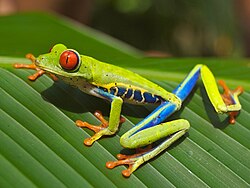
Red-eyed tree frog (Agalychnis callidryas) with limbs and feet specialised for climbing: Red-eyed tree frog (Agalychnis callidryas) with limbs and feet specialised for climbing
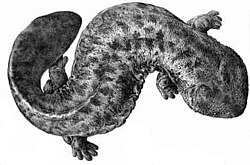
Japanese giant salamander (Andrias japonicus), a primitive salamander: Japanese giant salamander (Andrias japonicus), a primitive salamander
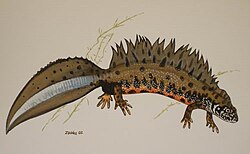
Danube crested newt (Triturus dobrogicus), an advanced salamander: Danube crested newt (Triturus dobrogicus), an advanced salamander
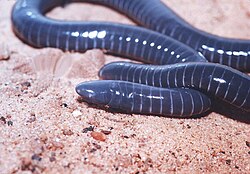
The limbless South American caecilian Siphonops paulensis: The limbless South American caecilian Siphonops paulensis
Anatomy and Physiology
The ringed caecilian (Siphonops annulatus) resembles an earthworm
Amphibian physiology is highly specialized for their dual-environment lifestyle. Their skin is a critical organ, often serving as a respiratory surface (cutaneous respiration) and containing various glands for protection and moisture.
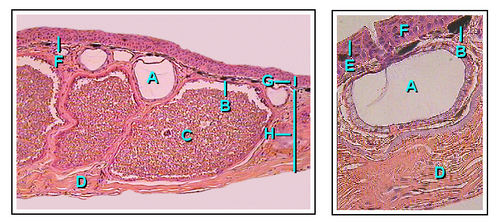
Cross section of frog skin: A. Mucous glandB. ChromatophoreC. Granular poison glandD. Connective tissueE. Stratum corneumF. Transition zoneG. EpidermisH. Dermis: Cross section of frog skin: A. Mucous glandB. ChromatophoreC. Granular poison glandD. Connective tissueE. Stratum corneumF. Transition zoneG. EpidermisH. Dermis
Skeletal and Circulatory Systems
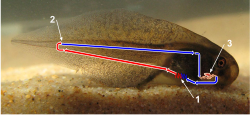
The skeletal structure varies by order, from the reinforced skulls of temnospondyls to the lightweight, jumping-optimized frames of frogs. Their circulatory system evolves as they grow; juvenile amphibians typically have a single-loop system similar to fish, which transitions into a more complex system as they mature.
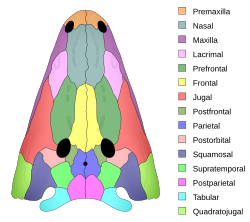
Skull diagram of Xenotosuchus, a temnospondyl: Skull diagram of Xenotosuchus, a temnospondyl
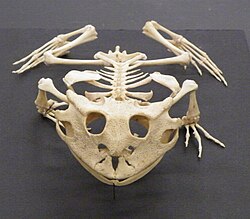
Skeleton of the Surinam horned frog(Ceratophrys cornuta): Skeleton of the Surinam horned frog(Ceratophrys cornuta)
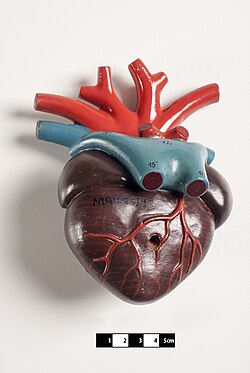
Didactic model of an amphibian heart.: Didactic model of an amphibian heart.
Juvenile amphibian circulatory systems are single loop systems which resemble fish. Internal gills where the blood is reoxygenatedPoint where the blood is depleted of oxygen and returns to the heart via veinsTwo chambered heart Red indicates oxygenated blood, and blue represents oxygen depleted blood.: Juvenile amphibian circulatory systems are single loop systems which resemble fish. Internal gills where the blood is reoxygenatedPoint where the blood is depleted of oxygen and returns to the heart via veinsTwo chambered heart Red indicates oxygenated blood, and blue represents oxygen depleted blood.
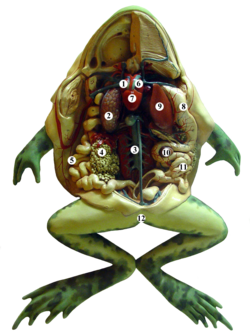
Dissected frog: Right atriumLiverAortaEgg massColonLeft atriumVentricleStomachLeft lungSpleenSmall intestineCloaca: Dissected frog: Right atriumLiverAortaEgg massColonLeft atriumVentricleStomachLeft lungSpleenSmall intestineCloaca
Genetics and Genomics
Amphibians are notable for their extreme genomic diversity. Karyotypes (the number and appearance of chromosomes) have been determined for about 14.5% of known species. Salamanders, in particular, possess massive genomes, with some reaching up to 120.56 picograms of DNA in haploid nuclei.
Life Cycle and Reproduction
Northwestern salamander (Ambystoma gracile) eating a worm
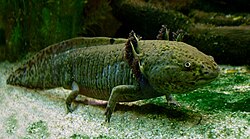
Most amphibians undergo metamorphosis, a biological process of transforming from an aquatic larva to a terrestrial adult. However, some species exhibit neoteny, where they retain larval traits—such as external gills—into adulthood.
The axolotl (Ambystoma mexicanum) retains its larval form with gills into adulthood: The axolotl (Ambystoma mexicanum) retains its larval form with gills into adulthood
Developmental Stages
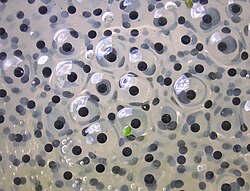
Eggs: Usually laid in water as a mass of jelly-covered embryos (frogspawn).
Larvae: Aquatic stages, such as tadpoles, that breathe through gills.
Adults: Terrestrial or semi-aquatic forms that typically breathe through lungs and skin.
Frogspawn, a mass of eggs surrounded by jelly: Frogspawn, a mass of eggs surrounded by jelly
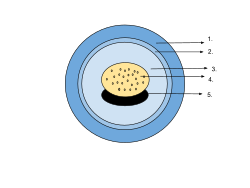
Amphibian egg: Jelly capsuleVitelline membranePerivitelline fluidYolk plugEmbryo: Amphibian egg: Jelly capsuleVitelline membranePerivitelline fluidYolk plugEmbryo
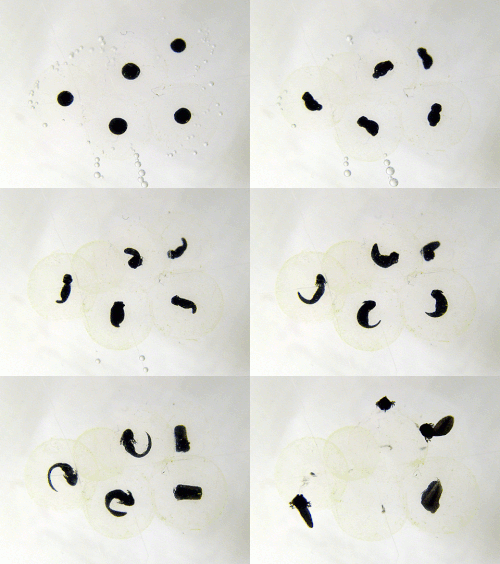
Early stages in the development of the embryos of the common frog (Rana temporaria): Early stages in the development of the embryos of the common frog (Rana temporaria)
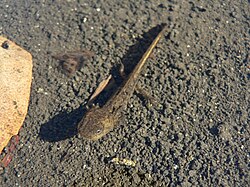
Larva of the long-toed salamander (Ambystoma macrodactylum): Larva of the long-toed salamander (Ambystoma macrodactylum)
Larva of the long-toed salamander (Ambystoma macrodactylum): Larva of the long-toed salamander (Ambystoma macrodactylum)
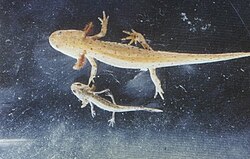
Larvae of the alpine newt (Ichthyosaura alpestris): Larvae of the alpine newt (Ichthyosaura alpestris)
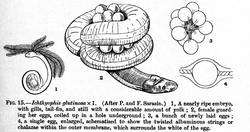
The caecilian Ichthyophis glutinosus with eggs and developing embryo: The caecilian Ichthyophis glutinosus with eggs and developing embryo
Parental Care
Parental strategies vary wildly. Some species provide no care, while others exhibit complex behaviors, such as male rocket frogs carrying tadpoles on their backs or midwife toads carrying eggs.
Male common rocket frog (Colostethus panamensis) carrying tadpoles on his back: Male common rocket frog (Colostethus panamensis) carrying tadpoles on his back
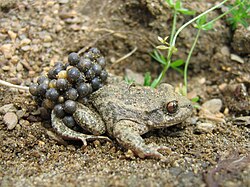
Male common midwife toad (Alytes obstetricans) carrying eggs: Male common midwife toad (Alytes obstetricans) carrying eggs
Amphibians employ a variety of strategies for survival, ranging from vocal communication to chemical warfare. Many species use vocalization to attract mates or defend territories, often utilizing specialized air sacs.
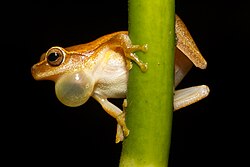
Male treefrog (Dendropsophus microcephalus) inflating his air sac as he calls: Male treefrog (Dendropsophus microcephalus) inflating his air sac as he calls
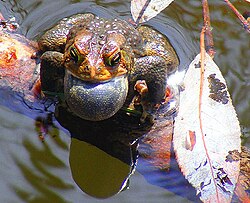
American toad (Anaxyrus americanus) singing: American toad (Anaxyrus americanus) singing
Defense and Toxicity
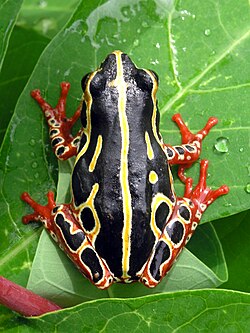
To deter predators, many amphibians produce toxins. These are often signaled by aposematism (warning coloration), such as the bright hues of the golden poison frog, one of the most poisonous animals on Earth.
The bright colours of the common reed frog (Hyperolius viridiflavus) are typical of a toxic species: The bright colours of the common reed frog (Hyperolius viridiflavus) are typical of a toxic species
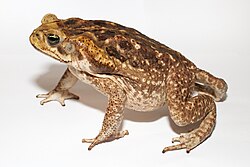
Cane toad (Rhinella marina) with poison glands behind the eyes: Cane toad (Rhinella marina) with poison glands behind the eyes
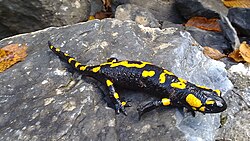
The fire salamander (Salamandra salamandra), a toxic species, wears warning colours.: The fire salamander (Salamandra salamandra), a toxic species, wears warning colours.
Perhaps the most poisonous animal in the world, the golden poison frog (Phyllobates terribilis) is endemic to Colombia.[165]: Perhaps the most poisonous animal in the world, the golden poison frog (Phyllobates terribilis) is endemic to Colombia.[165]
Summary of Amphibian Groups
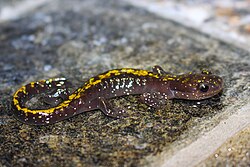
The red back salamander (Plethodon cinereus) defends a territory against intruders.
Comparison of Modern Amphibian Orders
Order
Common Examples
Key Physical Feature
Typical Habitat
Anura
Frogs, Toads
No tail, powerful hind legs
Semi-aquatic / Terrestrial
Caudata
Salamanders, Newts
Tail retained in adulthood
Moist land / Aquatic
Gymnophiona
Caecilians
Limbless, serpentine body
Burrowing / Soil
Frequently Asked Questions
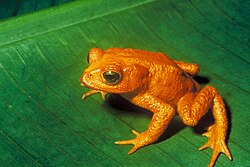
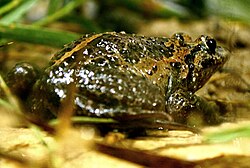
The extinct golden toad (Incilius periglenes), last seen in 1989The Hula painted frog (Discoglossus nigriventer) was believed to be extinct but was rediscovered in 2011.
What is the difference between batrachology and herpetology?
Batrachology is the specific study of amphibians, whereas herpetology is the broader scientific study of both amphibians and reptiles.
Which is the smallest vertebrate in the world?
The smallest known vertebrate is a frog from New Guinea called Paedophryne amauensis, which measures only 7.7 mm in length.
What is neoteny in amphibians?
Neoteny is a condition where an amphibian retains its larval characteristics, such as external gills, throughout its entire adult life. The axolotl is a well-known example.
How do amphibians breathe?
Amphibians use a combination of methods: larvae use gills, adults typically use lungs, and almost all amphibians utilize their skin (cutaneous respiration) to exchange gases.
Why are some amphibians brightly colored?
Bright colors often serve as a warning to predators that the animal is toxic or poisonous, a biological strategy known as aposematism.
![Many amphibians—like this Ceratophrys cranwelli—exhibit biofluorescence.[4]](/images/83/cd/83cd46bf5d0343423359502b1bbdd3c9388e08ecb3d1059397b2a292645a6735.png)
![Perhaps the most poisonous animal in the world, the golden poison frog (Phyllobates terribilis) is endemic to Colombia.[165]](/images/bc/8b/bc8b2805fad9faca6e80170fec0ddcbfdddde3c7dc4cf56c174183ebc6cc5bda.jpg)