American Sycamore
The American sycamore (Platanus occidentalis), also known as the American planetree, is a massive, long-lived hardwood native to the eastern and central United States, southern Ontario, southern Quebec, and the mountains of northeastern Mexico. Renowned for its striking appearance and immense size, this species is a cornerstone of North American riparian ecosystems.
While commonly called "sycamore" in North America, it is distinct from the sycamore maple (Acer pseudoplatanus) found in the United Kingdom. The species name occidentalis is Latin for "western," a term assigned by Carl Linnaeus to distinguish it from the P. orientalis of the Eastern Hemisphere.
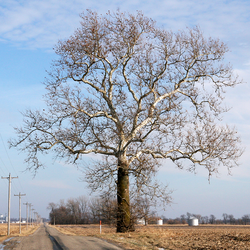
Key Facts
- Lifespan: Typically survives at least 200 years, with some living 500 to 600 years.
- Size: Can reach heights of 30 to 40 meters (98 to 131 ft), with record specimens hitting 53 meters (174 ft).
- Distinctive Feature: Mottled, exfoliating bark that peels away in irregular plates.
- Habitat: Primarily found in bottomlands, floodplains, and wetland areas.
- Conservation Status: Listed as Least Concern by the IUCN.
Botanical Description
Bark and Structure
The most identifying characteristic of the American sycamore is its mottled bark. Because the bark is more rigid and less elastic than that of other trees, it cannot stretch to accommodate the growing trunk. Instead, it flakes off in large, brittle masses, revealing a surface of gray, greenish-white, and brown.
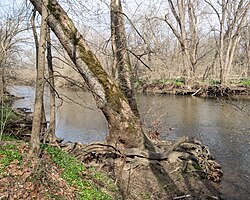
The tree often divides near the ground into several secondary trunks, leading to an irregular, open crown. In mature specimens, the heartwood frequently decays, creating large hollow cavities. Historically, these hollows were so vast that settlers in the 18th century were known to live inside them.
Leaves and Buds
The leaves are alternate, broadly ovate, and palmately nerved, typically measuring 10 to 23 cm (4 to 9 in) in length. They feature three to five lobes with toothed edges. A unique botanical trait is the development of the winter buds; rather than appearing on the branch, the sticky, green buds are enclosed within an enlargement of the petiole (the leaf stalk) during the summer.
Flowers and Fruit
Flowering occurs in May, coinciding with leaf growth. The tree is monoecious, meaning it bears both staminate (male) and pistillate (female) flowers in dense heads. The fruit consists of brown, solitary heads about 2.5 cm (1 in) in diameter, composed of achenes that persist through the winter on slender stems.
Distribution and Ecology
The American sycamore thrives in wet environments, particularly along rivers and streams where groundwater is abundant. Its native range extends from Nebraska in the west to New Hampshire in the east, and from Ontario in the north to Texas and Florida in the south. It has also become naturalized in parts of Australia and Argentina.
As a fast-growing, early-to-mid successional species, the sycamore often acts as a pioneer. However, in ideal wet sites, it can persist as a climax species. These trees provide critical habitat; their hollow trunks serve as nesting sites for black bears, bats, and various cavity-nesting birds, including barred owls and wood ducks.
Uses and Human History
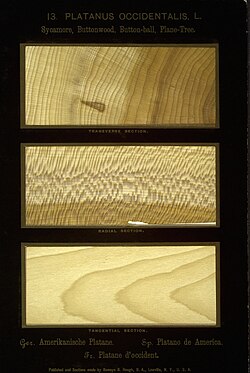
Historically, the wood of the American sycamore has been used for furniture, crates, siding, and musical instruments. Due to its density and durability, it is particularly prized for making butcher's blocks. Native Americans traditionally used the bark to create small dishes for gathering whortleberries.
In urban settings, it was once a popular shade tree. However, its susceptibility to disease has led many landscapers to prefer the London plane, a hybrid of P. occidentalis and P. orientalis. Interestingly, the New York Stock Exchange was founded under a sycamore (then called a buttonwood) tree in 1792, an event known as the "Buttonwood Agreement."
Pests and Diseases
The primary threat to the American sycamore is plane anthracnose (Apiognomonia veneta). This introduced fungus causes new leaves to wilt and mature leaves to turn brown and shrivel in early spring. While the disease rarely kills the tree, it can cause significant defoliation and create cankers on branches that restrict nutrient flow, leading to "witch's broom" growth patterns.
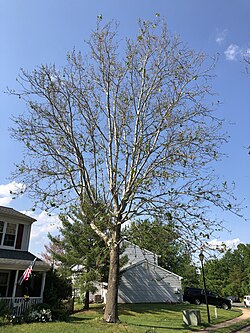
Additionally, the tree is a food source for the sycamore leaf beetle and serves as a host for the sycamore tussock moth.
Summary Table
| Feature | Details |
|---|---|
| Scientific Name | Platanus occidentalis |
| Common Names | American sycamore, American planetree |
| Max Height | Up to 53 m (174 ft) |
| Bark Type | Exfoliating, mottled (gray, white, brown) |
| Primary Habitat | Riparian and wetland areas |
| Wood Use | Butcher's blocks, furniture, biomass |
| Major Disease | Plane anthracnose |
Frequently Asked Questions
How can I tell an American sycamore apart from other trees?
The most reliable indicator is the mottled, peeling bark that leaves patches of white, gray, and green on the trunk. Additionally, look for large, lobed leaves and buds that are enclosed at the base of the leaf stalk.
Is the American sycamore the same as the European sycamore?
No. The European sycamore (Acer pseudoplatanus) is actually a species of maple. While they share a common name in some regions, they belong to entirely different families.
Why are sycamores often hollow?
The heartwood of the American sycamore decays relatively quickly. This natural process creates large cavities that, while not harming the tree's overall survival, provide essential nesting sites for wildlife.
What is the London plane tree?
The London plane (P. × hispanica) is a hybrid between the American sycamore and the Oriental plane. It is often planted in cities because it is more resistant to anthracnose than the pure American species.
Can American sycamores survive total flooding?
While they thrive in wet bottomlands and floodplains, they cannot survive being completely flooded for more than two weeks at a time.