Ambush Predators: The Art of Stealth and Surprise
In the natural world, the hunt is not always a high-speed chase. While pursuit predators rely on endurance and velocity to run down their prey, ambush predators—also known as sit-and-wait predators—employ a different philosophy: patience and surprise. By remaining concealed and minimizing energy expenditure, these carnivorous animals wait for their prey to come to them, launching a sudden, overwhelming attack that incapacitates the target almost instantly.
This strategy is widely distributed across the animal kingdom. From the depths of the ocean to the canopy of the rainforest, ambush predation is utilized by starfish, cephalopods, crustaceans, spiders, insects like mantises, and vertebrates including various snakes, fish, and cats.
![In the foraging cycle, ambush predators choose variants of the sit-and-wait strategy in place of active pursuit to capture their prey.[1]](/images/57/dc/57dc293d20f40580531453eb64337f50d994632708d49169635720c2c852f487.webp)
Key Facts
- Energy Efficiency: Ambush predators avoid the fatigue associated with active pursuit by staying motionless.
- Diverse Tactics: Strategies include camouflage, burrowing, aggressive mimicry, and the construction of physical traps.
- Specialized Vision: Many nocturnal ambushers possess vertical slit pupils to better judge distance in low light.
- Rapid Execution: Attacks are often ballistic or vacuum-based, occurring in milliseconds to prevent prey escape.
Strategies for Concealment and Luring
The success of an ambush depends entirely on the predator's ability to remain undetected until the moment of impact. Depending on the species, this is achieved through various biological and behavioral adaptations.
Burrows and Physical Hiding
Some predators create permanent homes that double as hunting blinds. Trapdoor spiders and Australian crab spiders on land, as well as mantis shrimps in the sea, utilize burrows. While this restricts their field of vision, it provides near-perfect concealment.
Trapdoor spiders, for example, seal their burrows with a silk-hinged door camouflaged with pebbles and sticks. They use silk "trip wires" to detect vibrations; once prey is sensed, the spider uses its chelicerae (protruding mouthparts) to hold the door and spring outward.
Camouflage and Aggressive Mimicry
When hiding in a hole isn't an option, many predators blend into their environment. Some take this a step further through aggressive mimicry, where the predator lures prey by appearing harmless or attractive.
- The Alligator Snapping Turtle: Uses a pink, worm-like extension of its tongue to lure fish.
- Rat Snakes: Employ caudal luring, moving their tails to entice small vertebrates.
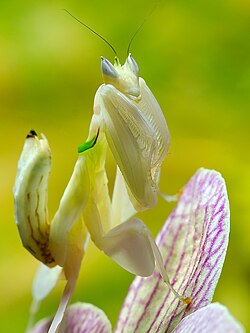
- Orchid Mantises: Mimic rainforest orchids so convincingly that they attract pollinator insects more effectively than actual flowers.
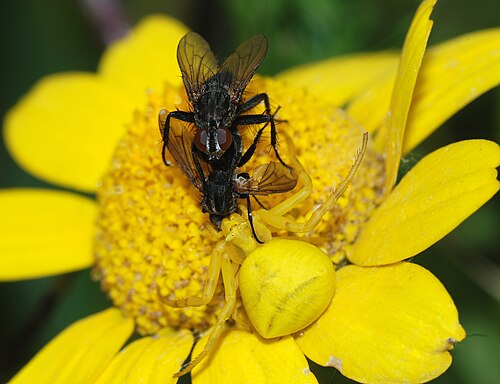
- Crab Spiders: Match the color of the flowers they inhabit to ambush visiting insects.
The Use of Traps
Certain insects build external structures to capture prey. The antlion larva creates a crater-shaped sandpit; when an ant or beetle slides into the pit, the hidden antlion seizes it with powerful mandibles. Similarly, sheetweb spiders (Linyphiidae) remain with their webs for long periods, acting as classic sit-and-wait predators.
Detection and Precision Strikes
Once a prey item is within range, the predator must time its strike perfectly. Because these attacks are often non-modifiable once launched, precision is critical.
Sensory Adaptations
Detection varies by environment. The deep-sea tripodfish uses tactile and mechanosensory cues to feel prey drifting in the current. In the animal kingdom, pupil shape also plays a role; nocturnal ambushers like cats and snakes have vertical slit pupils, which are superior for estimating distance in dim light compared to the round pupils of diurnal pursuit predators.
![Many nocturnal ambush predators like this leopard cat have vertical pupils, enabling them to judge distance to prey accurately in dim light.[30]](/images/5c/5a/5c5a1db28f9a758edd2f1a2c464e71ef8d0124fc67e1e1ef2b51855567ded9e8.jpg)
Mechanisms of Capture
The final strike is often a marvel of biological engineering, utilizing extreme speed or specialized anatomy.
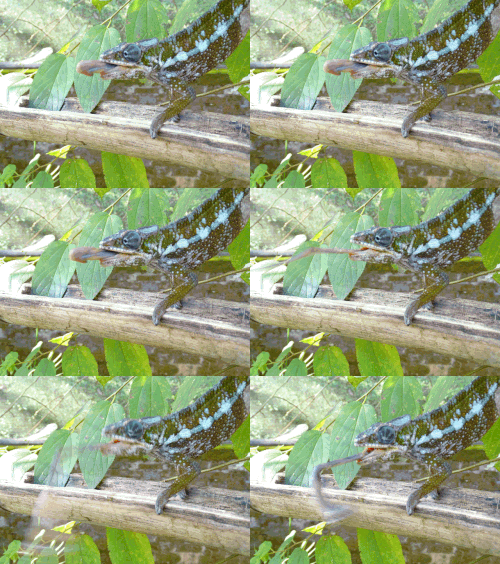
- Ballistic Projection: Chameleons project their tongues—often twice their body length—in as little as 0.07 seconds with an acceleration exceeding 41 g. This power is generated by stored energy in elastic tissue.
- High-Speed Impact: The zebra mantis shrimp strikes with a mean peak speed of 2.30 m/s (5.1 mph), with the entire movement lasting roughly 24.98 ms.
- Vacuum Suction: Frogfishes open their jaws so rapidly that the mouth cavity volume increases up to 12-fold, sucking in prey and water in as little as 6 milliseconds.
Comparison of Predation Styles
| Feature | Ambush Predation | Pursuit Predation |
|---|---|---|
| Primary Tactic | Stealth, luring, and surprise | Speed and endurance |
| Energy Use | Low (until the strike) | High (during the chase) |
| Key Adaptations | Camouflage, mimicry, traps | Aerodynamic bodies, high stamina |
| Typical Pupil Shape | Often vertical slits (nocturnal) | Often round (diurnal) |
Frequently Asked Questions
What is the difference between ambush and pursuit predators?
Ambush predators stay hidden and wait for prey to come within range to launch a surprise attack, whereas pursuit predators actively chase their prey using speed or endurance.
What is aggressive mimicry?
Aggressive mimicry is a strategy where a predator lures its prey by mimicking something attractive or harmless, such as the orchid mantis mimicking a flower or the alligator snapping turtle mimicking a worm with its tongue.
Why do some ambush predators have vertical pupils?
Vertical slit pupils help nocturnal ambush predators, such as certain cats and snakes, more accurately judge the distance to their prey in low-light conditions.
How does a frogfish capture its prey?
The frogfish uses a rapid jaw-opening mechanism that expands its mouth volume up to 12-fold, creating a vacuum that sucks the prey into its mouth in as little as 6 milliseconds.
How do chameleons launch their tongues so fast?
Chameleons use elastic tissue to store energy, allowing them to project their tongues ballistically at accelerations over 41 g, a level of power that muscle alone cannot produce.