Ambala Cavalry Brigade: History and Service in the First World War
The Ambala Cavalry Brigade was a distinguished formation of the British Indian Army that played a vital role during the early 20th century. Established during a period of sweeping military reorganization, the brigade transitioned from a regional security force in India to a combat-ready unit on the battlefields of Europe during the First World War.
Origins and the Kitchener Reforms
The brigade was born out of the Kitchener Reforms, a series of strategic overhauls implemented by Lord Kitchener during his tenure as Commander-in-Chief, India (1902–1909). These reforms aimed to unify various disparate forces—including the three former Presidency armies, the Punjab Frontier Force, and the Hyderabad Contingent—into a single, cohesive Indian Army.
Kitchener's primary objective was to shift the army's focus toward the defense of the North-West Frontier to counter potential foreign aggression, specifically Russian expansion into Afghanistan. Under this new structure, the army was organized into divisions and brigades capable of acting as field formations while maintaining internal security. The Ambala Brigade was formed in July 1904 as part of the 3rd (Lahore) Division and was later redesignated as the Ambala Cavalry Brigade in 1908.
Mobilization and Deployment to France
At the outbreak of the First World War in August 1914, the unit was mobilized as the 3rd (Ambala) Cavalry Brigade and assigned to the 1st Indian Cavalry Division. To ensure that internal security duties in India continued uninterrupted, a new Ambala Brigade was established in November 1914 within the 3rd Lahore Divisional Area.
The brigade departed Bombay on October 16, 1914, arriving in Marseille, France, on November 7. By November 26, they had reached the Front. To prevent confusion with the British 3rd Cavalry Brigade, the unit was referred to by its geographical name, "Ambala," rather than its numerical designation while serving in France.
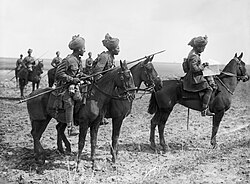
Combat Operations on the Western Front
The Ambala Cavalry Brigade spent several years navigating the grueling conditions of the Western Front. While cavalry units were often held in reserve to exploit potential breakthroughs in the line, the brigade was frequently called upon for active duty.
In 1916, the brigade participated in the Battle of the Somme, seeing significant action during the Battle of Bazentin (July 14–17) and the Battle of Flers–Courcelette (September 15–22). In 1917, they were involved in the Battle of Cambrai, contributing to the Tank Attack in November and the subsequent German counter-attacks through early December.
When not engaged in cavalry maneuvers, the brigade provided infantry support. Parties sent to the trenches to hold the line or perform the duties of Pioneers (soldiers trained in field engineering and construction) were designated as the Ambala Battalion.
Dissolution and Legacy
In March 1918, the brigade was broken up in France. The British components, including the 8th (King's Royal Irish) Hussars and X Battery of the Royal Horse Artillery, remained in France. The Indian elements were redeployed to Egypt, where they merged with the 5th Mounted Brigade on April 24, 1918, eventually becoming part of the 13th Cavalry Brigade within the 5th Cavalry Division by July 1918.
Key Facts
- Active Period: July 1904 – March 1918.
- Primary Allegiance: British Crown / British Indian Army.
- Major Engagements: Battle of the Somme (Bazentin, Flers–Courcelette) and Battle of Cambrai.
- Headquarters: Ambala Cantonment, British India.
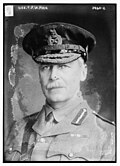
- Notable Commander: Brigadier-General R.B. Adams VC.
Brigade Summary
| Category | Details |
|---|---|
| Formation Date | July 1904 |
| Branch | Cavalry |
| Higher Formations | 3rd (Lahore) Division, 1st & 2nd Indian Cavalry Divisions |
| Key Units (Western Front) | 8th Hussars, 9th Hodson's Horse, 18th Tiwana Lancers, X Battery RHA |
| Dissolution Date | March 1918 |
Frequently Asked Questions
Why was the brigade called the Ambala Brigade instead of the 3rd Cavalry Brigade in France?
The unit used its geographical name to avoid confusion with the British 3rd Cavalry Brigade, which was serving on the Western Front at the same time.
What were the Kitchener Reforms?
These were military reforms led by Lord Kitchener between 1902 and 1909 that unified various regional and local forces into a single Indian Army, prioritizing the defense of the North-West Frontier.
What was the "Ambala Battalion"?
The Ambala Battalion was the designation given to parties from the cavalry brigade when they were deployed to the trenches to hold the line or act as Pioneers.
What happened to the brigade's units after March 1918?
The British units remained in France, while the Indian units were sent to Egypt, where they eventually merged into the 5th Mounted Brigade and later the 13th Cavalry Brigade.
Which notable commanders led the brigade?
Notable commanders included Brigadier-General Robert Bellew Adams VC and Major-General Charles Patrick William Pirie.