Alpha Centauri Ab: Analyzing the Characteristics of a Candidate Planet
The search for planets orbiting our nearest stellar neighbors has led to the identification of a compelling candidate: Alpha Centauri Ab. As astronomers refine their observations, the understanding of this distant world has evolved from early theoretical inferences to more concrete data provided by state-of-the-art space telescopes.
Initial Inferences and Early Models
Early observations of the candidate planet suggested an orbital inclination—the angle of the orbit relative to the observer's line of sight—of approximately 70°. This alignment is consistent with the overall inclination of the Alpha Centauri system. Based on the detection algorithms used at the time, researchers initially suspected the planet had a mass similar to Neptune.
Size constraints were also established to explain the observed signatures. The planet was estimated to be no larger than 7 Earth radii (R 🜨), as any larger mass would have exceeded the radial-velocity threshold (the minimum detectable change in a star's velocity caused by a planet's gravity) of approximately 50 Earth masses (M 🜨). Conversely, it could not be smaller than 3.3 R 🜨, as a smaller size would not have produced the specific signature recorded in the research. Given these dimensions, scientists concluded the planet was unlikely to be rocky and was most likely a Neptune-sized gas giant.
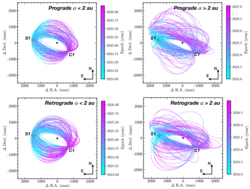
Updated Findings from JWST and VLT
Recent data has significantly revised the physical profile of Alpha Centauri Ab. A 2025 study utilizing the James Webb Space Telescope (JWST) provided more precise measurements, suggesting the planet is far more massive than previously thought. The updated mass is estimated to be between 90 and 150 M 🜨, with a radius ranging from 1.0 to 1.1 Jupiter radii (R J).
By synthesizing non-detections and observations from the Very Large Telescope (VLT) in 2019 and the JWST in 2024, researchers have narrowed down the planet's orbital dynamics. The team estimates an orbital period of between 2 and 3 years and an orbital eccentricity (the measure of how much an orbit deviates from a perfect circle) of 0.4. Additionally, the inclination relative to the Alpha Centauri AB orbital plane is estimated to be between 50° and 130°.
Key Facts
- Estimated Mass: 90 to 150 Earth masses (M 🜨).
- Estimated Radius: 1.0 to 1.1 Jupiter radii (R J).
- Orbital Period: Between 2 and 3 years.
- Orbital Eccentricity: 0.4.
- Inclination: 50° to 130° relative to the Alpha Centauri AB orbital plane.
- Observation Tools: James Webb Space Telescope (JWST) and Very Large Telescope (VLT).
Comparison of Candidate Characteristics
| Characteristic | Initial Inferences | 2025 JWST Findings |
|---|---|---|
| Mass | ~Neptune mass (< 50 M 🜨) | 90–150 M 🜨 |
| Radius | 3.3 to 7 R 🜨 | 1.0–1.1 R J |
| Composition | Likely Neptune-sized/Gas | Gas Giant |
| Orbital Period | Not specified | 2–3 years |
Frequently Asked Questions
Is Alpha Centauri Ab a rocky planet?
No. Based on both early size estimates (up to 7 Earth radii) and recent JWST data (1.0–1.1 Jupiter radii), the planet is too large to be rocky and is considered a gas giant.
What is the orbital period of the candidate planet?
Based on observations from the VLT and JWST, the estimated orbital period is between 2 and 3 years.
How was the mass of the planet determined?
The mass was derived using a 2025 study with the James Webb Space Telescope, which estimated the mass to be between 90 and 150 Earth masses.
What does an orbital eccentricity of 0.4 mean?
An orbital eccentricity of 0.4 indicates that the planet's orbit is not a perfect circle but is instead an elliptical shape, deviating moderately from a circular path.
Which telescopes were used to study this candidate?
The research relied on data from the Very Large Telescope (VLT) and the James Webb Space Telescope (JWST).