Almendra: The Pioneers of Argentine Rock
Emerging from the vibrant cultural landscape of Buenos Aires in the late 1960s, Almendra was more than just a band; they were a catalyst for a musical revolution. Led by the visionary guitarist and lyricist Luis Alberto Spinetta, the group blended psychedelic rock, folk, and art rock to redefine the sound of Argentine music. Their influence was so profound that they are often compared to The Beatles for their ability to shift the perceptions of both critics and audiences across South America.
Key Facts
- Origin: Buenos Aires, Argentina.
- Active Years: 1967–1970, 1979–1981, and a final reunion in 2009.
- Core Members: Luis Alberto Spinetta, Edelmiro Molinari, Emilio del Guercio, and Rodolfo García.
- Major Works: Two seminal studio albums, Almendra and Almendra II.
- Legacy: Paved the way for subsequent bands like Pescado Rabioso, Color Humano, and Aquelarre.
Formation and Early Success
Almendra was formed in 1968 following the dissolution of three teenage school groups: Los Sbirros, Los Mods, and Los Larkins. The band began their journey with rehearsals at Spinetta's home in Belgrano, an upper-middle-class neighborhood of Buenos Aires. Their professional trajectory accelerated when they met producer Ricardo Kleiman, owner of the Modart clothing shop and host of the influential radio show Modart en la Noche, which introduced international beat and rock music to local listeners.
The band's recording debut came on September 20, 1968, with the release of the single "Tema de Pototo" (also known as "Para saber cómo es la soledad"), a beat ballad featuring orchestral arrangements by Rodolfo Alchourrón. This was followed by "Hoy todo el hielo en la ciudad," which showcased Edelmiro Molinari's fuzz guitar work.
Throughout 1969, Almendra established their live presence, performing in the resort city of Mar del Plata and making their Buenos Aires debut on March 24 at the di Tella Institute, a hub for avant-garde culture. A pivotal moment occurred on September 21, 1969, when they performed at the Pinap Festival, the first major event dedicated to Argentine rock.
The Debut Album and Artistic Struggles
The recording of their first album was marked by a notable conflict with their label, RCA Victor. Spinetta had created an enigmatic face for the cover art, but the record company claimed the drawing was lost and intended to use a group photograph instead. After discovering the original artwork discarded in the trash, Spinetta spent an entire night recreating the drawing to ensure his vision remained on the cover.
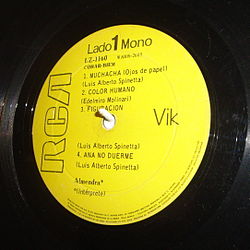
Released on November 29, 1969, the self-titled debut album Almendra became a cornerstone of the genre. It was accompanied by an insert containing lyrics and technical details, with a back cover featuring a live photo from the Pinap Festival.
Almendra II and the Unfinished Opera
By 1970, Spinetta began conceptualizing a highly ambitious rock opera centered on humanity's inner search. However, internal tensions led the group to split before the project could be completed. Despite the breakup, the band released Almendra II on December 19, 1970.
This double album served as a transition point. While it contained fragments of the unfinished opera (such as the "Obertura"), it highlighted the individual musical identities of the members. Edelmiro Molinari's influence is evident in tracks like "Toma el tren hacia el sur" and "Aire de amor," while Emilio del Guercio contributed rhythm ballads like "Carmen" and the rock number "Un pájaro te sostiene."
Reunions and Final Years
Although the original lineup dissolved in 1970, the members remained the backbone of Argentine rock throughout the 1970s. The band reunited briefly from 1979 to 1981, performing legendary shows at the Obras Sanitarias Stadium. This era produced the live album Almendra en Obras and a new studio album, El valle interior, released on their own independent label.
The final gathering of the group took place on December 4, 2009, at the Vélez Sarsfield Stadium during the Spinetta y las Bandas Eternas concert, where they performed five of their most iconic songs.
The band's history is marked by the loss of its key members: Luis Alberto Spinetta passed away from lung cancer in 2012 at age 62, and drummer Rodolfo García died following a stroke in 2021 at age 75.
Summary of Discography
| Year | Title | Type | Key Notes |
|---|---|---|---|
| 1969 | Almendra | Studio Album | Debut album with iconic cover art |
| 1970 | Almendra II | Studio Album | Double album featuring opera fragments |
| 1980 | El Valle Interior | Studio Album | Released on independent label |
| 1980 | Almendra en Obras I/II | Live Album | Recorded at Obras Sanitarias Stadium |
Frequently Asked Questions
Who was the primary leader of Almendra?
The band was led by Luis Alberto Spinetta, who served as the primary guitarist and lyricist, and was the main composer for the first album and early singles.
What happened to the band after their initial split in 1970?
The split led to the formation of several other influential Argentine bands, specifically Aquelarre, Color Humano, and Pescado Rabioso.
What is the significance of the album Almendra II?
Almendra II is a double album that contains traces of a planned but unfinished rock opera about humanity's inner search, while showcasing the diverse songwriting styles of Molinari and Del Guercio.
How did the band's cover art for the first album come to be?
After the record company lost Spinetta's original drawing and tried to replace it with a photo, the band found the drawing in the garbage. Spinetta recreated the artwork overnight to ensure it was used for the final release.
When was the final reunion of Almendra?
The band reunited for the last time on December 4, 2009, performing five songs as part of the Spinetta y las Bandas Eternas concert in Buenos Aires.