Aliyah: The History and Evolution of Jewish Immigration to Israel
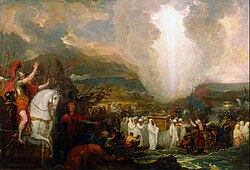
Aliyah (Hebrew: עֲלִיָּה), literally meaning "ascent," refers to the immigration of Jews from the diaspora to the Land of Israel. This term is traditionally described as the act of "going up" toward the holy city of Jerusalem. For many, making aliyah is a central tenet of Zionism, the movement for the self-determination of the Jewish people in their ancestral homeland.
Conversely, the act of emigrating from the Land of Israel is known as yerida, meaning "descent." While the majority of the global Jewish population lived outside the region for much of history—reaching 99.7% in the late 19th century—the desire to return has remained a persistent national aspiration.
Key Facts
- Law of Return (1950): Grants all Jews, their children, and grandchildren the right to relocate to Israel and obtain citizenship.
- Demographic Shift: As of 2014, approximately 42.9% of the world's Jewish population resides in Israel and the Israeli-occupied territories.
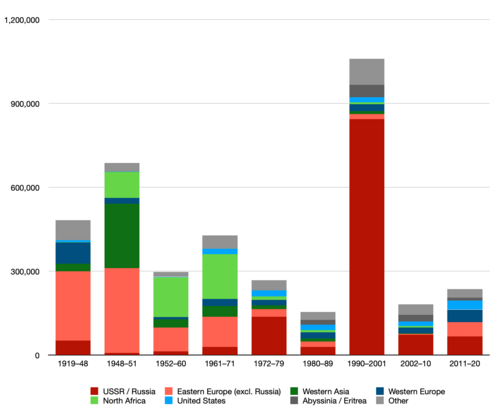
- Mass Migration: The largest surge in modern history occurred between 1948 and 1951, with over 680,000 immigrants arriving.
- Recent Trends: Since 2024, Israel has experienced net negative migration, where yerida exceeds aliyah.
The Rise of Modern Aliyah
While small numbers of Jews returned to the region in antiquity and the Middle Ages, large-scale immigration began in 1882 following a "national awakening" and the rise of the Zionist movement. This period saw the transition from sporadic individual moves to organized waves of immigration.
The Early Waves (1881–1914)
During the Ottoman period, the First Aliyah (1882–1903) and Second Aliyah (1904–1914) established the foundations for Jewish agricultural and social structures in the region. This era was characterized by the early efforts to rebuild a Jewish presence in the land.

The British Mandate and Aliyah Bet (1919–1948)
Under British rule, immigration continued through the Third, Fourth, and Fifth Aliyahs. However, the rise of Nazi Germany in the 1930s created an urgent need for refuge. Between 1932 and 1939, Mandatory Palestine absorbed 247,000 newcomers, roughly 46% of all Jewish emigration from Europe during that time.
The 1939 White Paper imposed strict limits, capping immigration at 75,000 over five years. This led to Aliyah Bet, a movement of illegal immigration to bypass British restrictions.

Post-Independence and the Law of Return
Following the Israeli Declaration of Independence in 1948, the Jewish population more than doubled within a few years. The 1950 Law of Return institutionalized the right of diaspora Jews to return home, leading to millions of immigrants arriving from diverse global regions.
Global Migration Patterns
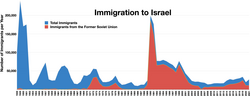
Immigration has occurred in distinct waves based on geopolitical events. Significant numbers arrived from North Africa (particularly Morocco), the Middle East (Iraq and Yemen), and later, the Soviet Union. The struggle of "refuseniks"—Soviet Jews denied permission to emigrate—marked a poignant chapter in the 1970s.
![Soviet authorities break up a demonstration of Jewish refuseniks in front of the Ministry of Internal Affairs for the right to immigrate to Israel, January 10, 1973[77]](/images/a2/8c/a28cfd50b56eb6b815da20356ef71213939bb689f79c27c8a97b3796ac859387.jpg)
Modern Aliyah Trends
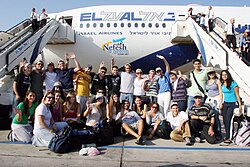
In recent decades, immigration has continued from North America, France, and the former Soviet states. Organizations like Nefesh B'Nefesh facilitate the transition for those moving from English-speaking countries.

Aliyah by the Numbers
The following table summarizes the historical scale of immigration from major regions over the last century.
| Region | 1882–1918 | 1919–1948 | 1948–1951 | 1990–2001 | 2011–2020 |
|---|---|---|---|---|---|
| Europe | 62,500 | 482,857 | 687,624 | 1,059,993 | 236,903 |
| Asia | 40,776 | 237,704 | 37,119 | 17,300 | 500 |
| Africa | 4,033 | 93,282 | 143,485 | 31,558 | 561,642 |
| Americas/Oceania | 7,579 | 3,822 | 6,922 | 36,209 | 272,373 |
Frequently Asked Questions
What is the difference between Aliyah and Yerida?
Aliyah is the act of immigrating to the Land of Israel (the "ascent"), while yerida is the act of emigrating from Israel to another country (the "descent").
Who is eligible for citizenship under the Law of Return?
The Law of Return, passed in 1950, allows all diaspora Jews, as well as their children and grandchildren, to relocate to Israel and acquire citizenship based on their Jewish identity.
What was Aliyah Bet?
Aliyah Bet refers to the clandestine or "illegal" immigration of Jews to Mandatory Palestine between 1933 and 1948, primarily to bypass the restrictive quotas set by the British government.
Which region has provided the most immigrants historically?
Europe has been the largest source of immigrants, with over 3.8 million people arriving between 1882 and 2020, including massive waves from the former Soviet Union and Poland.
Is Aliyah still common today?
Yes, though trends fluctuate. While millions have moved to Israel since 1950, recent data from 2024 indicates a period of net negative migration, where more people are leaving the country than arriving.