Alfonso Bonilla Aragón International Airport
The Alfonso Bonilla Aragón International Airport (IATA: CLO, ICAO: SKCL), formerly known as Palmaseca International Airport, serves as a vital aviation gateway for southwest Colombia. Strategically located between the cities of Palmira and Cali, the capital of the Valle del Cauca Department, it stands as the country's fourth-busiest airport by passenger volume and the third largest in terms of area and construction.
Situated in the fertile Cauca River valley between the Western and Central Colombian Andes, the airport is a critical node for regional and international travel. It is approximately 50 minutes from Quito, Ecuador; five hours from Santiago de Chile; and roughly three hours and 18 minutes from Miami, USA. Due to its stable year-round weather and distance from urban centers—which eliminates noise restrictions—it is one of the few secondary airports in Latin America to operate 24 hours a day. It also frequently serves as the primary alternate airport for Bogotá's El Dorado International Airport.
Key Facts
- Location: Between Palmira and Cali, Valle del Cauca, Colombia.
- Passenger Volume: 5,686,212 passengers in 2019.
- Operational Status: 24-hour operation with no noise restrictions.
- Primary Hub: Major hub for Avianca and TAC Colombia; focus city for Aerosucre.
- Runway: A single asphalt runway (02/20) measuring 3,000 meters (9,843 ft).
- Elevation: 3,162 feet (964 meters) above mean sea level (AMSL).
Historical Evolution
Early Aviation and Military Beginnings
Aviation in Cali began on April 21, 1921, when Ferruccio Guicciardi landed an Italian-made Macchi-Hanriot HD-1, winning a prize offered by the city and department. Following the 1932 war with Peru, the government sought a site for military air support. In 1933, the "El Guabito" site was developed into an Air Force Base and Air National Guard station, eventually hosting airlines like SCADTA Panagra, TACA de Colombia, and VIARCO SAETA.
The Transition to Modern Facilities
As demand grew, Panagra established "Calipuerto" in Candelaria in 1947 to link South America with Panama. Simultaneously, VIARCO Valle opened "El Limonar" in the Pasoancho area in 1947. However, by 1954, El Limonar closed following a merger between LANSA and Avianca, consolidating operations at Calipuerto. The original Calipuerto facilities were later repurposed as an agricultural distribution center known as Cavasa.
The Birth of Palmaseca
The current airport was spurred by the 1971 Pan American Games held in Cali. The government invested heavily, including a US$35 million injection to meet international safety standards. Inaugurated on July 24, 1971, as Palmaseca International Airport, the facility featured a 3,000m runway and a comprehensive terminal. In June 1989, it was renamed in honor of Alfonso Bonilla Aragón, a local journalist and civic leader instrumental in the airport's creation.
Infrastructure and Operations
Capacity and Facilities
The airport is equipped to handle significant cargo and passenger traffic. Loading facilities include a 747 freighter dock, a bonded warehouse, a free trade zone, and secure storage for valuables. For passengers, Avianca operates an Executive Lounge in the Domestic Satellite Terminal, providing amenities such as Wi-Fi, a wet bar, and charging ports.
Management and Reform
In the early 1980s, attempts were made to decentralize management through a mixed-economy company involving state and private capital, though this was not fully realized. The airport has undergone several structural reinforcements, including the reconstruction of the international terminal satellite in 1986 and the repaving of the main runway in 1989.
Airlines and Destinations
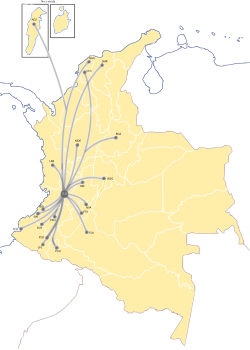
The airport connects the Valle del Cauca region to major domestic cities and international hubs across the Americas and Europe.
| Metric | Value |
|---|---|
| Aircraft Operations | 81,420 |
| Total Passengers | 5,686,212 |
| Cargo Tonnage | 44,362 |
| Runway Length | 3,000 m / 9,843 ft |
Passenger Services
- International: Flights to Miami (American Airlines), Mexico City (Aeroméxico), Panama City (Copa, Wingo), Madrid (Avianca, World2Fly), and Santiago de Chile (JetSmart Chile).
- Domestic: Extensive networks to Bogotá, Medellín, Cartagena, and Barranquilla via Avianca, LATAM, and JetSmart.
- Regional: SATENA and Clic provide essential connectivity to smaller towns like Guapi, Tumaco, and Nuquí.
Cargo Services
Cargo operations are primarily handled by Aerosucre (connecting to Bogotá), Avianca Cargo (Medellín and Miami), and LATAM Cargo Colombia (Miami).
Safety Record
The airport has been the site of significant aviation incidents. On January 21, 1974, a Vickers Viscount was hijacked and diverted to Cali. More tragically, on December 20, 1995, American Airlines Flight 965 crashed near Cali due to pilot error in interpreting waypoints, marking the deadliest air disaster in Colombian history. Additionally, Copa Airlines Flight 201 crashed in the Darién Gap in 1992 while en route to the airport due to instrument malfunction and spatial disorientation.
Frequently Asked Questions
Why does the airport operate 24 hours a day?
The airport can operate around the clock because of stable year-round weather conditions and its location away from the city centers of Cali and Palmira, which means it is not subject to urban noise restrictions.
What is the airport's role in the national aviation network?
Beyond serving the Valle del Cauca region, it is the fourth-busiest airport in Colombia and serves as a critical alternate airport for Bogotá's El Dorado International Airport.
Who is Alfonso Bonilla Aragón?
He was a local journalist and civic leader who played a pivotal role in the approval and construction of the airport, leading to the facility being renamed in his honor in 1989.
What are the main international destinations from CLO?
The airport offers non-stop flights to the United States (Miami, Fort Lauderdale), Spain (Madrid), Panama, Ecuador, Mexico, Chile, and the Dutch Antilles.