Alfonsina Storni: The Voice of Modernist Poetry and Feminism in Argentina
Alfonsina Storni was a trailblazing Swiss-Argentine poet and playwright who became a defining figure of the Modernist period—a literary movement characterized by a break from traditional forms and an emphasis on aesthetic beauty and individual expression. Her work is celebrated for its raw honesty, exploring the complexities of womanhood, eroticism, and social constraints in early 20th-century Argentina.
Key Facts
- Born: May 22, 1892, in Sala Capriasca, Switzerland.
- Died: October 25, 1938, in Mar del Plata, Argentina.
- Literary Movement: Modernism.
- Major Works: Ocre ("Ochre") and El dulce daño ("Sweet Pain").
- Legacy: A pioneer of feminist themes in Spanish-language poetry.
Early Life and Struggles
Born to parents of Italian-Swiss descent, Alfonsina Storni spent her first four years in Switzerland before moving to San Juan, Argentina, in 1896. Her childhood was marked by economic instability; after her father's brewery failed, the family moved to Rosario, where Storni worked in her father's tavern. She began writing poetry at the age of twelve, balancing her creative passion with a part-time education at the Colegio de la Santa Unión.
Following her father's death in 1906, Storni entered the workforce at a hat factory to support her family. Her adventurous spirit led her to join a traveling theater company in 1907, performing works by Henrik Ibsen and Benito Pérez Galdós. Later, she trained as a rural primary schoolteacher and began contributing to magazines such as Mundo Rosarino and Mundo Argentino.
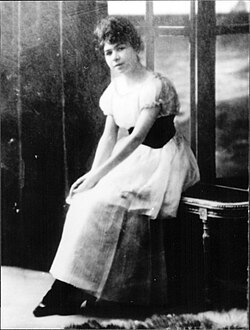
In 1912, Storni moved to Buenos Aires to seek anonymity. During this time, she became a single mother at nineteen, supporting herself through teaching and journalism. This period of personal struggle coincided with the rise of women's rights activism among Argentina's middle class, which deeply influenced her perspective.
Literary Career and Evolution
Early Work and Controversy
Storni's professional literary journey gained momentum in 1916 with contributions to La Nota and the publication of La inquietud del rosal. While her work was highly regarded by many, she faced harsh criticism from male contemporaries, including Jorge Luis Borges. Her direct approach to eroticism and feminist themes was considered controversial, yet these innovations established her as a bold voice in a male-dominated field.
Rise to Recognition
Between 1918 and 1920, Storni entered a highly productive phase, publishing three influential volumes: El dulce daño (1918), Irremediablemente (1919), and Languidez (1920). The latter earned her the first Municipal Poetry Prize and the second National Literature Prize. She continued to experiment with form, producing the traditional sonnets of Ocre (1925) and the prose poems of Poemas de Amor (1926).
Ventures into Theater
Storni expanded her repertoire into drama with the autobiographical play El amo del mundo (1927). Although it was not a commercial success—likely due to a general decline in Argentine theater at the time—she continued to write, including Dos farsas pirotécnicas (1931). She also wrote several musical plays for children, such as Blanco...Negro...Blanco, which used poetic fantasy to critique adult prejudices.
Final Poetic Experiments
After a hiatus, Storni returned to poetry with El mundo de siete pozos (1934) and her final work, Mascarilla y trébol (1938). In this final volume, she introduced "antisonnets," which utilized the structure of traditional sonnets but abandoned the standard rhyme schemes, marking the peak of her formal experimentation.
Personal Relationships and Influence
Storni maintained a complex and deep friendship with the writer Horacio Quiroga. The two shared a love for Wagner and frequently traveled to Montevideo together. Quiroga expressed immense respect for Storni, treating her as a literary equal. Their bond remained strong until Quiroga's second marriage in 1927. Storni dedicated a poem to him following his suicide in 1937.
Illness and Death
In 1935, Storni underwent a radical mastectomy after discovering a lump in her left breast. When the cancer reappeared in 1938, she chose to end her life. On October 25, 1938, she walked into the sea at La Perla beach in Mar del Plata. Her death became the inspiration for the famous song "Alfonsina y el mar," composed by Ariel Ramírez and Félix Luna.
| Year | Title | Genre/Format |
|---|---|---|
| 1916 | La inquietud del rosal | Poetry |
| 1918 | El dulce daño | Poetry |
| 1920 | Languidez | Poetry |
| 1925 | Ocre | Sonnets |
| 1927 | El amo del mundo | Play |
| 1934 | El mundo de siete pozos | Poetry |
| 1938 | Mascarilla y trébol | Poetry (Antisonnets) |
Frequently Asked Questions
What was Alfonsina Storni's primary contribution to literature?
Storni is best known for introducing direct feminist themes and eroticism into Argentine poetry during the Modernist period, challenging the social norms of her time and providing a voice for womanhood.
What are "antisonnets"?
Antisonnets are a poetic form used by Storni in her final volume, Mascarilla y trébol. They maintain the general versification structure of a traditional sonnet but intentionally disregard the traditional rhyme scheme.
Who was Horacio Quiroga in relation to Storni?
Horacio Quiroga was a fellow writer and close friend of Storni. They shared intellectual interests, traveled together, and maintained a relationship of mutual professional respect.
How did Storni die?
After battling breast cancer, Alfonsina Storni died by suicide on October 25, 1938, by walking into the sea at La Perla beach in Mar del Plata, Argentina.
Did Storni write for children?
Yes, she wrote several brief theater pieces for her students at Teatro Labardén, including Pedro y Pedrito and Jorge y su Conciencia, some of which included music she composed herself.