Aleppo Codex: The History and Mystery of the Crown of Aleppo
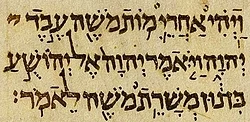
The Aleppo Codex, known in Hebrew as Keṯer ʾĂrām-Ṣoḇāʾ (the Crown of Aleppo), is one of the most significant medieval manuscripts of the Hebrew Bible. Written in the city of Tiberias around 920 CE during the Abbasid Caliphate, this bound manuscript represents the pinnacle of the Aaron ben Moses ben Asher Masoretic Text tradition. Its precision was so renowned that the great scholar Maimonides endorsed it as a text trusted by all Jewish scholars.
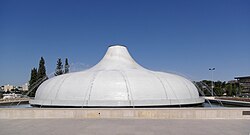
Today, the surviving portions of the codex are housed in the Shrine of the Book at the Israel Museum, serving as a vital link to the ancient Tiberian textual tradition.
Key Facts
- Origin: Created circa 920 CE in Tiberias.
- Significance: Endorsed by Maimonides for its extreme accuracy.
- Current Location: The Shrine of the Book, Israel Museum.
- Status: Approximately 40% of the original manuscript is missing.
- Recognition: Included in UNESCO's Memory of the World register in 2015.
- Physicality: Written on parchment pages measuring 33 cm by 26.5 cm.
A Journey Through Centuries: From Tiberias to Jerusalem
Early History and the Crusades
About a century after its creation, the codex was acquired by the Karaite Jewish community of Jerusalem. However, the First Crusade in 1099 brought turmoil; the city was plundered, and the codex was seized by Crusaders who held it for a high ransom. Using funds from Egypt, the manuscript was eventually bought back and transferred to Fustat (modern-day Old Cairo).
In Cairo, the manuscript was preserved by the Karaites and later the Rabbanite synagogue. It was during this period that Maimonides consulted the text, cementing its reputation as the authoritative version of the Hebrew Bible. Around 1375, a descendant of Maimonides is believed to have brought the codex to Aleppo, Syria, where it earned its famous name.
The Syrian Era and the 1947 Riots
For nearly 600 years, the community of Aleppo guarded the codex with extreme zeal. It was kept in a special cupboard—and later an iron safe—within a basement chapel of the Central Synagogue of Aleppo, a site believed to be the Cave of Elijah. The manuscript was treated as the community's most sacred object; it was used for taking oaths and as a point of prayer for those in distress.
Because of its sanctity, the community strictly limited access to the manuscript. In the 1920s, scholar Paul E. Kahle was unable to obtain a photographic copy, leading him to use the Leningrad Codex for the third edition of the Biblia Hebraica instead. Only a few scholars, such as Umberto Cassuto in 1943, were permitted to examine the text.
The Tragedy of the Missing Pages
In 1947, anti-Jewish riots sparked by the United Nations Partition Plan for Palestine led to the burning of the Central Synagogue of Aleppo. The codex disappeared during the chaos and only resurfaced in 1958, when it was smuggled into Israel by Murad Faham and presented to President Yitzhak Ben-Zvi.
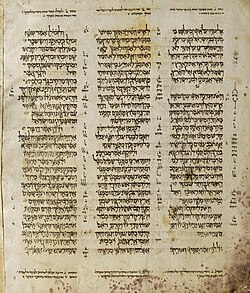
Upon its arrival, it was discovered that a vast portion of the manuscript was gone. Of the estimated 487 original pages, only 294 survived. This loss included the majority of the Torah section.
![Photograph of missing page[16]](/images/18/d1/18d1f9151425c5a714837f0ba7be13204051197ebb4d2a0fe0c67ae75d8af323.jpg)
The Mystery of the Loss
The fate of the missing pages remains a subject of intense debate. While it was initially assumed they were destroyed in the 1947 fire, scientific analysis revealed no evidence of fire damage on the surviving pages (dark marks were identified as fungus). This has led to theories that the pages were stolen or torn out by individuals for private ownership.
These theories gained weight in the 1980s when a leaf from the Book of Chronicles and a fragment from the Book of Exodus resurfaced from private sources. Furthermore, eyewitnesses in Aleppo reported that the codex was nearly complete shortly after the fire, suggesting the loss occurred during the decade before it reached Israel.
Physical Composition and Contents
The Aleppo Codex is written on parchment using ink made from three types of gall mixed with black soot and iron sulfate. The surviving pages are currently kept unbound in a vault.
Textual Order and Gaps
The codex follows the Tiberian tradition. While the Torah and Nevi'im (Prophets) follow the standard order, the Ketuvim (Writings) are arranged differently, starting with Chronicles and ending with Ezra-Nehemiah.
| Feature | Details |
|---|---|
| Original Page Estimate | ~487 pages |
| Surviving Pages | 294 pages (plus minor recovered fragments) |
| Major Missing Sections | Most of the Pentateuch (up to Deut 28:17), parts of Kings, Jeremiah, Amos, Micah, and several books of the Ketuvim |
| Ink Composition | Gall, black soot, and iron sulfate |
| Dimensions | 33 cm x 26.5 cm |
Modern Reconstruction and Legacy
To address the gaps in the manuscript, scholar Mordechai Breuer undertook a massive reconstruction of the Masoretic text using other ancient manuscripts. His work matched the surviving parts of the Aleppo Codex almost perfectly. This reconstruction forms the basis of the Jerusalem Crown (Keter Yerushalayim), a modern printed Tanakh that mimics the codex's calligraphy and layout.
The legacy of the Aleppo Codex continues through various critical editions, including the Mikraot Gedolot Haketer by Bar-Ilan University, which incorporates the codex's masoretic notes to provide a comprehensive scholarly resource.
Frequently Asked Questions
Why is the Aleppo Codex so important?
It is considered one of the most accurate witnesses to the Masoretic Text of the Hebrew Bible and was endorsed by Maimonides as the authoritative standard for Jewish scholars.
Where are the missing pages now?
The exact location of the missing pages is unknown. While some were thought to be burned in 1947, the discovery of fragments in the 1980s suggests that some may still be held in private collections.
What is the Masoretic Text?
The Masoretic Text is the traditional, standardized text of the Hebrew Bible, characterized by a system of vowels and cantillation marks (the Masorah) to ensure the precise pronunciation and reading of the scriptures.
How was the missing text reconstructed?
Scholar Mordechai Breuer used other ancient manuscripts to reconstruct the missing portions. Because his results aligned so closely with the existing parts of the Aleppo Codex, his version is now used authoritatively to fill the gaps.
Where can I see the Aleppo Codex today?
The surviving pages are kept in a vault at the Shrine of the Book, part of the Israel Museum in Jerusalem.