Alejandro Lanusse: The De Facto President of Argentina
Alejandro Agustín Lanusse Gelly was a pivotal and controversial figure in 20th-century Argentine history. Serving as the de facto president—a leader who holds power without legal authority—from 1971 to 1973, Lanusse navigated a period of intense political instability during the military dictatorship known as the "Argentine Revolution." His tenure was marked by a complex attempt to transition the country back toward democracy amidst rising guerrilla violence and social unrest.
Key Facts
- Presidency: Served as de facto president from March 26, 1971, to May 25, 1973.
- Military Rank: Attained the rank of Lieutenant General in the Argentine Army.
- Political Shift: Ended the proscription of Peronism to facilitate a democratic transition.
- Diplomacy: Established diplomatic relations with China and supported Chile's Salvador Allende.
- Legacy: Later testified against military regime leaders during the Trial of the Juntas.
Early Life and Military Ascent
Born on August 28, 1918, in Buenos Aires, Alejandro Lanusse was raised in an upper-middle-class family with significant commercial, industrial, and landholding interests. He began his professional journey at the Army Academy (Colegio Militar de la Nación), graduating in 1938.
Lanusse's early career was characterized by both prestige and political volatility. He commanded the Regimiento de Granaderos a Caballo, the elite presidential escort unit. However, his involvement in an attempted coup against Juan Perón in 1951 led to a life imprisonment sentence. He was eventually released in 1955 during the Revolución Libertadora, a military uprising that ousted Perón. Following his release, he served as the Ambassador to the Holy See in 1956.
Throughout the 1960s, Lanusse held several high-ranking positions, including assistant director of the Superior Military School and Commander of the First Armored Cavalry Division. He participated in the overthrow of President Arturo Frondizi in 1962 and supported the ousting of President Arturo Illia in 1966, though he later expressed regret for the latter. By 1968, he had risen to become the Commander-in-Chief of the Argentine Army.
The Path to the Presidency
Lanusse was often viewed by his peers as "the last liberal officer" within the armed forces, contrasting with the conservative approach of General Juan Carlos Onganía. In 1970, Lanusse led a coup to remove Onganía, installing General Roberto Levingston as president. However, the relationship between the two soured when Levingston attempted to dismiss Lanusse from his role as commander-in-chief.
In response, Lanusse executed another coup in 1971, overthrowing Levingston and assuming the presidency himself on March 26, 1971.
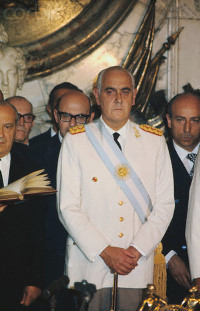
Presidency and Political Transition
Lanusse assumed power during a period of extreme volatility. To address growing popular discontent and guerrilla violence, he pursued a policy of political opening. He recognized that the continued banning of Peronism—the political movement following Juan Domingo Perón—was unsustainable.
His administration sought a resolution through the Grand National Accord. As part of these negotiations with the Montoneros (a Peronist guerrilla group), Lanusse arranged for the return of the body of Eva "Evita" Perón, which had been hidden since the Revolución Libertadora. Despite these diplomatic efforts, his term was marred by tragedy, most notably the Trelew massacre on August 22, 1971, where imprisoned guerrillas were executed without trial at the Naval Base of Rawson.
International Relations and Exit
On the global stage, Lanusse established diplomatic ties with China and maintained a supportive relationship with Chile's Socialist president, Salvador Allende. He described Allende's death during the 1973 Chilean coup as a personal loss.
Lanusse eventually called for presidential elections in March 1973, which were won by Héctor José Cámpora. His departure from the Casa Rosada was hostile, as he was jostled and spat at by crowds. Although he had previously questioned Juan Perón's courage to return from exile in Spain, Lanusse ultimately helped facilitate Perón's return to Argentina in June 1973.
Later Years and Death
In his later life, Lanusse became a critic of the military's excesses. In his 1985 autobiography, Confessions of a General, he condemned the human rights violations of the "Dirty War," specifically mentioning the state murder of his cousin, Elena Holmberg. He also provided testimony during the Trial of the Juntas, noting that one of his own press secretaries had been forcibly disappeared.
His final years were not without conflict; in 1994, he was placed under house arrest after calling President Carlos Menem a "womanizer" in a magazine interview. Alejandro Lanusse died in Buenos Aires on August 26, 1996, at the age of 77, following surgery for a brain blood clot caused by a fall.
| Attribute | Details |
|---|---|
| Term of Office | March 26, 1971 – May 25, 1973 |
| Preceded by | Roberto Marcelo Levingston |
| Succeeded by | Héctor José Cámpora |
| Key Policy | Grand National Accord (Political Opening) |
| Military Rank | Lieutenant General |
Frequently Asked Questions
How did Alejandro Lanusse become president?
Lanusse became president through a coup in 1971, overthrowing General Roberto Levingston after Levingston attempted to remove him from his position as commander-in-chief of the army.
What was the "Grand National Accord"?
The Grand National Accord was a political initiative by Lanusse to end the proscription of Peronism and negotiate a transition back to democracy, which included the return of Eva Perón's body.
What was Lanusse's role in the Trial of the Juntas?
Lanusse testified against the leaders of the military regime, criticizing the human rights violations and forced disappearances that occurred during the Dirty War.
Who succeeded Lanusse as president?
Lanusse was succeeded by Héctor José Cámpora, who won the presidential elections held in March 1973.
What was the Trelew massacre?
The Trelew massacre occurred on August 22, 1971, during Lanusse's administration, when several imprisoned guerrillas attempting to escape from the Naval Base of Rawson were executed without trial.