Al-Qassam and the Rise of Armed Resistance in Mandatory Palestine
In the early 20th century, the landscape of Palestinian activism shifted from the diplomatic efforts of the urban elite toward a more radical, grassroots movement. Central to this transformation was al-Qassam, an Islamic scholar and activist who sought to mobilize the marginalized classes of society against British rule and Zionist expansion. His approach combined religious revivalism with a clandestine military strategy, creating a movement that resonated deeply with the rural and urban poor.
Establishment in Haifa
After traveling from Tartus to Beirut and eventually to Haifa, al-Qassam settled in the city under the British Mandate. In 1921, he began teaching at the Madrasa Islamiya, an Islamic educational institution funded by the Jamiat Islamiya, a waqf (religious endowment). Al-Qassam quickly became a public figure, often delaying his lessons to provide guidance to citizens who stopped him in the street. This accessibility eventually led to his resignation when the school demanded he adhere to a strict schedule.
As a proponent of Islamic revivalism, al-Qassam worked to purge local traditions he viewed as superstitious innovations. He specifically discouraged unorthodox funeral rituals, tribal dances at religious sites, and the practice of mothers visiting the al-Khidr shrine on Mount Carmel to pray for their children.
By 1922, the Supreme Muslim Council appointed him as a preacher at the Istiqlāl (Independence) Mosque. His sermons emphasized a puritanical lifestyle, urging young Muslims to avoid taverns, gaming clubs, and brothels. While these teachings alarmed some of the establishment, they found a receptive audience among the lower classes.
Al-Qassam focused his efforts on casual laborers and landless ex-tenant farmers from the Upper Galilee. These individuals had been dispossessed of their livelihoods due to Hebrew labor policies and land purchases by the Jewish National Fund. To support them, he established a night school and acted as an imam, reaching out to the most marginalized in hashish dens and brothels.
Political Alliances and Social Activism
In May 1928, al-Qassam co-founded the Haifa branch of the Jamʿiyyat al-Shubbān al-Muslimīn (Young Men’s Muslim Association or YMMA), modeled after the YMCA. This role allowed him to bridge the gap between the urban poor and the educated middle class.
He developed a close relationship with Rashid al-Hajj Ibrahim, a leader of Hizb al-Istiqlal (the Independence Party). Although al-Qassam's religious focus differed from the secular nationalism of the Istiqlal party, they were united by the belief that opposing Zionist expansion required active resistance against British rule.
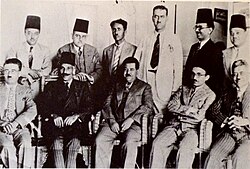
In 1929, al-Qassam was appointed as a marriage registrar (maʾdhūn) at the sharia court in Haifa. This position granted him the mobility to travel throughout Palestine, where he encouraged northern villagers to form agricultural cooperatives. During these travels, he warned that the British Mandate was facilitating the creation of a Jewish state and advocated for clandestine military preparation for a popular uprising.
To legitimize this struggle, al-Qassam obtained a fatwa (legal opinion) from Shaykh Badr al-Din al-Taji al-Hasani, the Mufti of Damascus, ruling that the fight against the British and the Jews was permissible.
The Organization of the Black Hand
Between 1930 and 1931, al-Qassam began recruiting a disciplined cadre of followers, organizing them into roughly a dozen independent circles to maintain secrecy. These followers, primarily peasants and urban laborers, were trained not only in combat but in moral conduct. Al-Qassam taught that virtues—such as aiding the sick, providing for the needy, and regular prayer—were prerequisites for becoming fearless fighters.
His training program included several unique elements:
- Literacy: He taught illiterate followers to read and write using the Qur'an.
- Moral Stability: He provided financial aid for wedding expenses to prevent the moral corruption of young men.
- Identity: He encouraged the growing of beards and the constant carrying of the Qur'an.
- Spirituality: He integrated the spiritual exercises and chants of the Qadiriyya Sufi order.
This militant organization became known as the Black Hand (al-kaff al-aswad). While a faction led by Abu Ibrahim al-Kabir pushed for immediate attacks, al-Qassam cautioned that a premature revolt would expose their preparations.
Escalation to Revolt
By 1935, the movement had grown to between 200 and 800 men, organized into five-man cells. These units were equipped with firearms and bombs, which they used for sabotaging British rail lines and raiding Jewish settlements. This activity deeply troubled the Muslim urban elite, who feared the loss of their political standing with the British authorities.
The final catalyst for open revolt occurred in October 1935, following the discovery of a Belgian arms shipment in Jaffa destined for the Haganah (a Jewish paramilitary force). This event sparked general strikes and provided the impetus for al-Qassam to launch his planned uprising.
Key Facts
- Primary Target: Al-Qassam targeted both the British Mandate authorities and Zionist settlement.
- Social Base: His movement was rooted in the urban underclass and dispossessed rural peasants.
- Organizational Structure: The "Black Hand" operated in secret cells of five men to ensure security.
- Ideology: He viewed the conflict as a religious struggle, advocating for a moral, political, and military jihad.
- Key Alliance: He maintained a strategic relationship with the secularist Hizb al-Istiqlal party.
| Category | Details |
|---|---|
| Educational Roles | Teacher at Madrasa Islamiya; Founder of night schools for laborers. |
| Religious Roles | Preacher at Istiqlāl Mosque; Marriage registrar (maʾdhūn). |
| Political Affiliations | President of YMMA Haifa; Associate of Hizb al-Istiqlal. |
| Militant Group | The Black Hand (al-kaff al-aswad). |
| Core Strategy | Clandestine cell-based organization and moral/spiritual training. |
Frequently Asked Questions
Who were the primary followers of al-Qassam?
His greatest following came from the lower classes, specifically casual urban laborers in Haifa and landless ex-tenant farmers from the Upper Galilee who had lost their livelihoods.
How did al-Qassam's approach differ from other Palestinian leaders?
Unlike traditional leaders who focused on political solutions or avoided confrontation with the British, al-Qassam viewed the struggle as a religious jihad and prioritized armed resistance against both the British and Zionist forces.
What was the purpose of the "Black Hand"?
The Black Hand was an anti-Zionist and anti-British militant organization designed to conduct guerrilla warfare, including sabotage of rail lines and raids on settlements.
What role did the YMMA play in his activism?
The Young Men's Muslim Association (YMMA) provided al-Qassam with a platform to reach the middle and educated classes, helping him secure financial support and political protection from the urban elite.
Why did al-Qassam emphasize moral and spiritual training for his fighters?
He believed that maintaining good character, praying regularly, and providing for the needy were essential prerequisites for becoming disciplined and fearless fighters.