Agricultural Drainage Systems: Classification and Implementation
Effective water management is critical for maintaining soil health and maximizing crop productivity. In agriculture, drainage systems are designed to remove excess water from the soil profile to prevent waterlogging—a condition where soil pores are saturated, limiting the oxygen available to plant roots. By controlling the water table, these systems ensure an optimal balance of air and water in the root zone.
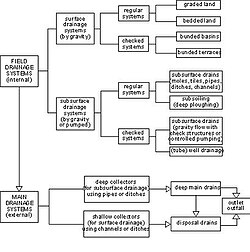
Agricultural drainage is broadly categorized into two primary types: surface drainage and sub-surface drainage. While surface systems manage water above the soil, subsurface systems address the water table beneath the surface. These are further divided into field (internal) systems, which control the water table, and main (external) systems, which collect and transport water to a final disposal point.
Key Facts
![Crop yield (Y) and depth of water table (X in dm) [1]](/images/4d/fa/4dfa73ad8f2cd5ba0f8c8243cad9e6c620a85fea2f93b012ff851f572d831a5b.jpg)
- Surface Drainage: Operates by gravity using reshaped land surfaces to remove excess rainfall or irrigation.
- Subsurface Drainage: Uses underground channels or wells to lower the water table.
- Controlled Drainage: A "checked" system that allows water to be retained during specific growth stages and drained during others (e.g., harvest).
- Horizontal vs. Vertical: Horizontal drainage uses ditches or pipes; vertical drainage utilizes wells.
- Main Systems: Consist of collectors and disposal drains that move water toward a gravity outlet or pumping station.
Surface Drainage Systems
Regular surface drainage systems function automatically via gravity as soon as excess water is present. These systems rely on land reformation and are generally categorized by the topography of the land:
- Bedded Systems: Utilized in flat terrains for crops other than rice.
- Graded Systems: Utilized in sloping terrains for crops other than rice.
Both bedded and graded systems may incorporate ridges and furrows to direct water flow.
In contrast, checked surface drainage systems use check gates in embankments to manage water in flat basins or terraced lands, most commonly in rice fields. These fields remain submerged for most of the growth cycle and are only drained on specific occasions, such as during harvest, to prevent the loss of excessive quantities of water.
Subsurface Drainage Systems
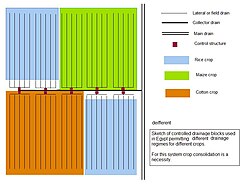
Subsurface systems are designed to manage the water table below the soil surface. Like surface systems, these can be regular (continuous) or checked (controlled). Controlled subsurface systems use gates to regulate discharge, which can significantly save irrigation water and reduce the construction costs of the main drainage system.
When pumping is used instead of gravity, drainage is "checked" by simply adjusting the operation time of the pumps. This method has been successfully implemented in northwestern India to increase irrigation efficiency without causing undue salinization.
Methods of Subsurface Implementation
Subsurface drainage can be achieved through several technical approaches:
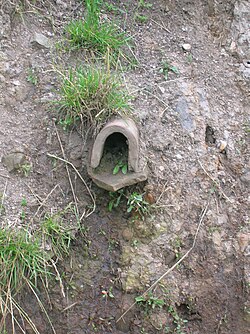
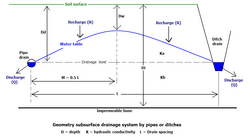
- Horizontal Drainage: This involves channels made in the soil, such as open ditches, trenches filled with brushwood or stones, tile drains, or mole drains. Modern systems often use perforated plastic (PE or PVC) pipes wrapped in a geotextile (synthetic fiber) envelope to prevent soil particles from clogging the pipe.
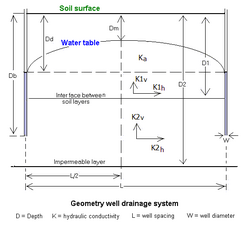
- Vertical Drainage: This involves the use of open dug wells or tubewells that are typically pumped to remove water.
- Sub-soiling: In areas with sufficient natural underground drainage, deep plowing can break up slowly permeable soil layers to facilitate drainage.
Main Drainage Systems and Outlets
The main drainage system acts as the transport network that carries water away from the field drains (laterals). This network consists of collectors and disposal drains.
Collectors and Disposal Drains
Collectors are categorized by the depth of the water level they maintain relative to the soil surface:
- Shallow Collectors: Used primarily for surface drainage or pumped subsurface systems.
- Deep Collectors: Required for gravity-based subsurface field drainage. These may be open ditches or buried pipes.
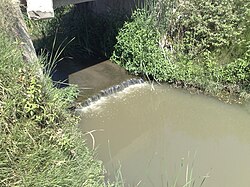
Deep collectors discharge into deep main drains (which only receive water from collectors) or are pumped into disposal drains. Disposal drains are the final conduits where the water level is not bound to a minimum and may even rise above the soil surface, provided embankments are in place to prevent flooding.
The Final Outlet
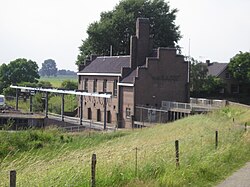
The system concludes at the main drainage outlet, which is either a gravity-based structure or a pumping station that discharges the water into a larger body of water or disposal area.
Summary of Drainage System Types
| System Type | Primary Mechanism | Common Applications | Key Feature |
|---|---|---|---|
| Surface (Regular) | Gravity / Land Shaping | Flat or sloping lands (non-rice) | Bedded or graded surfaces |
| Surface (Checked) | Check Gates | Rice fields / Terraced lands | Temporary drainage for harvest |
| Subsurface (Horizontal) | Pipes, Ditches, Mole drains | Water table control | Use of geotextile filters |
| Subsurface (Vertical) | Wells / Tubewells | Deep water table management | Usually requires pumping |
| Main System | Collectors & Disposal Drains | Water transport to outlet | Deep vs. shallow collectors |
Frequently Asked Questions
What is the difference between field drainage and main drainage?
Field drainage (internal) is designed to control the water table within the crop area, while main drainage (external) is responsible for collecting that water and transporting it to a final disposal outlet.
How does a controlled drainage system benefit a farmer?
Controlled or "checked" drainage allows farmers to retain water in the soil during specific growth periods, reducing the amount of irrigation water needed and lowering the construction costs of the main drainage system by reducing total discharge.
What is the purpose of a geotextile envelope in pipe drains?
The geotextile envelope acts as a filter that improves permeability around the pipe while preventing fine sandy or silty soil particles from entering and clogging the drain.
What is sub-soiling in the context of drainage?
Sub-soiling is the process of deep plowing to break up slowly permeable soil layers. This can improve drainage if the deeper underground layers have sufficient natural drainage capacity.
What is the difference between a deep collector and a disposal drain?
A deep collector maintains a specific water level depth to service field drains, whereas a disposal drain is a final main drain where the water level is not restricted to a minimum and may even be above the soil surface.